Thank you for visiting SNEWPapers!
Sign up free
Alexandria Gazette & Advertiser
Alexandria, Virginia
What is this article about?
On June 17, British House of Commons debated Ireland's severe distress and famine. MPs like Vessey Fitzgerald, Goulburn, Smith, Spring Rice, O'Brien, Newport, Peel, and Abercromby discussed inadequate relief funds, charity efforts, and government plans for public works employment. Reports cited 99,639 in Clare, 139,000 in Cork, and 20,000 in Limerick relying on charity; some famine deaths reported.
Clipping
OCR Quality
Full Text
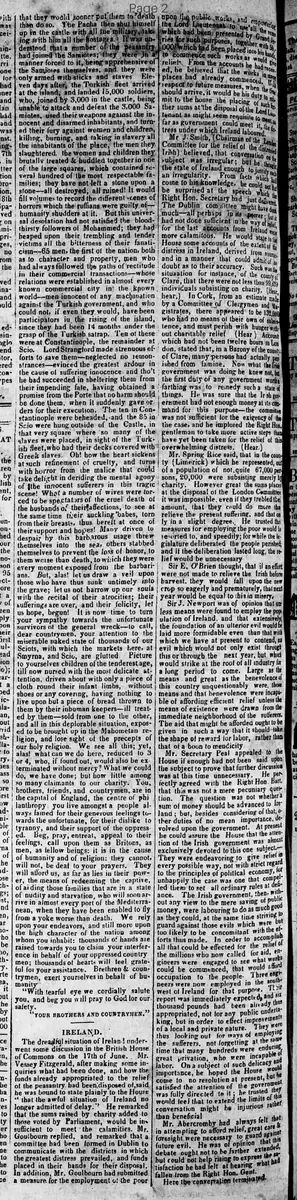
The dreadful situation of Ireland underwent some discussion in the British House of Commons on the 17th of June. Mr. Vessey Fitzgerald, after making some inquiries what had been done, and how the funds already appropriated to the relief of the peasantry had been disposed of, said he was bound to state plainly to the House " that the awful situation of Ireland no longer admitted of delay. " He remarked that the sums raised by charity added to those voted by Parliament, would be insufficient to meet the calamities. Mr. Goulburn replied, and remarked that a committee had been formed in Dublin to communicate with the districts in which the greatest distress prevailed, and funds placed in their hands for their disposal. In addition. Mr. Goulburn had submitted a measure for the employment of the poor upon the public works, and empowering the Lord Lieutenant to commence such works as might seem requisite to meet, as far as government could meet it, the distress under which Ireland laboured. Mr J. Smith, (Chairman of the London Committee for the relief of the distressed Irish): believed, that conversation on the subject was irregular; but he thought the state of Ireland enough to justify such an irregularity. From facts which had come to his knowledge, he could not but be surprised at the speech which the Right Hon. Secretary had just delivered The Dublin committee might have done much-all perhaps in its power; but had not done sufficient in the way of relief. for the last accounts from Ireland were more calamitous. He would state to the House some accounts of the extent of the distress in Ireland, derived from sources and in a manner that could admit of doubt as to their accuracy. Such was the situation for instance, of the county of Clare, that there were not less than 99,639 individuals subsisting on charity. (Hear, hear.) In Cork, from an estimate made by a Committee of Clergymen and Magistrates, there appeared to be 139,000 who had no means of their own of subsistence, and must perish with hunger without charitable relief (Hear )Account which had not been twelve hours in London, stated that, in a Barony of the county of Clare, many persons had actually perished from famine. Now what the Irish government was doing he knew not, but the first duty of any government was to remedy such a state of things. He was sure that the Irish government had not enough money at its command for this purpose--the committee was not sufficient for the exigency of the case, and he implored the Right Hon. gentleman to take more active steps than have yet been taken for the relief of this overwhelming distress, (Hear.) Mr. Spring Rice said, that in the county (Limerick) which he represented, out of a population of not quite 67,000 persons, 20,000 were subsisting merely by charity. However great the sums placed at the disposal of the London Committee it was impossible, even if they trebled the amount, that they could do more than relieve the present suffering, and that only in a slight degree. He trusted that measures for employing the poor would be resorted to, and speedily; for while the legislature deliberated the people perished and if the deliberation lasted long, the relief would be unnecessary Sir E. O'Brien thought, that if an effort were not made to relieve the Irish before harvest. they would fall upon the new crop so eagerly and prematurely, that next year would be equal to this in misery. Sir J. Newport was of opinion that unless means were found to employ the population of Ireland, and that extensively the foundation of an ulterior evil would be laid more formidable even than that with which we have at present to contend, an evil which would not only exist through this or through the next year, but which would strike at the root of all industry for a long period to come. Large as the means and great as the benevolence of this country unquestionably were, those means and that benevolence were incapable of affording efficient relief unless the means of existence were drawn from the immediate neighborhood of the sufferers. The aid that might be afforded ought to be given in such a way that it should take the shape of reward for labor, rather than that of a boon to mendicity Mr. Secretary Peel appealed to the House if enough had not been said upon the subject to prove that further discussion was at this time unnecessary. He perfectly agreed with the Right Hon. Bart. that this was not a mere pecuniary question. The question was not whether a sum of money should be advanced to Ireland; but, besides considering of that, other duties of no mean importance, devolved upon the government. At present he could assure the House that the attention of the Irish government was almost exclusively devoted to this one subject.- They were endeavoring in every possible way, not with strict regard to the principles of political economy so much as to the exigency of the case, to set all ordinary rules at defiance. The Irish government, then, without out any regard to the mere saving of public money, were labouring to do as much good as they could. In order to accomplish all that could be effected for the relief of the millions who now called for aid, engineers were engaged to see what works could be commenced, that would afford occupation to the people Three engineers were now employed in the south of Ireland for that purpose Their report was immediately expected, and six or that purpose Their report was immediately expected, and six or eight more were to be sent over. £20,000 had been already thus appropriated, not for any public undertaking, but for improvements of a local and private nature. They were thus looking out for ways of employing the sufferers not forgetting the same time that many hundreds were enduring great privation who were incapable of labor. On a subject of such delicacy and importance, he hoped the House would come to no resolution at present, but be satisfied with knowing that the attention of the government was fully directed to it; he trusted they would feel that to extend the limits of this conversation might be injurious rather than beneficial Mr. Abercromby had always felt that great foresight were necessary to guard against attempting to afford relief without great care The debate ought not to be further extended, and he expressed the satisfaction he had felt at hearing what had fallen from the Right Hon. Gent. Here the conversation terminated.
What sub-type of article is it?
What keywords are associated?
What entities or persons were involved?
Where did it happen?
Foreign News Details
Primary Location
Ireland
Event Date
17th Of June
Key Persons
Outcome
99,639 individuals subsisting on charity in county of clare; 139,000 in cork with no means of subsistence; 20,000 in limerick subsisting by charity out of 67,000 population; many persons perished from famine in a barony of clare; government measures include committee in dublin, public works employment, £20,000 appropriated for local improvements, engineers employed.
Event Details
Discussion in British House of Commons on Ireland's dreadful situation, with MPs urging immediate action on relief funds and employment for peasantry amid famine. Government responses detail Dublin committee, public works plans, and engineer deployments to address distress.