Thank you for visiting SNEWPapers!
Sign up free
Letter to Editor
October 22, 1830
Phenix Gazette
Alexandria, Virginia
What is this article about?
Response to 'Penn''s letter accusing county militia officers of misconduct. Defends their handling of fines, court legality, and 1829 expenditures ($546 receipts, used for expenses and debts). Justifies national militia system per U.S. Constitution. Signed 'JUSTICE,' Oct. 20.
Clipping
OCR Quality
95%
Excellent
Full Text
[COMMUNICATED.]
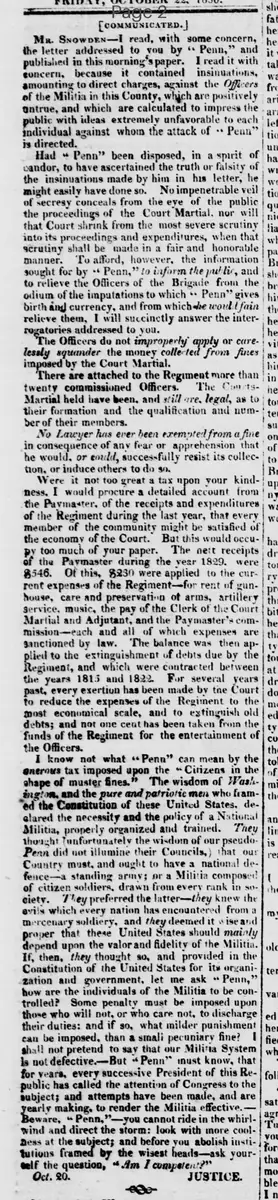
Mr. Snowden—I read, with some concern, the letter addressed to you by "Penn," and published in this morning's paper. I read it with concern, because it contained insinuations, amounting to direct charges, against the Officers of the Militia in this County, which are positively untrue, and which are calculated to impress the public with ideas extremely unfavorable to each individual against whom the attack of "Penn" is directed.
Had "Penn" been disposed, in a spirit of candor, to have ascertained the truth or falsity of the insinuations made by him in his letter, he might easily have done so. No impenetrable veil of secrecy conceals from the eye of the public the proceedings of the Court Martial. nor will that Court shrink from the most severe scrutiny into its proceedings and expenditures, when that scrutiny shall be made in a fair and honorable manner. To afford, however, the information sought for by "Penn," to inform the public, and to relieve the Officers of the Brigade from the odium of the imputations to which "Penn" gives birth and currency, and from which he would fain relieve them, I will succinctly answer the interrogatories addressed to you.
The Officers do not improperly apply or carelessly squander the money collected from fines imposed by the Court Martial.
There are attached to the Regiment more than twenty commissioned Officers. The Courts-Martial held have been, and still are, legal, as to their formation and the qualification and number of their members.
No Lawyer has ever been exempted from a fine in consequence of any fear or apprehension that he would, or could, successfully resist its collection, or induce others to do so.
Were it not too great a tax upon your kindness, I would procure a detailed account from the Paymaster, of the receipts and expenditures of the Regiment during the last year, that every member of the community might be satisfied of the economy of the Court. But this would occupy too much of your paper. The nett receipts of the Paymaster during the year 1829, were $546. Of this, $230 were applied to the current expenses of the Regiment—for rent of gun-house, care and preservation of arms, artillery service, music, the pay of the Clerk of the Court Martial and Adjutant, and the Paymaster's commission—each and all of which expenses are sanctioned by law. The balance was then applied to the extinguishment of debts due by the Regiment, and which were contracted between the years 1815 and 1822. For several years past, every exertion has been made by the Court to reduce the expenses of the Regiment to the most economical scale, and to extinguish old debts; and not one cent has been taken from the funds of the Regiment for the entertainment of the Officers.
I know not what "Penn" can mean by the onerous tax imposed upon the Citizens in the shape of muster fines. The wisdom of Washington, and the pure and patriotic men who framed the Constitution of these United States, declared the necessity and the policy of a National Militia, properly organized and trained. They thought (unfortunately the wisdom of our pseudo-Penn did not illuminate their Councils,) that our Country must, and ought to have a national defence—a standing army, or a Militia composed of citizen soldiers, drawn from every rank in society. They preferred the latter; they knew the evils which every nation has encountered from a mercenary soldiery, and they deemed it wise and proper that these United States should mainly depend upon the valor and fidelity of the Militia.
If, then, they thought so, and provided in the Constitution of the United States for its organization and government, let me ask "Penn," how are the individuals of the Militia to be controlled? Some penalty must be imposed upon those who will not, or who care not, to discharge their duties: and if so, what milder punishment can be imposed, than a small pecuniary fine? I shall not pretend to say that our Militia System is not defective.—But "Penn" must know, that for years, every successive President of this Republic has called the attention of Congress to the subject; and attempts have been made, and are yearly making, to render the Militia effective.—Beware, "Penn," you cannot ride in the whirlwind and direct the storm: look with more coolness at the subject; and before you abolish institutions framed by the wisest heads—ask yourself the question,
"Am I competent?"
Oct. 20.
JUSTICE.
Mr. Snowden—I read, with some concern, the letter addressed to you by "Penn," and published in this morning's paper. I read it with concern, because it contained insinuations, amounting to direct charges, against the Officers of the Militia in this County, which are positively untrue, and which are calculated to impress the public with ideas extremely unfavorable to each individual against whom the attack of "Penn" is directed.
Had "Penn" been disposed, in a spirit of candor, to have ascertained the truth or falsity of the insinuations made by him in his letter, he might easily have done so. No impenetrable veil of secrecy conceals from the eye of the public the proceedings of the Court Martial. nor will that Court shrink from the most severe scrutiny into its proceedings and expenditures, when that scrutiny shall be made in a fair and honorable manner. To afford, however, the information sought for by "Penn," to inform the public, and to relieve the Officers of the Brigade from the odium of the imputations to which "Penn" gives birth and currency, and from which he would fain relieve them, I will succinctly answer the interrogatories addressed to you.
The Officers do not improperly apply or carelessly squander the money collected from fines imposed by the Court Martial.
There are attached to the Regiment more than twenty commissioned Officers. The Courts-Martial held have been, and still are, legal, as to their formation and the qualification and number of their members.
No Lawyer has ever been exempted from a fine in consequence of any fear or apprehension that he would, or could, successfully resist its collection, or induce others to do so.
Were it not too great a tax upon your kindness, I would procure a detailed account from the Paymaster, of the receipts and expenditures of the Regiment during the last year, that every member of the community might be satisfied of the economy of the Court. But this would occupy too much of your paper. The nett receipts of the Paymaster during the year 1829, were $546. Of this, $230 were applied to the current expenses of the Regiment—for rent of gun-house, care and preservation of arms, artillery service, music, the pay of the Clerk of the Court Martial and Adjutant, and the Paymaster's commission—each and all of which expenses are sanctioned by law. The balance was then applied to the extinguishment of debts due by the Regiment, and which were contracted between the years 1815 and 1822. For several years past, every exertion has been made by the Court to reduce the expenses of the Regiment to the most economical scale, and to extinguish old debts; and not one cent has been taken from the funds of the Regiment for the entertainment of the Officers.
I know not what "Penn" can mean by the onerous tax imposed upon the Citizens in the shape of muster fines. The wisdom of Washington, and the pure and patriotic men who framed the Constitution of these United States, declared the necessity and the policy of a National Militia, properly organized and trained. They thought (unfortunately the wisdom of our pseudo-Penn did not illuminate their Councils,) that our Country must, and ought to have a national defence—a standing army, or a Militia composed of citizen soldiers, drawn from every rank in society. They preferred the latter; they knew the evils which every nation has encountered from a mercenary soldiery, and they deemed it wise and proper that these United States should mainly depend upon the valor and fidelity of the Militia.
If, then, they thought so, and provided in the Constitution of the United States for its organization and government, let me ask "Penn," how are the individuals of the Militia to be controlled? Some penalty must be imposed upon those who will not, or who care not, to discharge their duties: and if so, what milder punishment can be imposed, than a small pecuniary fine? I shall not pretend to say that our Militia System is not defective.—But "Penn" must know, that for years, every successive President of this Republic has called the attention of Congress to the subject; and attempts have been made, and are yearly making, to render the Militia effective.—Beware, "Penn," you cannot ride in the whirlwind and direct the storm: look with more coolness at the subject; and before you abolish institutions framed by the wisest heads—ask yourself the question,
"Am I competent?"
Oct. 20.
JUSTICE.
What sub-type of article is it?
Persuasive
Informative
Political
What themes does it cover?
Military War
Politics
Constitutional Rights
What keywords are associated?
Militia Officers
Court Martial
Fines
Penn Response
Regiment Finances
National Defense
Us Constitution
What entities or persons were involved?
Justice.
Mr. Snowden
Letter to Editor Details
Author
Justice.
Recipient
Mr. Snowden
Main Argument
militia officers are not misusing fines or conducting illegal courts; 1829 finances were properly managed for expenses and debts. the national militia system, as established by the u.s. constitution, is necessary for defense, with fines as mild penalties for non-compliance.
Notable Details
References Washington And Constitution Framers
Quotes Rhetorical Question: 'Am I Competent?'
Details 1829 Receipts: $546, $230 For Current Expenses