Thank you for visiting SNEWPapers!
Sign up free
Daily National Intelligencer
Washington, District Of Columbia
What is this article about?
An editor of the Alexandria Gazette shares extracts from letters by a traveler in Louisiana describing the Mississippi River's geological formation from an ancient bay through sediment deposition, its current swampy state, and speculative future as fertile plains supporting commerce and agriculture, akin to Egypt.
Clipping
OCR Quality
Full Text
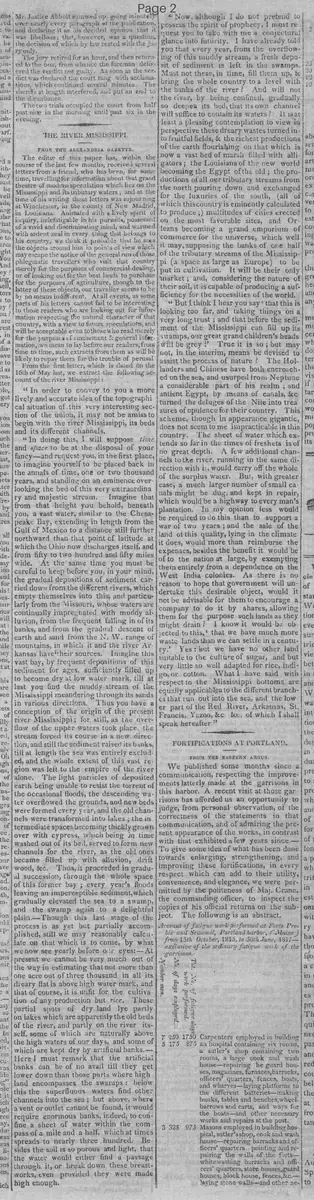
FROM THE ALEXANDRIA GAZETTE.
The editor of this paper has, within the course of the last few months, received several letters from a friend, who has been, for some time, travelling for information about that grand theatre of modern speculation which lies on the Mississippi and its tributary waters; and at the time of his writing these letters was sojourning at Winchester, in the county of New Madrid, in Louisiana. Animated with a lively spirit of inquiry, indefatigable in his pursuits, possessed of a vivid and discriminating mind, and warmed with ardent zeal in every thing that belongs to his country, we think it probable that he sees the objects around him in points of view which may escape the notice of the general run of those phlegmatic travellers who visit that country merely for the purposes of commercial dealing or of looking out for the best lands to purchase for the purposes of agriculture, though to the latter of these objects, our traveller seems to be by no means indifferent. At all events, as some parts of his letters cannot fail to be interesting to those readers who are looking out for information respecting the natural character of that country, with a view to future speculations, and will be acceptable even to those who read merely for the purposes of amusement & general information, we mean to lay before our readers, from time to time, such extracts from them as will be likely to repay them for the trouble of perusal.
From the first letter, which is dated on the 16th of May last, we extract the following account of the river Mississippi:
"In order to convey to you a more lively and accurate idea of the topographical situation of this very interesting section of the union, it may not be amiss to begin with the river Mississippi, its beds and its different channels.
"In doing this, I will suppose time and space to be at the disposal of your fancy—and request you, in the first place, to imagine yourself to be placed back in the annals of time, one or two thousand years, and standing on an eminence overlooking the bed of this very extraordinary and majestic stream. Imagine that from that height you behold, beneath you, a vast water, similar to the Chesapeake Bay, extending in length from the Gulf of Mexico to a distance still further northward than that point of latitude at which the Ohio now discharges itself, and from fifty to two hundred and fifty miles wide. At the same time you must be careful to keep before you, in your mind, the gradual depositions of sediment carried down from the different rivers, which empty themselves into this, and particularly from the Missouri, whose waters are continually impregnated with muddy alluvion, from the frequent falling in of its banks, and from the gradual descent of earth and sand from the N. W. range of mountains, in which it and the river Arkansas have their sources. Imagine this vast bay, by frequent depositions of this sediment for ages, sufficiently filled up to become dry at low water mark, till at last you find the muddy stream of the Mississippi meandering through its sands in various directions. Thus you have a conception of the origin of the present river Mississippi; for still, as the overflow of the upper waters took place, the stream forced its course in a new direction, and still the sediment raised its banks, till at length the sea was entirely excluded, and the whole extent of this vast region was left to the empire of the river alone. The light particles of deposited earth being unable to resist the torrent of the occasional floods, the descending water overflowed the grounds, and new beds were formed every year, and the old channels were transformed into lakes; the intermediate spaces becoming thickly grown over with cypress, which being in time washed out of its bed, served to form new channels for the river, as the old ones became filled up with alluvion, drift wood, &c. Thus, it proceeded in gradual succession, through the whole space of this former bay: every year's floods leaving an imperceptible sediment, which gradually elevated the sea to a swamp, and the swamp again to a delightful plain. Though this last stage of the process is as yet but partially accomplished, still we may reasonably calculate on that which is to come, by what we now see yearly before our eyes: At present we cannot be very much out of the way in estimating that not more than one acre out of three thousand in all its dreary flat is above high water mark, and that of course, it is unfit for the cultivation of any production but rice. These partial spots of dry land lie partly on lakes which are apparently the old beds of the river, and partly on the river itself, some of which are naturally above the high waters of our days, and some of which are kept dry by artificial banks.
Here I must remark that the artificial banks can be of no avail till they get lower down than those parts where high land encompasses the swamps: below this the superfluous waters find other channels into the sea; but above, where a vent or outlet cannot be found, it would require enormous banks, indeed, to confine a sheet of water within the compass of a mile and a half, which at times spreads to nearly three hundred. Besides the soil is so porous and light, that the water would either find a passage through it, or break down these breastworks, even provided they were made high enough.
"Now, although I do not pretend to possess the spirit of prophecy, I must request you to take with me a conjectural glance into futurity. I have already told you that every year, from the overflowing of this muddy stream, a fresh deposit of sediment is left in the swamps. Must not these, in time, fill them up, & bring the whole country to a level with the banks of the river? And will not the river, by being confined, gradually so deepen its bed, that its own channel will suffice to contain its waters? It is at least a pleasing contemplation to view in perspective these dreary wastes turned into fruitful fields, & the richest productions of the earth flourishing on that which is now a vast bed of marsh filled with alligators; the Louisiana of the new world becoming the Egypt of the old; the productions of all our tributary streams from the north pouring down and exchanged for the luxuries of the south, (all of which this country is eminently calculated to produce;) multitudes of cities erected on the most favorable sites, and New Orleans becoming a grand emporium of commerce for the universe, which well it may, supposing the banks of one half of the tributary streams of the Mississippi (a space as large as Europe) to be put in cultivation. It will be their only market; and, considering the nature of their soil, it is capable of producing a sufficiency for the necessities of the world.
"But I think I hear you say' that this is looking too far, and taking things on a very long trust; and that before the sediment of the Mississippi can fill up its swamps, our great grand children's heads will be grey!' True it is so; but may not, in the interim, means be devised to assist the process of nature? The Hollanders and Chinese have both encroached on the sea, and usurped from Neptune a considerable part of his realm; and ancient Egypt, by means of canals, &c turned the deluges of the Nile into treasures of opulence for their country. This scheme, though in appearance gigantic, does not seem to me impracticable in this country. The sheet of water which extends so far in the times of freshets is of no great depth. A few additional channels to the river, running in the same direction with it, would carry off the whole of the surplus water. But, with greater ease, a much larger number of small canals might be dug, and kept in repair, which would be a highway to every man's plantation. In my opinion less would be required to do this than to support a war of two years; and the sale of the land of this quality, lying in the climate it does, would more than reimburse the expenses, besides the benefit it would be of to the nation at large, by exempting them entirely from a dependence on the West India colonies. As there is no reason to hope that government will undertake this desirable object, would it not be advisable for them to encourage a company to do it by shares, allowing them for the purpose such lands as they might drain? I know it would be objected to this, 'that we have much more waste lands than we can settle in a century.' Yes: but we have no other land suitable to the culture of sugar, and but very little so well adapted for rice, indigo, or cotton. What I have said with respect to the Mississippi bottoms are equally applicable to the different branches that run out into the sea, and the lower part of the Red River, Arkansas, St. Francis, Yazoo, &c &c. of which I shall speak hereafter."
What sub-type of article is it?
What themes does it cover?
What keywords are associated?
Where did it happen?
Story Details
Location
Mississippi River, Louisiana, Winchester In New Madrid County
Event Date
16th Of May Last
Story Details
A traveler describes the Mississippi River's formation from an ancient bay filled by sediments over millennia, its current flood-prone swamps suitable only for rice, and envisions future drainage and cultivation turning it into fertile lands like Egypt, with New Orleans as a global commerce hub, proposing canals and land companies to accelerate the process.