Thank you for visiting SNEWPapers!
Sign up free
The New York Journal, And Weekly Register
New York, New York County, New York
What is this article about?
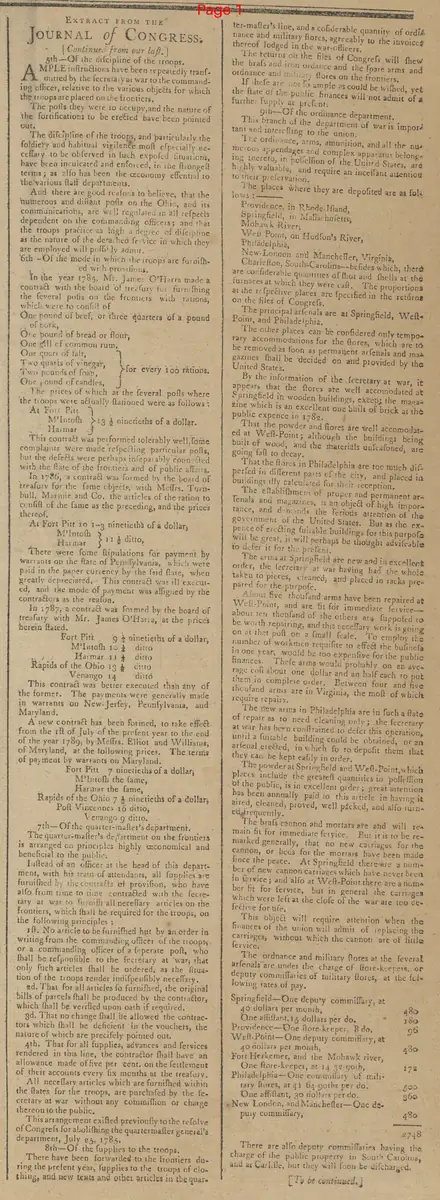
Extract from the Journal of Congress detailing military administration on the frontiers, including troop discipline, provision contracts from 1785-1789, quartermaster arrangements, supplies forwarded, and status of ordnance stores across U.S. locations.
Merged-components note: Continuation of extract from the Journal of Congress across two components.
Clipping
OCR Quality
Full Text
JOURNAL of CONGRESS:
Continued from our last.
5th—Of the discipline of the
people or the troops.
AMPLE instructions have been repeatedly trans-
mitted by the secretary at war to the command-
ing officer, relative to the various objects for which
the troops are placed on the frontiers.
The posts they were to occupy, and the nature of
the fortifications to be erected have been pointed
out.
The discipline of the troops, and particularly the
soldiery and habitual vigilance more especially ne-
cessary to be observed in such exposed situations,
have been inculcated and enforced, in the strongest
terms; as also has been the oeconomy essential to
the various staff departments.
And there are good reasons to believe, that the
numerous and distant posts on the Ohio, and its
communications, are well regulated in all respects
dependent on the commanding officers; and that
the troops practice as high a degree of discipline
as the nature of the detached service in which they
are employed will possibly admit.
5th—Of the mode in which the troops are furnish-
ed with provisions.
In the year 1785, Mr. James O'Hara made a
contract with the board of treasury for furnishing
the several posts on the frontiers with rations,
which were to consist of
One pound of beef, or three quarters of a pound
of pork,
One pound of bread or flour;
One gill of common rum,
One quart of salt,
Two quarts of vinegar,
for every 100 rations.
Two pounds of soap,
One pound of candles,
The prices of which at the several posts where
the troops were actually stationed were as follows:
At Fort Pitt
M'Intosh 13 ninetieths of a dollar.
Harmar
This contract was performed tolerably well, some
complaints were made respecting particular posts,
but the defects were perhaps inseparably connected
with the state of the frontiers and of public affairs.
In 1786, a contract was formed by the board of
treasury for the same objects, with Messrs. Turn-
bull, Marmie and Co. the articles of the ration to
consist of the same as the preceding, and the prices
thereof,
At Fort Pitt 10 1-3 ninetieths of a dollar
M'Intosh
Harmar 11 ditto,
There were some stipulations for payment by
warrants on the state of Pennsylvania, which were
paid in the paper currency by the said state, when
greatly depreciated. This contract was ill execut-
ed, and the mode of payment was assigned by the
contractors as the reason.
In 1787, a contract was formed by the board of
treasury with Mr. James O'Hara, at the prices
herein stated.
Fort Pitt 9 ninetieths of a dollar,
M'Intosh 10
ditto
Harmar 11
ditto
Rapids of the Ohio 13
ditto
Venango 14
ditto
This contract was better executed than any of
the former. The payments were generally made
in warrants on New-Jersey, Pennsylvania, and
Maryland:
A new contract has been formed, to take effect
from the 1st of July of the present year to the end
of the year 1789, by Messrs. Elliot and Williams,
of Maryland, at the following prices. The terms
of payment by warrants on Maryland.
Fort Pitt 7 ninetieths of a dollar
M'Intosh the same,
Harmar the same,
Rapids of the Ohio 7 ninetieths of a dollar
Post Vincennes 16 ditto,
Venango 9 ditto.
7th—Of the quarter-master's department.
The quarter-master's department on the frontiers
is arranged on principles highly oeconomical and
beneficial to the public:
Instead of an officer at the head of this depart-
ment, with his train of attendants, all supplies are
furnished by the contracts of provision, who have
also from time to time contracted with the secre-
tary at war to furnish all necessary articles on the
frontiers, which shall be required for the troops, on
the following principles :
1st. No article to be furnished but by an order in
writing from the commanding officer of the troops,
or a commanding officer of a separate post, who
shall be responsible to the secretary at war, that
only such articles shall be ordered, as the situa-
tion of the troops render indispensibly necessary.
2d. That for all articles so furnished, the original
bills of parcels shall be produced by the contractor,
which shall be verified upon oath if required.
3d. That no charge shall be allowed the contrac-
tors which shall be deficient in the vouchers, the
nature of which are precisely pointed out.
4th. That for all supplies, advances and services
rendered in this line, the contractor shall have an
allowance made of five per cent. on the settlement
of their accounts every six months at the treasury.
All necessary articles which are furnished within
the states for the troops, are purchased by the se-
cretary at war without any commission or charge
thereon to the public.
This arrangement existed previously to the resolve
of Congress for abolishing the quartermaster general's
department, July 25, 1785
8th—Of the supplies to the troops.
There have been forwarded to the frontiers du-
ring the present year, supplies to the troops of clo-
thing, and new tents and other articles in the quar-
ter-master's line, and a considerable quantity of ordi-
nance and military stores, agreeably to the invoice
thereof lodged in the war-office.
The returns on the files of Congress will shew
the brass and iron ordnance and the spare arms and
ordnance and military stores on the frontiers.
If these are not so ample as could be wished. yet
the state of the public finances will not admit of a
further supply at present:
6th—Of the ordnance department,
This branch of the department of war is impor-
tant and interesting to the union.
The ordnance, arms, ammunition, and all the nu-
merous appendages and complex apparatus belong-
ing thereto, in possession of the United States, are
highly valuable, and require an incessant attention
to their preservation.
The places where they are deposited are as fol-
lows:
Providence, in Rhode-Island,
Springfield, in Massachusetts,
Mohawk River,
West Point, on Hudson's River,
Philadelphia,
New-London and Manchester, Virginia,
Charleston, South-Carolina—besides which, there
are considerable quantities of shot and shells at the
furnaces at which they were cast. The proportions
at the respective places are specified in the returns
on the files of Congress.
The principal arsenals are at Springfield, West-
Point, and Philadelphia.
The other places can be considered only tempo-
rarily accommodations for the stores, which are to
be removed as soon as permanent arsenals and ma-
gazines shall be decided on and provided by the
United States.
By the information of the secretary at war, it
appears that the stores are well accommodated at
Springfield in wooden buildings, except the maga-
zine which is an excellent one built of brick at the
public expence in 1782.
That the powder and stores are well accommodat-
ed at West-Point; although the buildings being
built of wood, and the materials unseasoned, are
going fast to decay.
That the stores in Philadelphia are too much di-
persed in different parts of the city, and placed in
buildings illy calculated for their reception.
The establishment of proper and permanent ar-
senals and magazines, is an object of high impor-
tance, and demands the serious attention of the
government of the United States. But as the ex-
pence of erecting suitable buildings for this purpoe
will be great, it will perhaps be thought advisable
to defer it for the present.
The arms at Springfield are new and in excellent
order, the secretary at war having had the whole
taken to pieces, cleaned, and placed in racks pre-
pared for the purpose.
About five thousand arms have been repaired at
West-Point, and are fit for immediate service—
about ten thousand of the others are supposed to
be worth repairing, and this necessary work is going
on at that post on a small scale. To employ the
number of workmen requisite to effect the business
in one year, would be too expensive for the public
finances. These arms would probably on an ave-
rage cost about one dollar and an half each to put
them in complete order. Between four and five
thousand arms are in Virginia, the most of which
require repairs.
The new arms in Philadelphia are in such a state
of repair as to need cleaning only ; the secretary
at war has been constrained to defer this operation,
until a suitable building could be obtained, or an
arsenal erected, in which to deposit them that
they can be kept easily in order.
The powder at Springfield and West-Point, which
places include the greatest quantities in possession
of the public, is in excellent order; great attention
has been annually paid to this article in having it
aired, cleaned, proved, well packed, and also turn-
ed frequently.
The brass cannon and mortars are and will re-
main fit for immediate service. But it is to be re-
marked generally, that no new carriages for the
cannon, or beds for the mortars have been made
since the peace. At Springfield there are a num-
ber of new cannon carriages which have never been
in service: and also at West-Point there are a num-
ber fit for service, but in general the carriages
which were left at the close of the war are too de-
f ective for use.
This object will require attention when the
finances of the union will admit of replacing the
carriages, without which the cannon are of little
service:
The ordnance and military stores at the several
arsenals are under the charge of store-keepers, or
deputy commissaries of military stores, at the fol-
lowing rates of pay.
Springfield—One deputy commissary, at
40 dollars per month,
480
One assistant, 15 dollars per do.
180
Providence—One store-keeper, 8 do.
96
West-Point—One deputy commissary, at
40 dollars per month,
480
Fort Herkimer, and the Mohawk river,
One store-keeper, at 14 32/90 ths,
172
Philadelphia—One commissary of mili-
tary stores, at 4 1/64 goths per do.
500
One assistant, 20 dollars per do.
360
New London, and Manchester—One de-
puty commissary,
480
2748
There are also deputy commissaries having the
charge of the public property in South Carolina
and at Carlisle, but they will soon be discharged.
To be continued.
What sub-type of article is it?
What keywords are associated?
What entities or persons were involved?
Where did it happen?
Domestic News Details
Primary Location
Frontiers
Key Persons
Outcome
contracts for provisions executed with varying success; military stores maintained but some in need of repair and better facilities; no further supplies due to finances.
Event Details
Congressional report on troop discipline and vigilance at frontier posts, provision contracts from 1785-1789 specifying rations and prices at forts like Pitt, M'Intosh, Harmar; economical quartermaster arrangements via contractors; supplies of clothing, tents, ordnance forwarded; status of arms, ammunition, cannon at various U.S. locations including Springfield, West Point, Philadelphia, with notes on condition and needs.