Thank you for visiting SNEWPapers!
Sign up free
Litchfield Enquirer
Litchfield, Litchfield County, Connecticut
What is this article about?
Commentary from Liverpool Albion on the role of the French press and public opinion in the 1830 revolution that overthrew Charles X and his ministers, quoting George Canning's speech on the power of a free press in influencing politics.
Merged-components note: Continuation of the article on the power of the press and public opinion.
Clipping
OCR Quality
Full Text
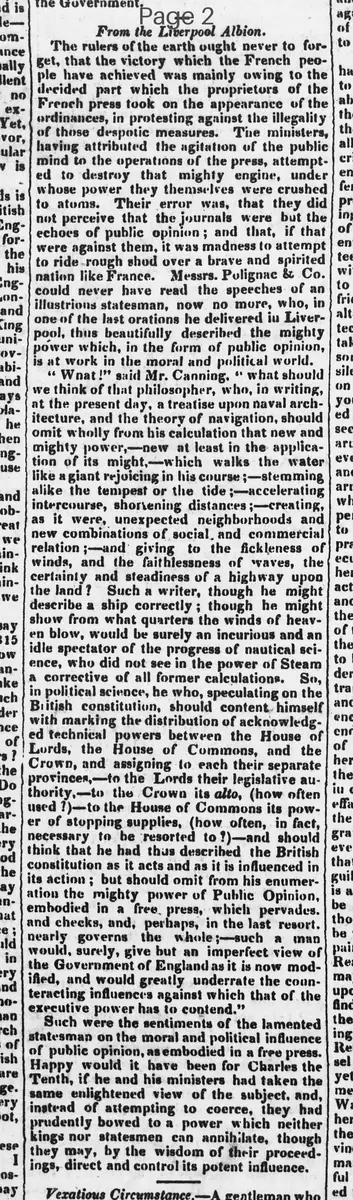
The rulers of the earth ought never to forget, that the victory which the French people have achieved was mainly owing to the decided part which the proprietors of the French press took on the appearance of the ordinances, in protesting against the illegality of those despotic measures. The ministers, having attributed the agitation of the public mind to the operations of the press, attempted to destroy that mighty engine. under whose power they themselves were crushed to atoms. Their error was, that they did not perceive that the journals were but the echoes of public opinion; and that, if that were against them, it was madness to attempt to ride rough shod over a brave and spirited nation like France. Messrs. Polignac & Co. could never have read the speeches of an illustrious statesman, now no more, who, in one of the last orations he delivered in Liverpool, thus beautifully described the mighty power which, in the form of public opinion, is at work in the moral and political world.
" What!" said Mr. Canning. " what should we think of that philosopher, who,in writing, at the present day, a treatise upon naval architecture, and the theory of navigation, should omit wholly from his calculation that new and mighty power,—new at least in the application of its might,which walks the water like a giant rejoicing in his course;—stemming alike the tempest or the tide;—accelerating intercourse, shortening distances;—creating, as it were, unexpected neighborhoods and new combinations of social and commercial relation;—and giving to the fickleness of winds, and the faithlessness of waves, the certainty and steadiness of a highway upon the land? Such a writer, though he might describe a ship correctly; though he might show from what quarters the winds of heaven blow, would be surely an incurious and an idle spectator of the progress of nautical science, who did not see in the power of Steam a corrective of all former calculations. So, in political science, he who, speculating on the British constitution, should content himself with marking the distribution of acknowledged technical powers between the House of Lords, the House of Commons, and the Crown, and assigning to each their separate provinces,—to the Lords their legislative authority,—to the Crown its veto, (how often used ?)—to the House of Commons its power of stopping supplies, (how often, in fact, necessary to be resorted to?)—and should think that he had thus described the British constitution as it acts and as it is influenced in its action;but should omit from his enumeration the mighty power of Public Opinion, embodied in a free press, which pervades. and checks, and, perhaps, in the last resort. nearly governs the whole;—such a man would, surely, give but an imperfect view of the Government of England as it is now modified, and would greatly underrate the counteracting influences against which that of the executive power has to contend."
Such were the sentiments of the lamented statesman on the moral and political influence of public opinion, as embodied in a free press.
Happy would it have been for Charles the Tenth, if he and his ministers had taken the same enlightened view of the subject. and, instead of attempting to coerce, they had prudently bowed to a power which neither kings nor statesmen can annihilate, though they may, by the wisdom of their proceedings, direct and control its potent influence.
What sub-type of article is it?
What keywords are associated?
What entities or persons were involved?
Where did it happen?
Foreign News Details
Primary Location
France
Key Persons
Outcome
the french people achieved victory mainly due to the press protesting against despotic ordinances, leading to the ministers being crushed to atoms.
Event Details
The French press protested against the illegality of despotic measures by Charles X's ministers, including Polignac, who attempted to suppress the press but failed as it echoed public opinion, resulting in the people's victory and the ministers' downfall. The article quotes Mr. Canning's speech on the power of public opinion embodied in a free press.