Thank you for visiting SNEWPapers!
Sign up free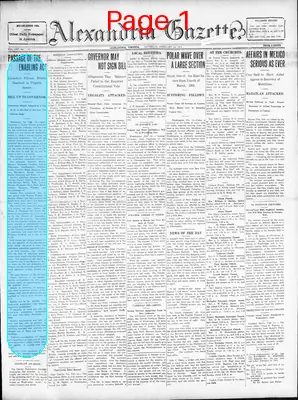
Alexandria Gazette
Alexandria, Alexandria County, District Of Columbia
What is this article about?
In Richmond, Va., on Feb. 14, 1914, Lt. Gov. J. Taylor Ellyson broke a 20-20 tie in the Virginia Senate to pass the Enabling Act for a statewide prohibition referendum on Sept. 22, 1914, ending a six-year legislative battle. House approved 64-31.
Clipping

OCR Quality
Full Text
Lieut. Gov. Ellyson Breaks Deadlock in Virginia Senate.
BILL UP TO GOVERNOR.
Conference Report Adopted by a Vote of 21 to 20—End of Six-Year Prohibition Siege.
Richmond, Va., Feb. 14.—Lieut. Governor J. Taylor Ellyson, president of the Senate yesterday cast his vote for the conference report on the enabling act, and forced the deadlocked senate to yield a narrow victory for state-wide prohibition. The roll call showed twenty senators in favor of adopting the conference report and an equal number enrolled against it. Under the rules of the body it was left to the chair to break the tie, and he voted in favor of adoption.
The recorded vote on the report of the conference committee follows:
For adoption, Senators Blanks, Bowers, Buchanan, Crockett, Echols, Edmonson, Featherstone, Fletcher Gayle, Gravatt, Mapp, Moncure, Paxton, Rhinehart, Royall, Saunders, Smith, Tavenner and West—19.
Against adoption—Senators Brock Cannon, Carter, Drewry, Early, Garrett, Harman, Hobbs, Holt, Lesner, Massie, Montague, Parr, Paul, Rison, Sowder, Thornton, Watkins and Wendenburg—19.
Senator Hart announced that he was paired with Senator Walker. If Senator Walker had been present, he would have voted "aye" and Senator Hart would have voted "no."
The vote of the senate was taken at 2:10 o'clock, one hour before the House of Delegates had finally disposed of the question by a vote of 64 to 31. Mr. Birrell, of Alexandria, voted with the majority. The action of the two branches uniting upon the same schedule of amendments formally ended the prohibition fight as far as the General Assembly of Virginia is concerned, and from now on the Williams enabling act is out of its hands.
Both houses had already passed the bill, the question of the amendments alone being the point at issue. The conference committee appointed jointly by both branches was charged with the duty of reporting amendments which would cure this disagreement. The adoption of the report by a majority vote in the House and Senate wiped out the last remaining difference, and the amended enabling act stood approved without further action.
The main features of the bill are:
Directs Governor to call special election on September 22, 1914, upon petition signed by approximately 18,000 qualified voters.
Admits to electorate all persons who voted in general election of November, 1913, and all persons who are qualified to vote in June elections of 1914.
Ballots are to be marked "for state-wide prohibition" and "against state-wide prohibition."
If majority of votes are cast for state-wide prohibition, prohibitive law goes into effect November 1, 1916.
Permits manufacture and sale of wine and beer only by persons or companies now engaged in their manufacture, provided that products are shipped out of State and into wet territory.
Prohibits manufacture of brandy as a by-product of wine, and all other wine by-products which contain a larger percentage of alcohol than wine itself.
Exempts from operation of prohibitive law domestic manufacture and sale of apple cider.
What sub-type of article is it?
What keywords are associated?
What entities or persons were involved?
Where did it happen?
Domestic News Details
Primary Location
Richmond, Va.
Event Date
Feb. 14.
Key Persons
Outcome
conference report adopted by senate vote of 21 to 20 (tie broken by lt. gov. ellyson); house vote 64 to 31; enabling act approved, ending prohibition fight in general assembly.
Event Details
Lieut. Governor J. Taylor Ellyson cast deciding vote in tied Virginia Senate (20-20) to adopt conference report on enabling act for state-wide prohibition referendum. Bill directs special election on September 22, 1914; if approved, prohibition effective November 1, 1916. Permits limited wine and beer production for export; exempts apple cider.