Thank you for visiting SNEWPapers!
Sign up free
The New Hampshire Gazette And General Advertiser
Portsmouth, Exeter, Rockingham County, New Hampshire
What is this article about?
The Spanish Gazette reports the surrender of Fort St. Philip in Minorca to the Duke de Crillon on February 4, 1782, after a siege. General Murray's garrison capitulated as prisoners of war under agreed terms, including honors of war and transport provisions. A Te Deum was sung in Madrid.
Clipping
OCR Quality
Full Text
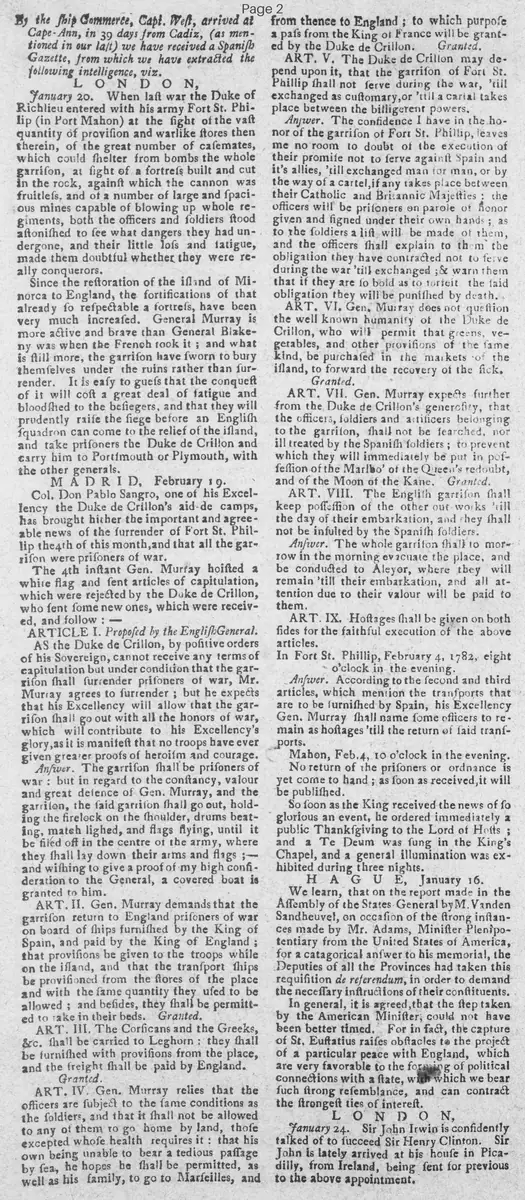
LONDON, January 20. When last war the Duke of Richelieu entered with his army Fort St. Philip (in Port Mahon) at the sight of the vast quantity of provision and warlike stores then therein, of the great number of casemates, which could shelter from bombs the whole garrison, at sight of a fortress built and cut in the rock, against which the cannon was fruitless, and of a number of large and spacious mines capable of blowing up whole regiments, both the officers and soldiers stood astonished to see what dangers they had undergone, and their little loss and fatigue, made them doubtful whether they were really conquerors.
Since the restoration of the island of Minorca to England, the fortifications of that already so respectable a fortress, have been very much increased. General Murray is more active and brave than General Blakeney was when the French took it; and what is still more, the garrison have sworn to bury themselves under the ruins rather than surrender. It is easy to guess that the conquest of it will cost a great deal of fatigue and bloodshed to the besiegers, and that they will prudently raise the siege before an English squadron can come to the relief of the island, and take prisoners the Duke de Crillon and carry him to Portsmouth or Plymouth, with the other generals.
MADRID, February 19. Col. Don Pablo Sangro, one of his Excellency the Duke de Crillon's aid-de-camps, has brought hither the important and agreeable news of the Surrender of Fort St. Philip the 4th of this month, and that all the garrison were prisoners of war.
The 4th instant Gen. Murray hoisted a white flag and sent articles of capitulation, which were rejected by the Duke de Crillon, who sent some new ones, which were received, and follow:
ARTICLE I. Proposed by the English General. As the Duke de Crillon, by positive orders of his Sovereign, cannot receive any terms of capitulation but under condition that the garrison shall surrender prisoners of war, Mr. Murray agrees to surrender; but he expects that his Excellency will allow that the garrison shall go out with all the honors of war, which will contribute to his Excellency's glory, as it is manifest that no troops have ever given greater proofs of heroism and courage.
Answer. The garrison shall be prisoners of war: but in regard to the constancy, valour and great defence of Gen. Murray, and the garrison, the said garrison shall go out, holding the firelock on the shoulder, drums beating, match lighted, and flags flying, until it be filed off in the centre of the army, where they shall lay down their arms and flags; and wishing to give a proof of my high consideration to the General, a covered boat is granted to him.
ART. II. Gen. Murray demands that the garrison return to England prisoners of war on board of ships furnished by the King of Spain, and paid by the King of England: that provisions be given to the troops while on the island, and that the transport ships be provisioned from the stores of the place and with the same quantity they used to be allowed; and besides, they shall be permitted to take in their beds. Granted.
ART. III. The Corsicans and the Greeks, &c. shall be carried to Leghorn: they shall be furnished with provisions from the place, and the freight shall be paid by England. Granted.
ART. IV. Gen. Murray relies that the officers are subject to the same conditions as the soldiers, and that it shall not be allowed to any of them to go home by land, those excepted whose health requires it: that his own being unable to bear a tedious passage by sea, he hopes he shall be permitted, as well as his family, to go to Marseilles, and from thence to England: to which purpose a pass from the King of France will be granted by the Duke de Crillon. Granted.
ART. V. The Duke de Crillon may depend upon it, that the garrison of Fort St. Phillip shall not serve during the war, till exchanged as customary, or till a cartel takes place between the belligerent powers.
Answer. The confidence I have in the honor of the garrison of Fort St. Phillip, leaves me no room to doubt of the execution of their promise not to serve against Spain and its allies, till exchanged man for man, or by the way of a cartel, if any takes place between their Catholic and Britannic Majesties: the officers will be prisoners on parole of honor given and signed under their own hands; as to the soldiers a list will be made of them, and the officers shall explain to them the obligation they have contracted not to serve during the war till exchanged; & warn them that if they are so bold as to forfeit the said obligation they will be punished by death.
ART. VI. Gen. Murray does not question the well known humanity of the Duke de Crillon, who will permit that greens, vegetables, and other provisions of the same kind, be purchased in the markets of the island, to forward the recovery of the sick. Granted.
ART. VII. Gen. Murray expects further from the Duke de Crillon's generosity, that the officers, soldiers and artificers belonging to the garrison, shall not be searched, nor ill treated by the Spanish soldiers; to prevent which they will immediately be put in possession of the Marlborough of the Queen's redoubt, and of the Moon of the Kane. Granted.
ART. VIII. The English garrison shall keep possession of the other out works till the day of their embarkation, and they shall not be insulted by the Spanish soldiers.
Answer. The whole garrison shall to-morrow in the morning evacuate the place, and be conducted to Mahon, where they will remain till their embarkation, and all attention due to their valour will be paid to them.
ART. IX. Hostages shall be given on both sides for the faithful execution of the above articles.
In Fort St. Phillip, February 4, 1782, eight o'clock in the evening.
Answer. According to the second and third articles, which mention the transports that are to be furnished by Spain, his Excellency Gen. Murray shall name some officers to remain as hostages till the return of said transports.
Mahon, Feb. 4, 10 o'clock in the evening.
No return of the prisoners or ordnance is yet come to hand; as soon as received it will be published.
So soon as the King received the news of so glorious an event, he ordered immediately a public Thanksgiving to the Lord of Hosts: and a Te Deum was sung in the King's Chapel, and a general illumination was exhibited during three nights.
What sub-type of article is it?
What keywords are associated?
What entities or persons were involved?
Where did it happen?
Foreign News Details
Primary Location
Minorca
Event Date
February 4, 1782
Key Persons
Outcome
all the garrison were prisoners of war; no specific casualties reported.
Event Details
The Duke de Crillon's forces besieged Fort St. Philip in Minorca. On February 4, 1782, Gen. Murray hoisted a white flag and proposed articles of capitulation, which were negotiated and accepted, stipulating surrender as prisoners of war with honors, provisions, transport to England, parole not to serve, and other terms. The news reached Madrid on February 19 via Col. Don Pablo Sangro, leading to public celebrations including a Te Deum.