Thank you for visiting SNEWPapers!
Sign up free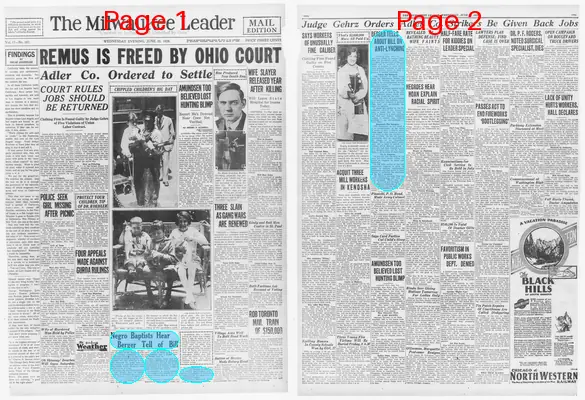
The Milwaukee Leader
Milwaukee, Milwaukee County, Wisconsin
What is this article about?
Congressman Victor L. Berger speaks at Negro Baptist convention about his anti-lynching bill, urging federal action with severe penalties; criticizes Republicans for failing pledge amid 79 lynchings in four years, 16 in 1927, and Democrats for state rights stance.
Merged-components note: Berger anti-lynching bill story continuation from page 1 to page 2, indicated by 'Turn to Page Two, Column Three'.
Clippings
1 of 2
OCR Quality
Full Text
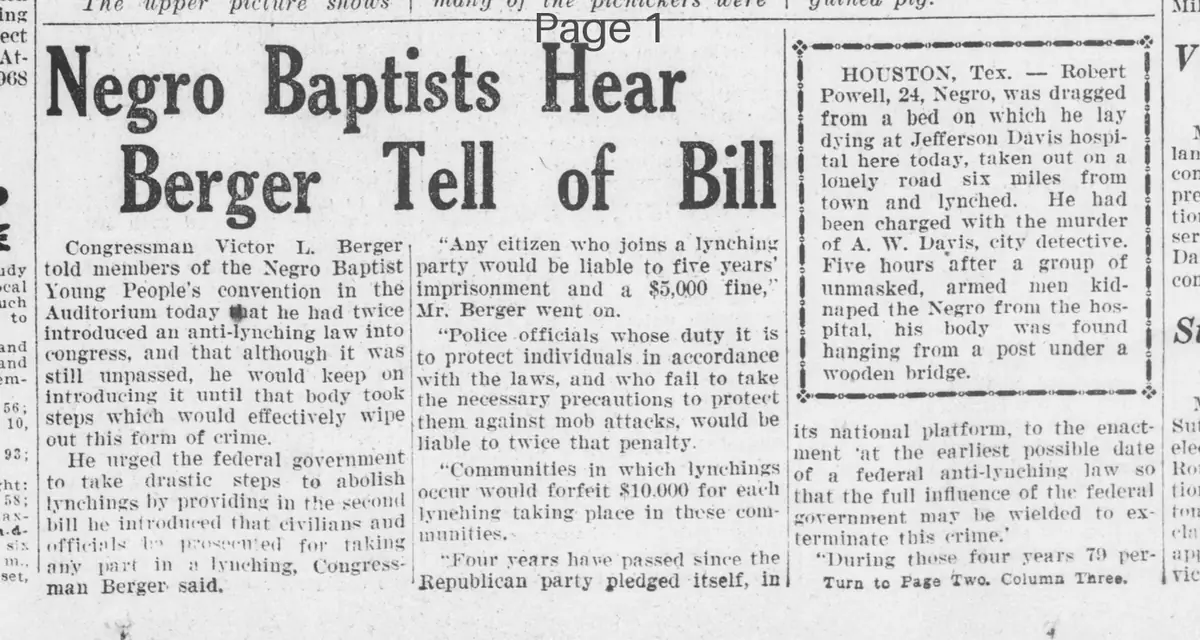
Congressman Victor L. Berger told members of the Negro Baptist Young People's convention in the Auditorium today that he had twice introduced an anti-lynching law into congress, and that although it was still unpassed, he would keep on introducing it until that body took steps which would effectively wipe out this form of crime.
He urged the federal government to take drastic steps to abolish lynchings by providing in the second bill he introduced that civilians and officials prosecuted for taking any part in a lynching, Congressman Berger said.
"Any citizen who joins a lynching party would be liable to five years imprisonment and a $5,000 fine," Mr. Berger went on.
"Police officials whose duty it is to protect individuals in accordance with the laws, and who fail to take the necessary precautions to protect them against mob attacks, would be liable to twice that penalty
"Communities in which lynchings occur would forfeit $10,000 for each lynching taking place in these communities.
"Four years have passed since the Republican party pledged itself, in its national platform, to the enactment at the earliest possible date of a federal anti-lynching law so that the full influence of the federal government may be wielded to exterminate this crime.'
"During those four years 79 per-
Turn to Page Two, Column Three.
BERGER TELLS ABOUT BILL ON ANTI-LYNCHING
Continued From Page One.
sons were killed by lawless mobs, while the Republican party, which had made this platform pledge, and which had a majority in both houses of congress to carry out its other policies beneficial to special interest groups, failed to keep its promise to outlaw lynchings.
Voters Are Betrayed.
"This betrayal of those whose votes the Republican leaders obtained by making this platform pledge is an encouragement to lawless communities to continue the barbarous practice.
"In 1927, 16 people, entitled to the protection of our laws, were lynched, seven of them in the state of Mississippi alone, which state holds the record for the year.
"The first duty of a government is to maintain the authority of its laws over the territory it governs. That duty our government has failed to perform.
"I made this appeal to the Republicans, because the Democrats seem to insist that the right to lynch a person is a state privilege and that any federal legislation seeking to abolish that valuable privilege is an encroachment on state rights.
Democrats For Snoopers.
"The Democrats do not think it is an encroachment on the rights of states to have a federal prohibition agent come snooping around your home to find out whether you take a drink. So far the federal government may go, according to the claims of my Democratic friends. But to have federal agents come into a state to punish lawlessness which deprives people of their life and limb without a trial or a hearing—that, say the Democrats, is an invasion of state rights.
Up to Congress.
"It was not only the duty of congress but also clearly within the power of congress to enact that legislation.
"In the fifth section of the 14th amendment congress is given the power to enforce constitutional guaranties, and that power is broad enough to authorize the enactment of the bill I proposed.
"My bill was stronger than any other anti-lynching bill that has been proposed. There were teeth in it. It is not any stronger, however, than the exigencies of the situation require—or the menace with which it is intended to deal would justify."
What sub-type of article is it?
What themes does it cover?
What keywords are associated?
What entities or persons were involved?
Where did it happen?
Story Details
Key Persons
Location
The Auditorium
Event Date
1927
Story Details
Congressman Victor L. Berger addresses Negro Baptist Young People's convention on his repeated introductions of an anti-lynching bill, detailing penalties for participants, officials, and communities; criticizes Republicans for betraying platform pledge while 79 persons were lynched in four years, including 16 in 1927, and Democrats for opposing federal intervention.