Thank you for visiting SNEWPapers!
Sign up free
Literary
September 15, 1791
The New Hampshire Gazette And General Advertiser
Portsmouth, Rockingham County, New Hampshire
What is this article about?
An essay titled 'The ECONOMIST' features Sedulus advising on the prudent use of time, emphasizing its irreplaceability compared to money. He discusses deductions from life for infancy, education, age, sickness, and sleep, urging diligent work, devotion, family provision, and moral education to avoid waste and prepare for the future.
Clipping
OCR Quality
98%
Excellent
Full Text
The ECONOMIST.
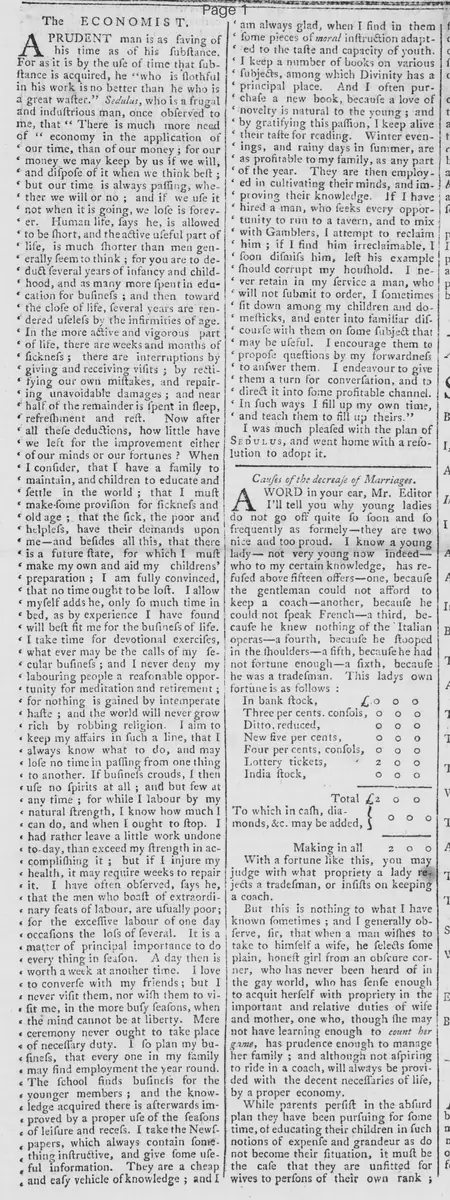
A PRUDENT man is as saving of his time as of his substance. For as it is by the use of time that substance is acquired, he who is slothful in his work is no better than he who is a great waster. Sedulus, who is a frugal and industrious man, once observed to me, that There is much more need of economy in the application of our time, than of our money; for our money we may keep by us if we will, and dispose of it when we think best; but our time is always passing, whether we will or no; and if we use it not when it is going, we lose it forever. Human life, says he, is allowed to be short, and the active useful part of life, is much shorter than men generally seem to think; for you are to deduct several years of infancy and childhood, and as many more spent in education for business; and then toward the close of life, several years are rendered useless by the infirmities of age. In the more active and vigorous part of life, there are weeks and months of sickness; there are interruptions by giving and receiving visits; by rectifying our own mistakes, and repairing unavoidable damages; and near half of the remainder is spent in sleep, refreshment and rest. Now after all these deductions, how little have we left for the improvement either of our minds or our fortunes? When I consider, that I have a family to maintain, and children to educate and settle in the world; that I must make some provision for sickness and old age; that the sick, the poor and helpless, have their demands upon me--and besides all this, that there is a future state, for which I must make my own and aid my childrens' preparation; I am fully convinced, that no time ought to be lost. I allow myself, adds he, only so much time in bed, as by experience I have found will best fit me for the business of life. I take time for devotional exercises, whatever may be the calls of my secular business; and I never deny my labouring people a reasonable opportunity for meditation and retirement; for nothing is gained by intemperate haste; and the world will never grow rich by robbing religion. I aim to keep my affairs in such a line, that I always know what to do, and may lose no time in passing from one thing to another. If business crowds, I then use no spirits at all; and but few at any time; for while I labour by my natural strength, I know how much I can do, and when I ought to stop. I had rather leave a little work undone to-day, than exceed my strength in accomplishing it; but if I injure my health, it may require weeks to repair it. I have often observed, says he, that the men who boast of extraordinary feats of labour, are usually poor; for the excessive labour of one day occasions the loss of several. It is a matter of principal importance to do every thing in season. A day then is worth a week at another time. I love to converse with my friends; but I never visit them, nor wish them to visit me, in the more busy seasons, when the mind cannot be at liberty. Mere ceremony never ought to take place of necessary duty. I so plan my business, that every one in my family may find employment the year round. The school finds business for the younger members; and the knowledge acquired there is afterwards improved by a proper use of the seasons of leisure and recess. I take the News papers, which always contain something instructive, and give some useful information. They are a cheap and easy vehicle of knowledge; and I am always glad, when I find in them some pieces of moral instruction adapted to the state and capacity of youth. I keep a number of books on various subjects, among which Divinity has a principal place. And I often purchase a new book, because a love of novelty is natural to the young; and by gratifying this passion, I keep alive their taste for reading. Winter evenings, and rainy days in summer, are as profitable to my family, as any part of the year. They are then employed in cultivating their minds, and improving their knowledge. If I have hired a man, who seeks every opportunity to run to a tavern, and to mix with Gamblers, I attempt to reclaim him: if I find him irreclaimable, I soon dismiss him, lest his example should corrupt my household. I never retain in my service a man, who will not submit to order. I sometimes sit down among my children and domestics, and enter into familiar discourse with them on some subject that may be useful. I encourage them to propose questions by my forwardness to answer them. I endeavour to give them a turn for conversation, and to direct it into some profitable channel. In such ways I fill up my own time, and teach them to fill up theirs. I was much pleased with the plan of Sedulus, and went home with a resolution to adopt it.
A PRUDENT man is as saving of his time as of his substance. For as it is by the use of time that substance is acquired, he who is slothful in his work is no better than he who is a great waster. Sedulus, who is a frugal and industrious man, once observed to me, that There is much more need of economy in the application of our time, than of our money; for our money we may keep by us if we will, and dispose of it when we think best; but our time is always passing, whether we will or no; and if we use it not when it is going, we lose it forever. Human life, says he, is allowed to be short, and the active useful part of life, is much shorter than men generally seem to think; for you are to deduct several years of infancy and childhood, and as many more spent in education for business; and then toward the close of life, several years are rendered useless by the infirmities of age. In the more active and vigorous part of life, there are weeks and months of sickness; there are interruptions by giving and receiving visits; by rectifying our own mistakes, and repairing unavoidable damages; and near half of the remainder is spent in sleep, refreshment and rest. Now after all these deductions, how little have we left for the improvement either of our minds or our fortunes? When I consider, that I have a family to maintain, and children to educate and settle in the world; that I must make some provision for sickness and old age; that the sick, the poor and helpless, have their demands upon me--and besides all this, that there is a future state, for which I must make my own and aid my childrens' preparation; I am fully convinced, that no time ought to be lost. I allow myself, adds he, only so much time in bed, as by experience I have found will best fit me for the business of life. I take time for devotional exercises, whatever may be the calls of my secular business; and I never deny my labouring people a reasonable opportunity for meditation and retirement; for nothing is gained by intemperate haste; and the world will never grow rich by robbing religion. I aim to keep my affairs in such a line, that I always know what to do, and may lose no time in passing from one thing to another. If business crowds, I then use no spirits at all; and but few at any time; for while I labour by my natural strength, I know how much I can do, and when I ought to stop. I had rather leave a little work undone to-day, than exceed my strength in accomplishing it; but if I injure my health, it may require weeks to repair it. I have often observed, says he, that the men who boast of extraordinary feats of labour, are usually poor; for the excessive labour of one day occasions the loss of several. It is a matter of principal importance to do every thing in season. A day then is worth a week at another time. I love to converse with my friends; but I never visit them, nor wish them to visit me, in the more busy seasons, when the mind cannot be at liberty. Mere ceremony never ought to take place of necessary duty. I so plan my business, that every one in my family may find employment the year round. The school finds business for the younger members; and the knowledge acquired there is afterwards improved by a proper use of the seasons of leisure and recess. I take the News papers, which always contain something instructive, and give some useful information. They are a cheap and easy vehicle of knowledge; and I am always glad, when I find in them some pieces of moral instruction adapted to the state and capacity of youth. I keep a number of books on various subjects, among which Divinity has a principal place. And I often purchase a new book, because a love of novelty is natural to the young; and by gratifying this passion, I keep alive their taste for reading. Winter evenings, and rainy days in summer, are as profitable to my family, as any part of the year. They are then employed in cultivating their minds, and improving their knowledge. If I have hired a man, who seeks every opportunity to run to a tavern, and to mix with Gamblers, I attempt to reclaim him: if I find him irreclaimable, I soon dismiss him, lest his example should corrupt my household. I never retain in my service a man, who will not submit to order. I sometimes sit down among my children and domestics, and enter into familiar discourse with them on some subject that may be useful. I encourage them to propose questions by my forwardness to answer them. I endeavour to give them a turn for conversation, and to direct it into some profitable channel. In such ways I fill up my own time, and teach them to fill up theirs. I was much pleased with the plan of Sedulus, and went home with a resolution to adopt it.
What sub-type of article is it?
Essay
What themes does it cover?
Moral Virtue
Temperance
Religious
What keywords are associated?
Time Economy
Frugality
Moral Instruction
Family Education
Devotion
Self Control
Industry
Literary Details
Title
The Economist.
Subject
On The Prudent Economy Of Time
Key Lines
There Is Much More Need Of Economy In The Application Of Our Time, Than Of Our Money; For Our Money We May Keep By Us If We Will, And Dispose Of It When We Think Best; But Our Time Is Always Passing, Whether We Will Or No; And If We Use It Not When It Is Going, We Lose It Forever.
I Am Fully Convinced, That No Time Ought To Be Lost.
Nothing Is Gained By Intemperate Haste; And The World Will Never Grow Rich By Robbing Religion.
It Is A Matter Of Principal Importance To Do Every Thing In Season. A Day Then Is Worth A Week At Another Time.