Thank you for visiting SNEWPapers!
Sign up free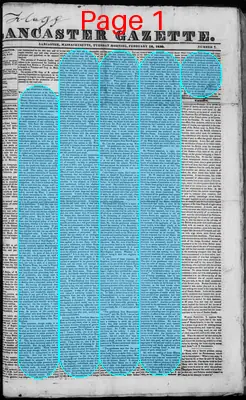
Story
February 16, 1830
Lancaster Gazette
Lancaster, Worcester County, Massachusetts
What is this article about?
Daniel Webster's Senate speech defends New England against Sen. Hayne's accusations of selfish policy hindering Western growth, citing historical support for Western measures like the Northwest Ordinance and tariff origins.
Clipping
OCR Quality
97%
Excellent
Full Text
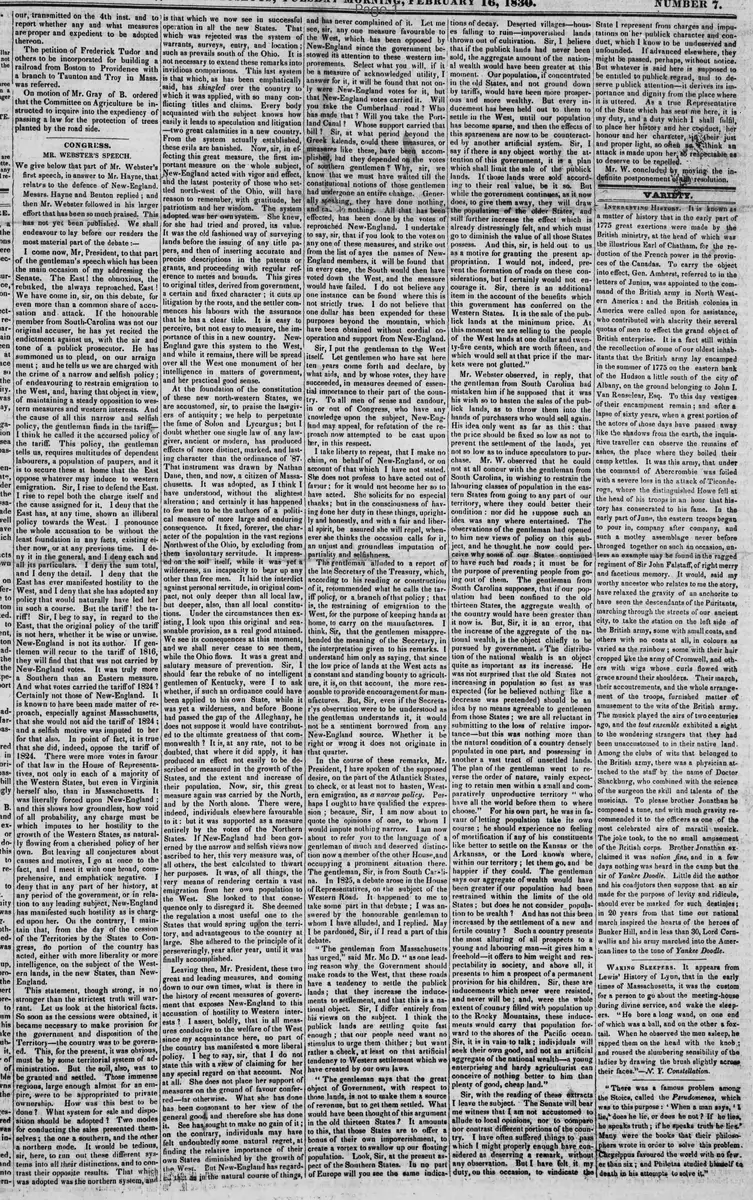
CONGRESS.
MR. WEBSTER'S SPEECH.
We give below that part of Mr. Webster's first speech, in answer to Mr. Hayne, that relates to the defence of New-England.
Messrs. Hayne and Benton replied; and then Mr. Webster followed in his larger effort that has been so much praised. This has not yet been published. We shall endeavour to lay before our readers the most material part of the debate:—
I come now, Mr. President, to that part of the gentleman's speech which has been the main occasion of my addressing the Senate. The East! the obnoxious, the rebuked, the always reproached, East! We have come in, sir, on this debate, for even more than a common share of accusation and attack. If the honourable member from South-Carolina was not our original accuser, he has yet recited the indictment against us, with the air and tone of a public prosecutor. He has summoned us to plead, on our arraignment; and he tells us we are charged with the crime of a narrow and selfish policy: of endeavouring to restrain emigration to the West, and, having that object in view, of maintaining a steady opposition to western measures and western interests. And the cause of all this narrow and selfish policy, the gentleman finds in the tariff—I think he called it the accursed policy of the tariff. This policy, the gentleman tells us, requires multitudes of dependent labourers, a population of paupers, and it is to secure these at home that the East oppose whatever may induce to western emigration. Sir, I rise to defend the East. I rise to repel both the charge itself and the cause assigned for it. I deny that the East has, at any time, shown an illiberal policy towards the West. I pronounce the whole accusation to be without the least foundation in any acts, existing either now, or at any previous time. I deny it in the general, and I deny each and all its particulars. I deny the sum total, and I deny the detail. I deny that the East has ever manifested hostility to the West, and I deny that she has adopted any policy that would naturally have led her in such a course. But the tariff! the tariff! Sir. I beg to say, in regard to the East, that the original policy of the tariff is not hers, whether it be wise or unwise. New-England is not its author. If gentlemen will recur to the tariff of 1816, they will find that that was not carried by New-England votes. It was truly more a Southern than an Eastern measure. And what votes carried the tariff of 1824? Certainly not those of New-England. It is known to have been made matter of reproach, especially against Massachusetts, that she would not aid the tariff of 1824; and a selfish motive was imputed to her for that also. In point of fact, it is true that she did, indeed, oppose the tariff of 1824. There were more votes in favour of that law in the House of Representatives, not only in each of a majority of the Western States, but even in Virginia herself also, than in Massachusetts. It was literally forced upon New-England; and this shows how groundless, how void of all probability, any charge must be which imputes to her hostility to the growth of the Western States, as naturally flowing from a cherished policy of her own. But leaving all conjectures about causes and motives, I go at once to the act, and I meet it with one broad, comprehensive, and emphatical negative. I deny that in any part of her history, at any period of the government, or in relation to any leading subject, New-England has manifested such hostility as is charged upon her. On the contrary, I maintain that, from the day of the cession of the Territories by the States to Congress, no portion of the country has acted, either with more liberality or more intelligence, on the subject of the Western lands, in the new States, than New-England. This statement, though strong, is no stronger than the strictest truth will warrant. Let us look at the historical facts. So soon as the cessions were obtained, it became necessary to make provision for the government and disposition of the Territory—the country was to be governed. This, for the present, it was obvious, must be by some territorial system of administration. But the soil, also, was to be granted and settled. Those immense regions, large enough almost for an empire, were to be appropriated to private ownership. How was this best to be done? What system for sale and disposition should be adopted? Two modes for conducting the sales presented themselves; the one a southern, and the other a northern mode. It would be tedious, sir, here, to run out these different systems into all their distinctions, and to contrast their opposite results. That which was adopted was the northern system, and is that which we now see in successful operation in all the new States. That which was rejected was the system of warrants, surveys, entry, and location; such as prevails south of the Ohio. It is not necessary to extend these remarks into invidious comparisons. This last system is that which, as has been emphatically said, has shingled over the country to which it was applied, with so many conflicting titles and claims. Every body acquainted with the subject knows how easily it leads to speculation and litigation—two great calamities in a new country. From the system actually established, these evils are banished. Now, sir, in effecting this great measure, the first important measure on the whole subject, New-England acted with vigor and effect, and the latest posterity of those who settled north-west of the Ohio, will have reason to remember, with gratitude, her patriotism and her wisdom. The system adopted was her own system. She knew, for she had tried and proved, its value. It was the old fashioned way of surveying lands before the issuing of any title papers, and then of inserting accurate and precise descriptions in the patents or grants, and proceeding with regular reference to metes and bounds. This gives to original titles, derived from government, a certain and fixed character; it cuts up litigation by the roots, and the settler commences his labours with the assurance that he has a clear title. It is easy to perceive, but not easy to measure, the importance of this in a new country. New-England gave this system to the West, and while it remains, there will be spread over all the West one monument of her intelligence in matters of government, and her practical good sense. At the foundation of the constitution of these new north-western States, we are accustomed, sir, to praise the lawgivers of antiquity; we help to perpetuate the fame of Solon and Lycurgus; but I doubt whether one single law of any lawgiver, ancient or modern, has produced effects of more distinct, marked, and lasting character than the ordinance of '87. That instrument was drawn by Nathan Dane, then, and now, a citizen of Massachusetts. It was adopted, as I think I have understood, without the slightest alteration; and certainly it has happened to few men to be the authors of a political measure of more large and enduring consequence. It fixed, forever, the character of the population in the vast regions Northwest of the Ohio, by excluding from them involuntary servitude. It impressed on the soil itself, while it was yet a wilderness, an incapacity to bear up any other than free men. It laid the interdict against personal servitude, in original compact, not only deeper than all local law, but deeper, also, than all local constitutions. Under the circumstances then existing, I look upon this original and seasonable provision, as a real good attained. We see its consequences at this moment, and we shall never cease to see them, while the Ohio flows. It was a great and salutary measure of prevention. Sir, I should fear the rebuke of no intelligent gentlemen of Kentucky, were I to ask whether, if such an ordinance could have been applied to his own State, while it was yet a wilderness, and before Boone had passed the gap of the Alleghany, he does not suppose it would have contributed to the ultimate greatness of that commonwealth? It is, at any rate, not to be doubted, that where it did apply, it has produced an effect not easily to be described or measured in the growth of the States, and the extent and increase of their population. Now, sir, this great measure again was carried by the North, and by the North alone. There were, indeed, individuals elsewhere favourable to it: but it was supported as a measure entirely by the votes of the Northern States. If New-England had been governed by the narrow and selfish views now ascribed to her, this very measure was, of all others, the best calculated to thwart her purposes. It was, of all things, the very means of rendering certain a vast emigration from her own population to the West. She looked to that consequence only to disregard it. She deemed the regulation a most useful one to the States that would spring up on the territory, and advantageous to the country at large. She adhered to the principle of it perseveringly, year after year, until it was finally accomplished. Leaving then, Mr. President, these two great and leading measures, and coming down to our own times, what is there in the history of recent measures of government that exposes New-England to this accusation of hostility to Western interests? I assert, boldly, that in all measures conducive to the welfare of the West since my acquaintance here, no part of the country has manifested a more liberal policy. I beg to say, sir, that I do not state this with a view of claiming for her any special regard on that account. Not at all. She does not place her support of measures on the ground of favour conferred—far otherwise. What she has done has been consonant to her view of the general good, and therefore she has done it. She has sought to make no gain of it; on the contrary, individuals may have felt undoubtedly some natural regret, at finding the relative importance of their own States diminished by the growth of the West. But New-England has regarded that as in the natural course of things, and has never complained of it. Let me see, sir, any one measure favourable to the West, which has been opposed by New-England since the government bestowed its attention to these western improvements. Select what you will, if it be a measure of acknowledged utility, I answer for it, it will be found that not only were New-England votes for it, but that New-England votes carried it. Will you take the Cumberland road? Who has made that? Will you take the Portland Canal? Whose support carried that bill? Sir, at what period beyond the Greek kalends, could these measures, or measures like these, have been accomplished, had they depended on the votes of southern gentlemen? Why, sir, we know that we must have waited till the constitutional notions of those gentlemen had undergone an entire change. Generally speaking, they have done nothing, and can do nothing. All that has been effected, has been done by the votes of the reproached New-England. I undertake to say, sir, that if you look to the votes on any one of these measures, and strike out from the list of ayes the names of New-England members, it will be found that in every case, the South would then have voted down the West, and the measure would have failed. I do not believe any one instance can be found where this is not strictly true. I do not believe that one dollar has been expended for these purposes beyond the mountain, which have been obtained without cordial co-operation and support from New-England. Sir, I put the gentleman to the West itself. Let gentlemen who have sat here ten years come forth and declare, by what aids, and by whose votes, they have succeeded in measures deemed of essential importance to their part of the country. To all men of sense and candour, in or out of Congress, who have any knowledge upon the subject, New-England may appeal, for refutation of the reproach now attempted to be cast upon her, in this respect. I take liberty to repeat, that I make no claim, on behalf of New-England, or on account of that which I have not stated. She does not profess to have acted out of favour; for it would not become her so to have acted. She solicits for no especial thanks; but in the consciousness of having done her duty in these things, uprightly and honestly, and with a fair and liberal spirit, be assured she will repel, whenever she thinks the occasion calls for it, an unjust and groundless imputation of partiality and selfishness. The gentleman alluded to a report of the late Secretary of the Treasury, which, according to his reading or construction of it, recommended what he calls the tariff policy, or a branch of that policy; that is, the restraining of emigration to the West, for the purpose of keeping hands at home, to carry on the manufactures. I think, Sir, that the gentleman misapprehended the meaning of the Secretary, in the interpretation given to his remarks. I understand him only as saying, that since the low price of lands at the West acts as a constant and standing bounty to agriculture, it is, on that account, the more reasonable to provide encouragement for manufactures. But, Sir, even if the Secretary's observation were to be understood as the gentleman understands it, it would not be a sentiment borrowed from any New-England source. Whether it be right or wrong it does not originate in that quarter. In the course of these remarks, Mr. President, I have spoken of the supposed desire, on the part of the Atlantic States, to check, or at least not to hasten, Western emigration, as a narrow policy. Perhaps I ought to have qualified the expression; because, Sir, I am now about to quote the opinions of one, to whom I would impute nothing narrow. I am now about to refer you to the language of a gentleman of much and deserved distinction now a member of the other House, and occupying a prominent situation there. The gentleman, Sir, is from South Carolina. In 1825, a debate arose in the House of Representatives, on the subject of the Western Road. It happened to me to take some part in that debate; I was answered by the honourable gentleman to whom I have alluded, and I replied. May I be pardoned, Sir, if I read a part of this debate.
"The gentleman from Massachusetts has urged," said Mr. McD. "as one leading reason why the Government should make roads to the West, that these roads have a tendency to settle the public lands; that they increase the inducements to settlement, and that this is a national object. Sir, I differ entirely from his views on the subject. I think the public lands are settling quite fast enough; that our people need want no stimulus to urge them thither; but want rather a check, at least on that artificial tendency to Western settlement which we have created by our own laws.
"The gentleman says that the great object of Government, with respect to those lands, is not to make them a source of revenue, but to get them settled. What would have been thought of this argument in the old thirteen States? It amounts to this, that those States are to offer a bonus of their own impoverishment, to create a vortex to swallow up our floating population. Look, Sir, at the present aspect of the Southern States. In no part of Europe will you see the same indications of decay. Deserted villages—houses falling to ruin—impoverished lands thrown out of cultivation. Sir, I believe that if the public lands had never been sold, the aggregate amount of the national wealth would have been greater at this moment. Our population, if concentrated in the old States, and not ground down by tariffs, would have been more prosperous and more wealthy. But every inducement has been held out to them to settle in the West, until our population has become sparse, and then the effects of this sparseness are now to be counteracted by another artificial system. Sir, I say if there is any object worthy the attention of this government, it is a plan which shall limit the sale of the public lands. If those lands were sold according to their real value, be it so. But while the government continues, as it now does, to give them away, they will draw the population of the older States, and still further increase the effect which is already distressingly felt, and which must go to diminish the value of all those States possess. And this, sir, is held out to us as a motive for granting the present appropriation. I would not, indeed, prevent the formation of roads on these considerations, but I certainly would not encourage it. Sir, there is an additional item in the account of the benefits which this government has conferred on the Western States. It is the sale of the public lands at the minimum price. At this moment we are selling to the people of the West lands at one dollar and twenty-five cents, which are worth fifteen, and which would sell at that price if the markets were not glutted."
Mr. Webster observed, in reply, that the gentleman from South Carolina had mistaken him if he supposed that it was his wish so to hasten the sales of the public lands, as to throw them into the hands of purchasers who would sell again. His idea only went as far as this: that the price should be fixed so low as not to prevent the settlement of the lands, yet not so low as to induce speculators to purchase. Mr. W. observed that he could not at all concur with the gentleman from South Carolina, in wishing to restrain the labouring classes of population in the eastern States from going to any part of our territory, where they could better their condition: nor did he suppose such an idea was any where entertained. The observations of the gentleman had opened to him new views of policy on this subject, and he thought he now could perceive why some of our States continued to have such bad roads; it must be for the purpose of preventing people from going out of them. The gentleman from South Carolina supposes, that if our population had been confined to the old thirteen States, the aggregate wealth of the country would have been greater than it now is. But, Sir, it is an error, that the increase of the aggregate of the national wealth, is the object chiefly to be pursued by government. The distribution of the national wealth is an object quite as important as its increase. He was not surprised that the old States not increasing in population so fast as was expected (for he believed nothing like a decrease was pretended) should be an idea by no means agreeable to gentlemen from those States; we are all reluctant in submitting to the loss of relative importance—but this was nothing more than the natural condition of a country densely populated in one part, and possessing in another a vast tract of unsettled lands. The plan of the gentleman went to reverse the order of nature, vainly expecting to retain men within a small and comparatively unproductive territory "who have all the world before them to where choose." For his own part, he was in favour of letting population take its own course; he should experience no feeling of mortification if any of his constituents like better to settle on the Kansas or the Arkansas, or the Lord knows where, within our territory; let them go, and be happier if they could. The gentleman says our aggregate of wealth would have been greater if our population had been restrained within the limits of the old States; but does he not consider population to be wealth? And has not this been increased by the settlement of a new and fertile country? Such a country presents the most alluring of all prospects to a young and labouring man—it gives him a freehold—it offers to him weight and respectability in society, and above all, it presents to him a prospect of a permanent provision for his children. Sir, these are inducements which never were resisted, and never will be; and, were the whole extent of country filled with population up to the Rocky Mountains, these inducements would carry that population forward to the shores of the Pacific ocean. Sir, it is in vain to talk: individuals will seek their own good, and not an artificial aggregate of the national wealth—a young enterprising and hardy agriculturist can conceive of nothing better to him than plenty of good, cheap land."
Sir, with the reading of these extracts I leave the subject. The Senate will bear me witness that I am not accustomed to allude to local opinions, nor to compare nor contrast different portions of the country. I have often suffered things to pass which I might properly enough have considered as deserving a remark, without any observation. But I have felt it my duty, on this occasion, to vindicate the State I represent from charges and imputations on her public character and conduct, which I know to be undeserved and unfounded. If advanced elsewhere, they might be passed, perhaps, without notice. But whatever is said here is supposed to be entitled to public regard, and to deserve public attention—it derives its importance and dignity from the place where it is uttered. As a true Representative of the State which has sent me here, it is my duty, and a duty which I shall fulfil, to place her history and her conduct, her honour and her character, in their just and proper light, so often as I think an attack is made upon her, so respectable as to deserve to be repelled.
Mr. W. concluded by moving the indefinite postponement of a resolution.
MR. WEBSTER'S SPEECH.
We give below that part of Mr. Webster's first speech, in answer to Mr. Hayne, that relates to the defence of New-England.
Messrs. Hayne and Benton replied; and then Mr. Webster followed in his larger effort that has been so much praised. This has not yet been published. We shall endeavour to lay before our readers the most material part of the debate:—
I come now, Mr. President, to that part of the gentleman's speech which has been the main occasion of my addressing the Senate. The East! the obnoxious, the rebuked, the always reproached, East! We have come in, sir, on this debate, for even more than a common share of accusation and attack. If the honourable member from South-Carolina was not our original accuser, he has yet recited the indictment against us, with the air and tone of a public prosecutor. He has summoned us to plead, on our arraignment; and he tells us we are charged with the crime of a narrow and selfish policy: of endeavouring to restrain emigration to the West, and, having that object in view, of maintaining a steady opposition to western measures and western interests. And the cause of all this narrow and selfish policy, the gentleman finds in the tariff—I think he called it the accursed policy of the tariff. This policy, the gentleman tells us, requires multitudes of dependent labourers, a population of paupers, and it is to secure these at home that the East oppose whatever may induce to western emigration. Sir, I rise to defend the East. I rise to repel both the charge itself and the cause assigned for it. I deny that the East has, at any time, shown an illiberal policy towards the West. I pronounce the whole accusation to be without the least foundation in any acts, existing either now, or at any previous time. I deny it in the general, and I deny each and all its particulars. I deny the sum total, and I deny the detail. I deny that the East has ever manifested hostility to the West, and I deny that she has adopted any policy that would naturally have led her in such a course. But the tariff! the tariff! Sir. I beg to say, in regard to the East, that the original policy of the tariff is not hers, whether it be wise or unwise. New-England is not its author. If gentlemen will recur to the tariff of 1816, they will find that that was not carried by New-England votes. It was truly more a Southern than an Eastern measure. And what votes carried the tariff of 1824? Certainly not those of New-England. It is known to have been made matter of reproach, especially against Massachusetts, that she would not aid the tariff of 1824; and a selfish motive was imputed to her for that also. In point of fact, it is true that she did, indeed, oppose the tariff of 1824. There were more votes in favour of that law in the House of Representatives, not only in each of a majority of the Western States, but even in Virginia herself also, than in Massachusetts. It was literally forced upon New-England; and this shows how groundless, how void of all probability, any charge must be which imputes to her hostility to the growth of the Western States, as naturally flowing from a cherished policy of her own. But leaving all conjectures about causes and motives, I go at once to the act, and I meet it with one broad, comprehensive, and emphatical negative. I deny that in any part of her history, at any period of the government, or in relation to any leading subject, New-England has manifested such hostility as is charged upon her. On the contrary, I maintain that, from the day of the cession of the Territories by the States to Congress, no portion of the country has acted, either with more liberality or more intelligence, on the subject of the Western lands, in the new States, than New-England. This statement, though strong, is no stronger than the strictest truth will warrant. Let us look at the historical facts. So soon as the cessions were obtained, it became necessary to make provision for the government and disposition of the Territory—the country was to be governed. This, for the present, it was obvious, must be by some territorial system of administration. But the soil, also, was to be granted and settled. Those immense regions, large enough almost for an empire, were to be appropriated to private ownership. How was this best to be done? What system for sale and disposition should be adopted? Two modes for conducting the sales presented themselves; the one a southern, and the other a northern mode. It would be tedious, sir, here, to run out these different systems into all their distinctions, and to contrast their opposite results. That which was adopted was the northern system, and is that which we now see in successful operation in all the new States. That which was rejected was the system of warrants, surveys, entry, and location; such as prevails south of the Ohio. It is not necessary to extend these remarks into invidious comparisons. This last system is that which, as has been emphatically said, has shingled over the country to which it was applied, with so many conflicting titles and claims. Every body acquainted with the subject knows how easily it leads to speculation and litigation—two great calamities in a new country. From the system actually established, these evils are banished. Now, sir, in effecting this great measure, the first important measure on the whole subject, New-England acted with vigor and effect, and the latest posterity of those who settled north-west of the Ohio, will have reason to remember, with gratitude, her patriotism and her wisdom. The system adopted was her own system. She knew, for she had tried and proved, its value. It was the old fashioned way of surveying lands before the issuing of any title papers, and then of inserting accurate and precise descriptions in the patents or grants, and proceeding with regular reference to metes and bounds. This gives to original titles, derived from government, a certain and fixed character; it cuts up litigation by the roots, and the settler commences his labours with the assurance that he has a clear title. It is easy to perceive, but not easy to measure, the importance of this in a new country. New-England gave this system to the West, and while it remains, there will be spread over all the West one monument of her intelligence in matters of government, and her practical good sense. At the foundation of the constitution of these new north-western States, we are accustomed, sir, to praise the lawgivers of antiquity; we help to perpetuate the fame of Solon and Lycurgus; but I doubt whether one single law of any lawgiver, ancient or modern, has produced effects of more distinct, marked, and lasting character than the ordinance of '87. That instrument was drawn by Nathan Dane, then, and now, a citizen of Massachusetts. It was adopted, as I think I have understood, without the slightest alteration; and certainly it has happened to few men to be the authors of a political measure of more large and enduring consequence. It fixed, forever, the character of the population in the vast regions Northwest of the Ohio, by excluding from them involuntary servitude. It impressed on the soil itself, while it was yet a wilderness, an incapacity to bear up any other than free men. It laid the interdict against personal servitude, in original compact, not only deeper than all local law, but deeper, also, than all local constitutions. Under the circumstances then existing, I look upon this original and seasonable provision, as a real good attained. We see its consequences at this moment, and we shall never cease to see them, while the Ohio flows. It was a great and salutary measure of prevention. Sir, I should fear the rebuke of no intelligent gentlemen of Kentucky, were I to ask whether, if such an ordinance could have been applied to his own State, while it was yet a wilderness, and before Boone had passed the gap of the Alleghany, he does not suppose it would have contributed to the ultimate greatness of that commonwealth? It is, at any rate, not to be doubted, that where it did apply, it has produced an effect not easily to be described or measured in the growth of the States, and the extent and increase of their population. Now, sir, this great measure again was carried by the North, and by the North alone. There were, indeed, individuals elsewhere favourable to it: but it was supported as a measure entirely by the votes of the Northern States. If New-England had been governed by the narrow and selfish views now ascribed to her, this very measure was, of all others, the best calculated to thwart her purposes. It was, of all things, the very means of rendering certain a vast emigration from her own population to the West. She looked to that consequence only to disregard it. She deemed the regulation a most useful one to the States that would spring up on the territory, and advantageous to the country at large. She adhered to the principle of it perseveringly, year after year, until it was finally accomplished. Leaving then, Mr. President, these two great and leading measures, and coming down to our own times, what is there in the history of recent measures of government that exposes New-England to this accusation of hostility to Western interests? I assert, boldly, that in all measures conducive to the welfare of the West since my acquaintance here, no part of the country has manifested a more liberal policy. I beg to say, sir, that I do not state this with a view of claiming for her any special regard on that account. Not at all. She does not place her support of measures on the ground of favour conferred—far otherwise. What she has done has been consonant to her view of the general good, and therefore she has done it. She has sought to make no gain of it; on the contrary, individuals may have felt undoubtedly some natural regret, at finding the relative importance of their own States diminished by the growth of the West. But New-England has regarded that as in the natural course of things, and has never complained of it. Let me see, sir, any one measure favourable to the West, which has been opposed by New-England since the government bestowed its attention to these western improvements. Select what you will, if it be a measure of acknowledged utility, I answer for it, it will be found that not only were New-England votes for it, but that New-England votes carried it. Will you take the Cumberland road? Who has made that? Will you take the Portland Canal? Whose support carried that bill? Sir, at what period beyond the Greek kalends, could these measures, or measures like these, have been accomplished, had they depended on the votes of southern gentlemen? Why, sir, we know that we must have waited till the constitutional notions of those gentlemen had undergone an entire change. Generally speaking, they have done nothing, and can do nothing. All that has been effected, has been done by the votes of the reproached New-England. I undertake to say, sir, that if you look to the votes on any one of these measures, and strike out from the list of ayes the names of New-England members, it will be found that in every case, the South would then have voted down the West, and the measure would have failed. I do not believe any one instance can be found where this is not strictly true. I do not believe that one dollar has been expended for these purposes beyond the mountain, which have been obtained without cordial co-operation and support from New-England. Sir, I put the gentleman to the West itself. Let gentlemen who have sat here ten years come forth and declare, by what aids, and by whose votes, they have succeeded in measures deemed of essential importance to their part of the country. To all men of sense and candour, in or out of Congress, who have any knowledge upon the subject, New-England may appeal, for refutation of the reproach now attempted to be cast upon her, in this respect. I take liberty to repeat, that I make no claim, on behalf of New-England, or on account of that which I have not stated. She does not profess to have acted out of favour; for it would not become her so to have acted. She solicits for no especial thanks; but in the consciousness of having done her duty in these things, uprightly and honestly, and with a fair and liberal spirit, be assured she will repel, whenever she thinks the occasion calls for it, an unjust and groundless imputation of partiality and selfishness. The gentleman alluded to a report of the late Secretary of the Treasury, which, according to his reading or construction of it, recommended what he calls the tariff policy, or a branch of that policy; that is, the restraining of emigration to the West, for the purpose of keeping hands at home, to carry on the manufactures. I think, Sir, that the gentleman misapprehended the meaning of the Secretary, in the interpretation given to his remarks. I understand him only as saying, that since the low price of lands at the West acts as a constant and standing bounty to agriculture, it is, on that account, the more reasonable to provide encouragement for manufactures. But, Sir, even if the Secretary's observation were to be understood as the gentleman understands it, it would not be a sentiment borrowed from any New-England source. Whether it be right or wrong it does not originate in that quarter. In the course of these remarks, Mr. President, I have spoken of the supposed desire, on the part of the Atlantic States, to check, or at least not to hasten, Western emigration, as a narrow policy. Perhaps I ought to have qualified the expression; because, Sir, I am now about to quote the opinions of one, to whom I would impute nothing narrow. I am now about to refer you to the language of a gentleman of much and deserved distinction now a member of the other House, and occupying a prominent situation there. The gentleman, Sir, is from South Carolina. In 1825, a debate arose in the House of Representatives, on the subject of the Western Road. It happened to me to take some part in that debate; I was answered by the honourable gentleman to whom I have alluded, and I replied. May I be pardoned, Sir, if I read a part of this debate.
"The gentleman from Massachusetts has urged," said Mr. McD. "as one leading reason why the Government should make roads to the West, that these roads have a tendency to settle the public lands; that they increase the inducements to settlement, and that this is a national object. Sir, I differ entirely from his views on the subject. I think the public lands are settling quite fast enough; that our people need want no stimulus to urge them thither; but want rather a check, at least on that artificial tendency to Western settlement which we have created by our own laws.
"The gentleman says that the great object of Government, with respect to those lands, is not to make them a source of revenue, but to get them settled. What would have been thought of this argument in the old thirteen States? It amounts to this, that those States are to offer a bonus of their own impoverishment, to create a vortex to swallow up our floating population. Look, Sir, at the present aspect of the Southern States. In no part of Europe will you see the same indications of decay. Deserted villages—houses falling to ruin—impoverished lands thrown out of cultivation. Sir, I believe that if the public lands had never been sold, the aggregate amount of the national wealth would have been greater at this moment. Our population, if concentrated in the old States, and not ground down by tariffs, would have been more prosperous and more wealthy. But every inducement has been held out to them to settle in the West, until our population has become sparse, and then the effects of this sparseness are now to be counteracted by another artificial system. Sir, I say if there is any object worthy the attention of this government, it is a plan which shall limit the sale of the public lands. If those lands were sold according to their real value, be it so. But while the government continues, as it now does, to give them away, they will draw the population of the older States, and still further increase the effect which is already distressingly felt, and which must go to diminish the value of all those States possess. And this, sir, is held out to us as a motive for granting the present appropriation. I would not, indeed, prevent the formation of roads on these considerations, but I certainly would not encourage it. Sir, there is an additional item in the account of the benefits which this government has conferred on the Western States. It is the sale of the public lands at the minimum price. At this moment we are selling to the people of the West lands at one dollar and twenty-five cents, which are worth fifteen, and which would sell at that price if the markets were not glutted."
Mr. Webster observed, in reply, that the gentleman from South Carolina had mistaken him if he supposed that it was his wish so to hasten the sales of the public lands, as to throw them into the hands of purchasers who would sell again. His idea only went as far as this: that the price should be fixed so low as not to prevent the settlement of the lands, yet not so low as to induce speculators to purchase. Mr. W. observed that he could not at all concur with the gentleman from South Carolina, in wishing to restrain the labouring classes of population in the eastern States from going to any part of our territory, where they could better their condition: nor did he suppose such an idea was any where entertained. The observations of the gentleman had opened to him new views of policy on this subject, and he thought he now could perceive why some of our States continued to have such bad roads; it must be for the purpose of preventing people from going out of them. The gentleman from South Carolina supposes, that if our population had been confined to the old thirteen States, the aggregate wealth of the country would have been greater than it now is. But, Sir, it is an error, that the increase of the aggregate of the national wealth, is the object chiefly to be pursued by government. The distribution of the national wealth is an object quite as important as its increase. He was not surprised that the old States not increasing in population so fast as was expected (for he believed nothing like a decrease was pretended) should be an idea by no means agreeable to gentlemen from those States; we are all reluctant in submitting to the loss of relative importance—but this was nothing more than the natural condition of a country densely populated in one part, and possessing in another a vast tract of unsettled lands. The plan of the gentleman went to reverse the order of nature, vainly expecting to retain men within a small and comparatively unproductive territory "who have all the world before them to where choose." For his own part, he was in favour of letting population take its own course; he should experience no feeling of mortification if any of his constituents like better to settle on the Kansas or the Arkansas, or the Lord knows where, within our territory; let them go, and be happier if they could. The gentleman says our aggregate of wealth would have been greater if our population had been restrained within the limits of the old States; but does he not consider population to be wealth? And has not this been increased by the settlement of a new and fertile country? Such a country presents the most alluring of all prospects to a young and labouring man—it gives him a freehold—it offers to him weight and respectability in society, and above all, it presents to him a prospect of a permanent provision for his children. Sir, these are inducements which never were resisted, and never will be; and, were the whole extent of country filled with population up to the Rocky Mountains, these inducements would carry that population forward to the shores of the Pacific ocean. Sir, it is in vain to talk: individuals will seek their own good, and not an artificial aggregate of the national wealth—a young enterprising and hardy agriculturist can conceive of nothing better to him than plenty of good, cheap land."
Sir, with the reading of these extracts I leave the subject. The Senate will bear me witness that I am not accustomed to allude to local opinions, nor to compare nor contrast different portions of the country. I have often suffered things to pass which I might properly enough have considered as deserving a remark, without any observation. But I have felt it my duty, on this occasion, to vindicate the State I represent from charges and imputations on her public character and conduct, which I know to be undeserved and unfounded. If advanced elsewhere, they might be passed, perhaps, without notice. But whatever is said here is supposed to be entitled to public regard, and to deserve public attention—it derives its importance and dignity from the place where it is uttered. As a true Representative of the State which has sent me here, it is my duty, and a duty which I shall fulfil, to place her history and her conduct, her honour and her character, in their just and proper light, so often as I think an attack is made upon her, so respectable as to deserve to be repelled.
Mr. W. concluded by moving the indefinite postponement of a resolution.
What sub-type of article is it?
Historical Event
What themes does it cover?
Justice
What keywords are associated?
Webster Speech
New England Defense
Hayne Debate
Tariff Policy
Western Emigration
Northwest Ordinance
Public Lands
What entities or persons were involved?
Mr. Webster
Mr. Hayne
Mr. Benton
Nathan Dane
Mr. Mcd.
Where did it happen?
The Senate
Story Details
Key Persons
Mr. Webster
Mr. Hayne
Mr. Benton
Nathan Dane
Mr. Mcd.
Location
The Senate
Story Details
Mr. Webster defends New England against accusations by Mr. Hayne of a narrow policy opposing Western interests due to the tariff, denying hostility and citing New England's historical support for Western land systems, the Northwest Ordinance of 1787 authored by Nathan Dane, and recent measures like the Cumberland Road, emphasizing liberal policy towards the West.