Thank you for visiting SNEWPapers!
Sign up free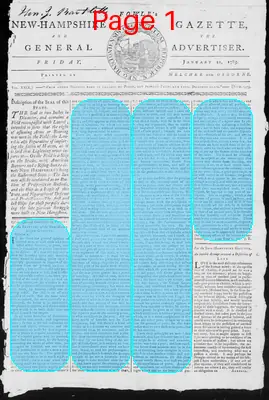
Fowle's New Hampshire Gazette And General Advertiser
Portsmouth, Rockingham County, New Hampshire
What is this article about?
An essay to the New-Hampshire Gazette arguing that poetry has a supernatural, divine essence, particularly in its creative power, which true poets like Homer, Spenser, Shakespeare, and Milton possess innately, distinguishing them from mere versifiers. It emphasizes that genius cannot be taught and elevates Milton above ancients.
Clipping
OCR Quality
Full Text
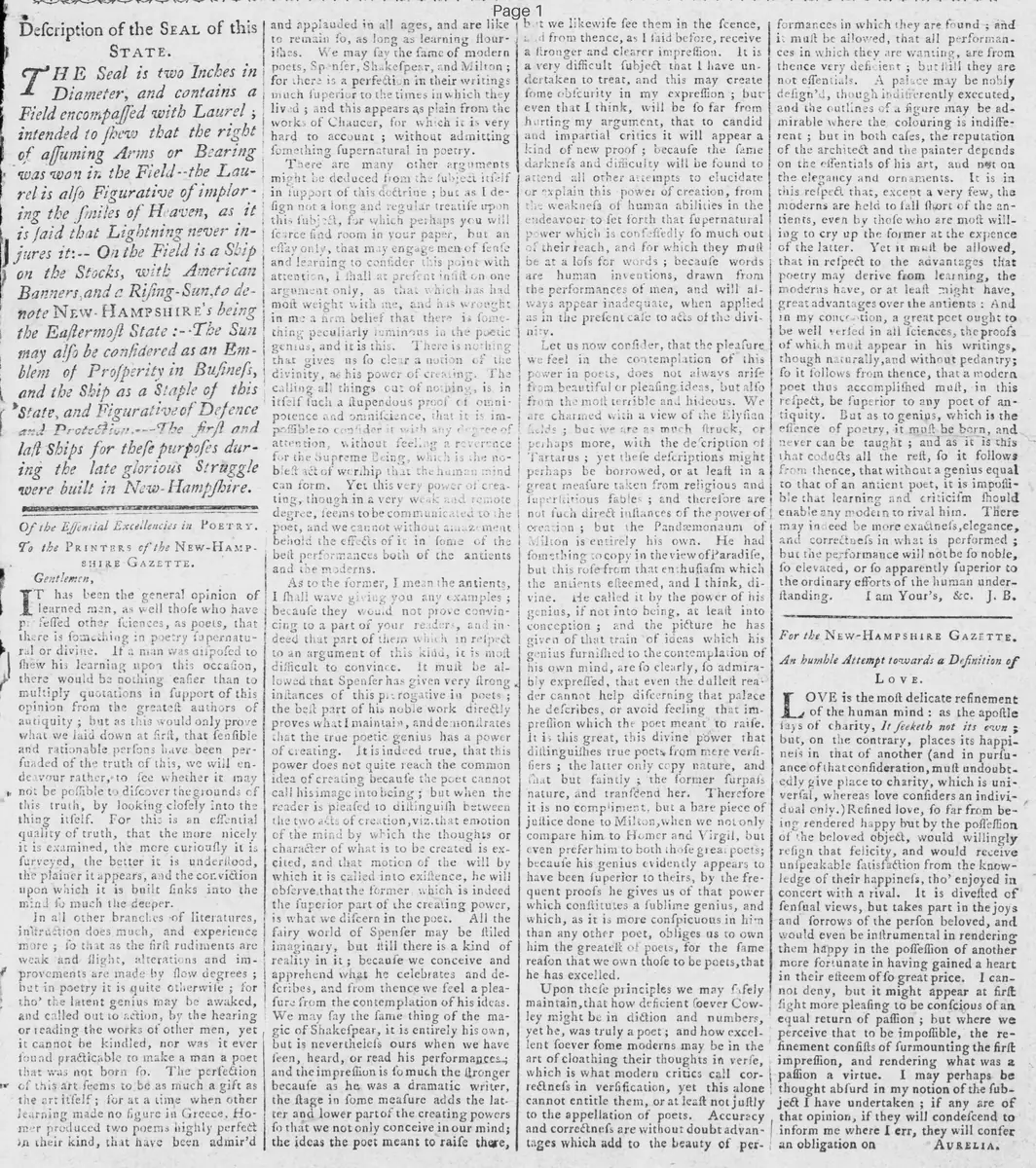
To the Printers of the New-HAMPSHIRE GAZETTE.
Gentlemen,
It has been the general opinion of learned men, as well those who have professed other sciences, as poets, that there is something in poetry supernatural or divine. If a man was disposed to shew his learning upon this occasion, there would be nothing easier than to multiply quotations in support of this opinion from the greatest authors of antiquity ; but as this would only prove what we laid down at first, that sensible and reasonable persons have been persuaded of the truth of this, we will endeavour rather, to see whether it may not be possible to discover the grounds of this truth, by looking closely into the thing itself. For this is an essential quality of truth, that the more nicely it is examined, the more curiously it is surveyed, the better it is understood, the plainer it appears, and the conviction upon which it is built sinks into the mind so much the deeper.
In all other branches of literatures, instruction does much, and experience more ; so that as the first rudiments are weak and slight, alterations and improvements are made by slow degrees : but in poetry it is quite otherwise : for tho' the latent genius may be awaked, and called out to action, by the hearing or reading the works of other men, yet it cannot be kindled, nor was it ever found practicable to make a man a poet that was not born so. The perfection of this art seems to be as much a gift as the art itself; for at a time when other learning made no figure in Greece. Homer produced two poems highly perfect and applauded in all ages, and are like to remain so, as long as learning flourishes. We may say the same of modern poets, Spenser, Shakespeare, and Milton ; for there is a perfection in their writings much superior to the times in which they lived ; and this appears as plain from the works of Chaucer, for which it is very hard to account ; without admitting something supernatural in poetry.
There are many other arguments might be deduced from the subject itself in support of this doctrine ; but as I design not a long and regular treatise upon this subject, for which perhaps you will scarce find room in your paper, but an essay only, that may engage men of sense and learning to consider this point with attention. I shall at present insist on one argument only, as that which has had most weight with me, and has wrought in me a firm belief that there is something peculiarly luminous in the poetic genius, and it is this. There is nothing that gives us so clear a notion of the divinity, as his power of creating. The calling all things out of nothing, is in itself such a stupendous proof of omnipotence and omniscience, that it is impossible to consider it with any degree of attention, without feeling a reverence for the Supreme Being, which is the noblest act of worship that the human mind can form. Yet this very power of creating, though in a very weak and remote degree, seems to be communicated to the poet, and we cannot without amazement behold the effects of it in some of the best performances both of the ancients and the moderns.
As to the former, I mean the ancients, I shall wave giving you any examples ; because they would not prove convincing to a part of your readers, and indeed that part of them which in respect to an argument of this kind, it is most difficult to convince. It must be allowed that Spenser has given very strong instances of this prerogative in poets ; the best part of his noble work directly proves what I maintain, and demonstrates that the true poetic genius has a power of creating. It is indeed true, that this power does not quite reach the common idea of creating because the poet cannot call his image into being ; but when the reader is pleased to distinguish between the two acts of creation, viz. that emotion of the mind by which the thoughts or character of what is to be created is excited, and that motion of the will by which it is called into existence. he will observe that the former which is indeed the superior part of the creating power, is what we discern in the poet. All the fairy world of Spenser may be styled imaginary. but still there is a kind of reality in it: because we conceive and apprehend what he celebrates and describes. and from thence we feel a pleasure from the contemplation of his ideas. We may say the same thing of the magic of Shakespeare, it is entirely his own, but is nevertheless ours when we have seen, heard, or read his performances; and the impression is so much the stronger because as he was a dramatic writer, the stage in some measure adds the latter and lower part of the creating powers so that we not only conceive in our mind; but we likewise see them in the scene, and from thence, as I said before, receive a stronger and clearer impression.
It is a very difficult subject that I have undertaken to treat. and this may create some obscurity in my expression ; but even that I think. will be so far from hurting my argument, that to candid and impartial critics it will appear a kind of new proof : because the same darkness and difficulty will be found to attend all other attempts to elucidate or explain this power of creation, from the weakness of human abilities in the endeavour to set forth that supernatural power which is confessedly so much out of their reach, and for which they must be at a loss for words : because words are human inventions, drawn from the performances of men, and will always appear inadequate, when applied as in the present case to acts of the divinity.
Let us now consider. that the pleasure we feel in the contemplation of this power in poets, does not always arise from beautiful or pleasing ideas. but also from the most terrible and hideous. We are charmed with a view of the Elysian Fields ; but we are as much struck. or perhaps more, with the description of Tartarus ; yet these descriptions might perhaps be borrowed. or at least in a great measure taken from religious and superstitious fables ; and therefore are not such direct instances of the power of creation : but the Pandemonium of Milton is entirely his own. He had something to copy in the view of Paradise, but this rose from that enthusiasm which the ancients esteemed, and I think. divine. re called it by the power of his genius, if not into being, at least into conception : and the picture he has given of that train of ideas which his genius furnished to the contemplation of his own mind, are so clearly, so admirably expressed, that even the dullest reader cannot help discerning that palace he describes, or avoid feeling that impression which the poet meant to raise.
It is this great, this divine power that distinguishes true poets from mere versifiers : the latter only copy nature, and that but faintly : the former surpass nature, and transcend her. Therefore it is no compliment. but a bare piece of justice done to Milton, when we not only compare him to Homer and Virgil, but even prefer him to both those great poets; because his genius evidently appears to have been superior to theirs, by the frequent proofs he gives us of that power which constitutes a sublime genius, and which, as it is more conspicuous in him than any other poet, obliges us to own him the greatest of poets, for the same reason that we own those to be poets, that he has excelled.
Upon these principles we may safely maintain, that how deficient soever Cowley might be in diction and numbers, yet he. was truly a poet; and how excellent soever some moderns may be in the art of cloathing their thoughts in verse, which is what modern critics call correctness in versification, yet this alone cannot entitle them, or at least not justly to the appellation of poets. Accuracy and correctness are without doubt advantages which add to the beauty of performances in which they are found : and it must be allowed, that all performances in which they are wanting, are from thence very deficient ; but still they are not essentials. A palace may be nobly designed, though indifferently executed, and the outlines of a figure may be admirable where the colouring is indifferent ; but in both cases. the reputation of the architect and the painter depends on the essentials of his art, and not on the elegance and ornaments. It is in this respect that, except a very few, the moderns are held to fall short of the ancients, even by those who are most willing to cry up the former at the expense of the latter. Yet it must be allowed, that in respect to the advantages that poetry may derive from learning, the moderns have, or at least might have, great advantages over the ancients : And in my conception, a great poet ought to be well versed in all sciences, the proofs of which must appear in his writings, though naturally, and without pedantry; so it follows from thence. that a modern poet thus accomplished must, in this respect, be superior to any poet of antiquity. But as to genius, which is the essence of poetry. it must be born. and never can be taught ; and as it is this that conducts all the rest, so it follows from thence, that without a genius equal to that of an ancient poet, it is impossible that learning and criticism should enable any modern to rival him. There may indeed be more exactness, elegance, and correctness in what is performed ; but the performance will not be so noble, so elevated, or so apparently superior to the ordinary efforts of the human understanding.
I am Yours, &c. J. B.
What sub-type of article is it?
What themes does it cover?
What keywords are associated?
What entities or persons were involved?
Letter to Editor Details
Author
J. B.
Recipient
The Printers Of The New Hampshire Gazette
Main Argument
poetry possesses a supernatural, divine quality, especially the innate power of creation that true poets like homer, spenser, shakespeare, and milton exhibit, which cannot be taught and distinguishes them from versifiers; this elevates milton above ancient poets.
Notable Details