Thank you for visiting SNEWPapers!
Sign up free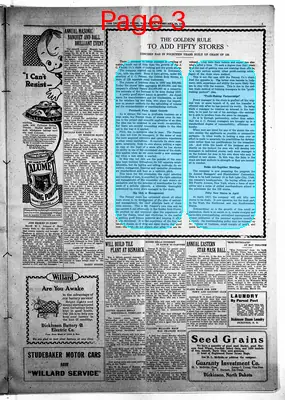
The Dickinson Press
Dickinson, Stark County, North Dakota
What is this article about?
The J.C. Penney Co. grew from one store in Kemmerer, Wyoming in 1902 with $29,000 sales to a chain of 125 Golden Rule Stores by 1917, projecting $12 million in sales. Success stems from co-operation, internal manager promotion to profit-sharing partners, centralized management, and standardized merchandising in Western US states.
Clipping
OCR Quality
Full Text
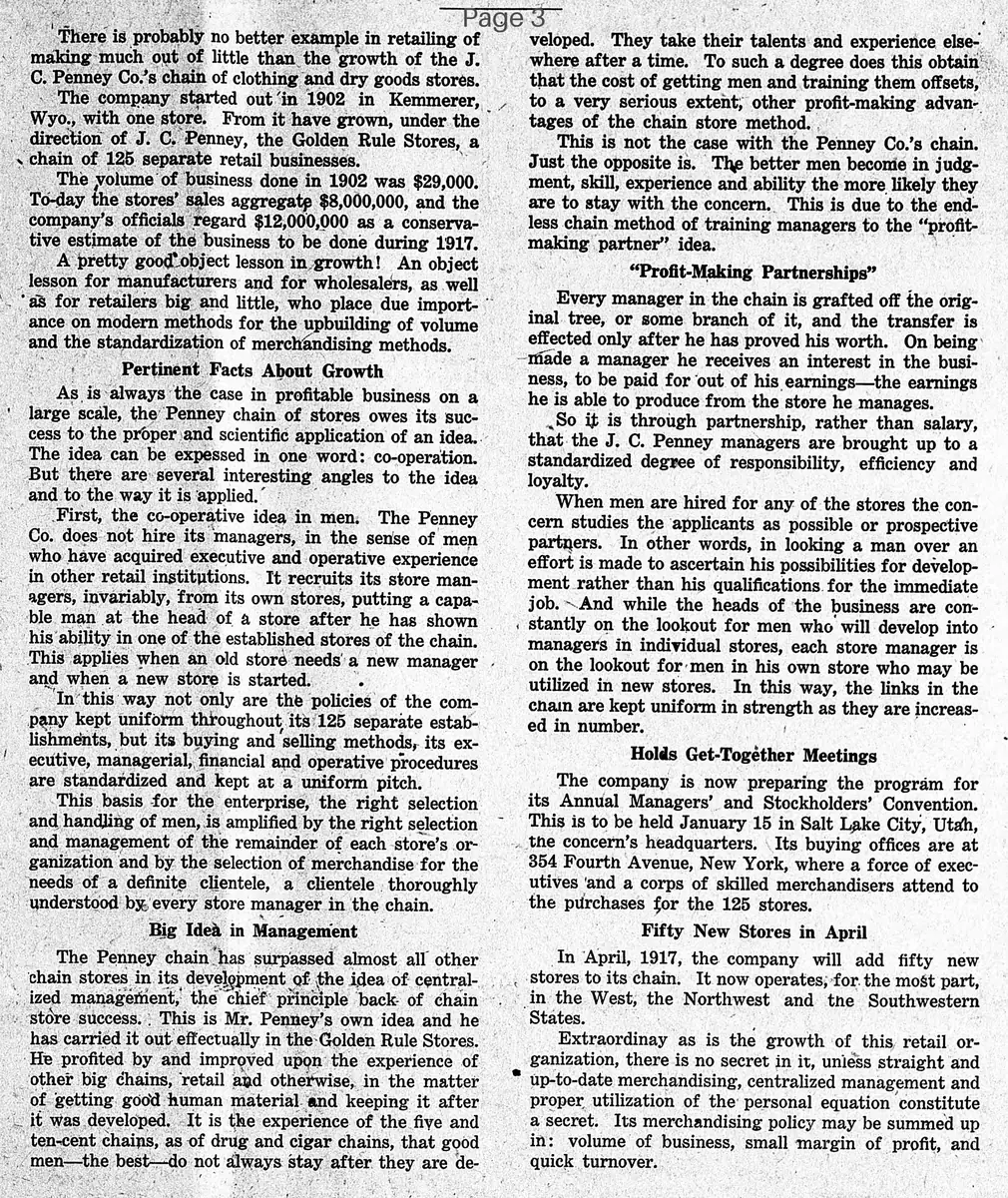
The company started out in 1902 in Kemmerer, Wyo., with one store. From it have grown, under the direction of J. C. Penney, the Golden Rule Stores, a chain of 125 separate retail businesses.
The volume of business done in 1902 was $29,000.
To-day the stores' sales aggregate $8,000,000, and the company's officials regard $12,000,000 as a conservative estimate of the business to be done during 1917.
A pretty good object lesson in growth! An object lesson for manufacturers and for wholesalers, as well as for retailers big and little, who place due importance on modern methods for the upbuilding of volume and the standardization of merchandising methods.
Pertinent Facts About Growth
As is always the case in profitable business on a large scale, the Penney chain of stores owes its success to the proper and scientific application of an idea.
The idea can be expressed in one word: co-operation.
But there are several interesting angles to the idea and to the way it is applied.
First, the co-operative idea in men. The Penney Co. does not hire its managers, in the sense of men who have acquired executive and operative experience in other retail institutions. It recruits its store managers, invariably, from its own stores, putting a capable man at the head of a store after he has shown his ability in one of the established stores of the chain.
This applies when an old store needs a new manager and when a new store is started.
In this way not only are the policies of the company kept uniform throughout its 125 separate establishments, but its buying and selling methods, its executive, managerial, financial and operative procedures are standardized and kept at a uniform pitch.
This basis for the enterprise, the right selection and handling of men, is amplified by the right selection and management of the remainder of each store's organization and by the selection of merchandise for the needs of a definite clientele, a clientele thoroughly understood by every store manager in the chain.
Big Idea in Management
The Penney chain has surpassed almost all other chain stores in its development of the idea of centralized management, the chief principle back of chain store success. This is Mr. Penney's own idea and he has carried it out effectually in the Golden Rule Stores.
He profited by and improved upon the experience of other big chains, retail and otherwise, in the matter of getting good human material and keeping it after it was developed. It is the experience of the five and ten-cent chains, as of drug and cigar chains, that good men—the best—do not always stay after they are developed. They take their talents and experience elsewhere after a time. To such a degree does this obtain that the cost of getting men and training them offsets, to a very serious extent, other profit-making advantages of the chain store method.
This is not the case with the Penney Co.'s chain.
Just the opposite is. The better men become in judgment, skill, experience and ability the more likely they are to stay with the concern. This is due to the endless chain method of training managers to the "profit-making partner" idea.
"Profit-Making Partnerships"
Every manager in the chain is grafted off the original tree, or some branch of it, and the transfer is effected only after he has proved his worth. On being made a manager he receives an interest in the business, to be paid for out of his earnings—the earnings he is able to produce from the store he manages.
So it is through partnership, rather than salary, that the J. C. Penney managers are brought up to a standardized degree of responsibility, efficiency and loyalty.
When men are hired for any of the stores the concern studies the applicants as possible or prospective partners. In other words, in looking a man over an effort is made to ascertain his possibilities for development rather than his qualifications for the immediate job. And while the heads of the business are constantly on the lookout for men who will develop into managers in individual stores, each store manager is on the lookout for men in his own store who may be utilized in new stores. In this way, the links in the chain are kept uniform in strength as they are increased in number.
Holds Get-Together Meetings
The company is now preparing the program for its Annual Managers' and Stockholders' Convention.
This is to be held January 15 in Salt Lake City, Utah, the concern's headquarters. Its buying offices are at 354 Fourth Avenue, New York, where a force of executives and a corps of skilled merchandisers attend to the purchases for the 125 stores.
Fifty New Stores in April
In April, 1917, the company will add fifty new stores to its chain. It now operates, for the most part, in the West, the Northwest and the Southwestern States.
Extraordinary as is the growth of this retail organization, there is no secret in it, unless straight and up-to-date merchandising, centralized management and proper utilization of the personal equation constitute a secret. Its merchandising policy may be summed up in: volume of business, small margin of profit, and quick turnover.
What sub-type of article is it?
What themes does it cover?
What keywords are associated?
What entities or persons were involved?
Where did it happen?
Story Details
Key Persons
Location
Kemmerer, Wyo.; West, Northwest, And Southwestern States; Salt Lake City, Utah; New York
Event Date
1902 To 1917
Story Details
J.C. Penney Co. expands from one store in 1902 to 125 by 1917 through co-operation, internal promotions to profit-sharing managers, centralized management, and standardized merchandising emphasizing volume, low margins, and quick turnover.