Thank you for visiting SNEWPapers!
Sign up free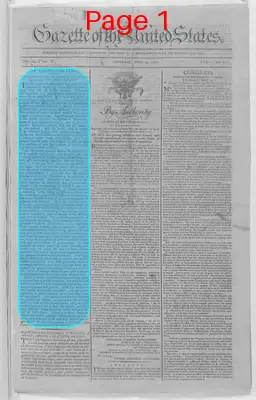
Editorial
June 19, 1790
Gazette Of The United States
New York, New York County, New York
What is this article about?
Editorial from The Tablet No. CXXIV argues that legislators should guide rather than follow public opinion, which is often indefinite and fluctuating. Emphasizes legislature's duty to represent diverse interests, equalize government burdens, and prioritize public welfare over individual prejudices.
Clipping
OCR Quality
98%
Excellent
Full Text
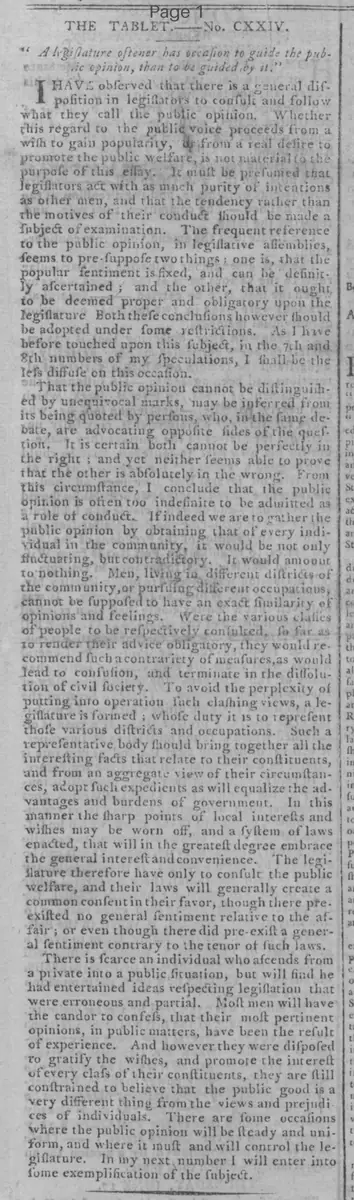
THE TABLET. -No. CXXIV.
"A Legislature oftener has occasion to guide the public opinion, than to be guided by it."
I have observed that there is a general disposition in legislators to consult and follow what they call the public opinion. Whether this regard to the public voice proceeds from a wish to gain popularity, or from a real desire to promote the public welfare, is not material to the purpose of this essay. It must be presumed that legislators act with as much purity of intentions as other men, and that the tendency rather than the motives of their conduct should be made a subject of examination. The frequent reference to the public opinion, in legislative assemblies, seems to presuppose two things; one is, that the popular sentiment is fixed, and can be definitely ascertained; and the other, that it ought to be deemed proper and obligatory upon the legislature. Both these conclusions however should be adopted under some restrictions. As I have before touched upon this subject, in the 7th and 8th numbers of my speculations, I shall be the less diffuse on this occasion.
That the public opinion cannot be distinguished by unequivocal marks, may be inferred from its being quoted by persons, who, in the same debate, are advocating opposite ideas of the question. It is certain both cannot be perfectly in the right; and yet neither seems able to prove that the other is absolutely in the wrong. From this circumstance, I conclude that the public opinion is often too indefinite to be admitted as a rule of conduct. If indeed we are to gather the public opinion by obtaining that of every individual in the community, it would be not only fluctuating, but contradictory. It would amount to nothing. Men, living in different districts of the community, or pursuing different occupations, cannot be supposed to have an exact similarity of opinions and feelings. Were the various classes of people to be respectively consulted, so far as to render their advice obligatory, they would recommend such a contrariety of measures, as would lead to confusion, and terminate in the dissolution of civil society. To avoid the perplexity of putting into operation such clashing views, a legislature is ordained; whose duty it is to represent those various districts and occupations. Such a representative body should bring together all the interesting facts that relate to their constituents, and from an aggregate view of their circumstances, adopt such expedients as will equalize the advantages and burdens of government. In this manner the sharp points of local interests and wishes may be worn off, and a system of laws enacted, that will in the greatest degree embrace the general interest and convenience. The legislature therefore have only to consult the public welfare, and their laws will generally create a common consent in their favor, though there previously existed no general sentiment relative to the affair; or even though there did previously exist a general sentiment contrary to the tenor of such laws.
There is scarce an individual who ascends from a private into a public situation, but will find he had entertained ideas respecting legislation that were erroneous and partial. Most men will have the candor to confess, that their most pertinent opinions, in public matters, have been the result of experience. And however they were disposed to gratify the wishes, and promote the interest of every class of their constituents, they are ill constrained to believe that the public good is a very different thing from the views and prejudices of individuals. There are some occasions where the public opinion will be steady and uniform, and where it must and will control the legislature. In my next number I will enter into some exemplification of the subject.
"A Legislature oftener has occasion to guide the public opinion, than to be guided by it."
I have observed that there is a general disposition in legislators to consult and follow what they call the public opinion. Whether this regard to the public voice proceeds from a wish to gain popularity, or from a real desire to promote the public welfare, is not material to the purpose of this essay. It must be presumed that legislators act with as much purity of intentions as other men, and that the tendency rather than the motives of their conduct should be made a subject of examination. The frequent reference to the public opinion, in legislative assemblies, seems to presuppose two things; one is, that the popular sentiment is fixed, and can be definitely ascertained; and the other, that it ought to be deemed proper and obligatory upon the legislature. Both these conclusions however should be adopted under some restrictions. As I have before touched upon this subject, in the 7th and 8th numbers of my speculations, I shall be the less diffuse on this occasion.
That the public opinion cannot be distinguished by unequivocal marks, may be inferred from its being quoted by persons, who, in the same debate, are advocating opposite ideas of the question. It is certain both cannot be perfectly in the right; and yet neither seems able to prove that the other is absolutely in the wrong. From this circumstance, I conclude that the public opinion is often too indefinite to be admitted as a rule of conduct. If indeed we are to gather the public opinion by obtaining that of every individual in the community, it would be not only fluctuating, but contradictory. It would amount to nothing. Men, living in different districts of the community, or pursuing different occupations, cannot be supposed to have an exact similarity of opinions and feelings. Were the various classes of people to be respectively consulted, so far as to render their advice obligatory, they would recommend such a contrariety of measures, as would lead to confusion, and terminate in the dissolution of civil society. To avoid the perplexity of putting into operation such clashing views, a legislature is ordained; whose duty it is to represent those various districts and occupations. Such a representative body should bring together all the interesting facts that relate to their constituents, and from an aggregate view of their circumstances, adopt such expedients as will equalize the advantages and burdens of government. In this manner the sharp points of local interests and wishes may be worn off, and a system of laws enacted, that will in the greatest degree embrace the general interest and convenience. The legislature therefore have only to consult the public welfare, and their laws will generally create a common consent in their favor, though there previously existed no general sentiment relative to the affair; or even though there did previously exist a general sentiment contrary to the tenor of such laws.
There is scarce an individual who ascends from a private into a public situation, but will find he had entertained ideas respecting legislation that were erroneous and partial. Most men will have the candor to confess, that their most pertinent opinions, in public matters, have been the result of experience. And however they were disposed to gratify the wishes, and promote the interest of every class of their constituents, they are ill constrained to believe that the public good is a very different thing from the views and prejudices of individuals. There are some occasions where the public opinion will be steady and uniform, and where it must and will control the legislature. In my next number I will enter into some exemplification of the subject.
What sub-type of article is it?
Constitutional
What keywords are associated?
Public Opinion
Legislature
Representation
Public Welfare
Government Structure
What entities or persons were involved?
Legislators
Public
Editorial Details
Primary Topic
Legislature Guiding Public Opinion Over Following It
Stance / Tone
Advocacy For Legislative Independence In Promoting Public Welfare
Key Figures
Legislators
Public
Key Arguments
Public Opinion Is Often Indefinite And Fluctuating, Unfit As A Rule For Conduct
Legislators Should Represent Diverse Districts And Occupations To Equalize Government Advantages And Burdens
Laws Focused On Public Welfare Create Consent, Even Against Prior Sentiments
Individual Views On Legislation Are Often Erroneous And Partial, Corrected By Experience
Public Opinion Controls Legislature Only When Steady And Uniform