Thank you for visiting SNEWPapers!
Sign up free
Virginia Argus
Richmond, Virginia
What is this article about?
On December 16, 1809, President James Madison transmitted to the US House of Representatives extracts from correspondence of Minister William Pinkney in London. These detail unofficial conversations with British Foreign Secretary George Canning in January 1809 on resolving disputes including the Orders in Council, Chesapeake affair, and US embargo, plus later letters clarifying instructions to David Erskine and negotiation points.
Merged-components note: This is a continuation of the President's message to Congress transmitting extracts from Mr. Pinkney's correspondence on foreign relations; labeled as domestic_news due to the congressional context, despite international content.
Clippings
1 of 2
OCR Quality
Full Text
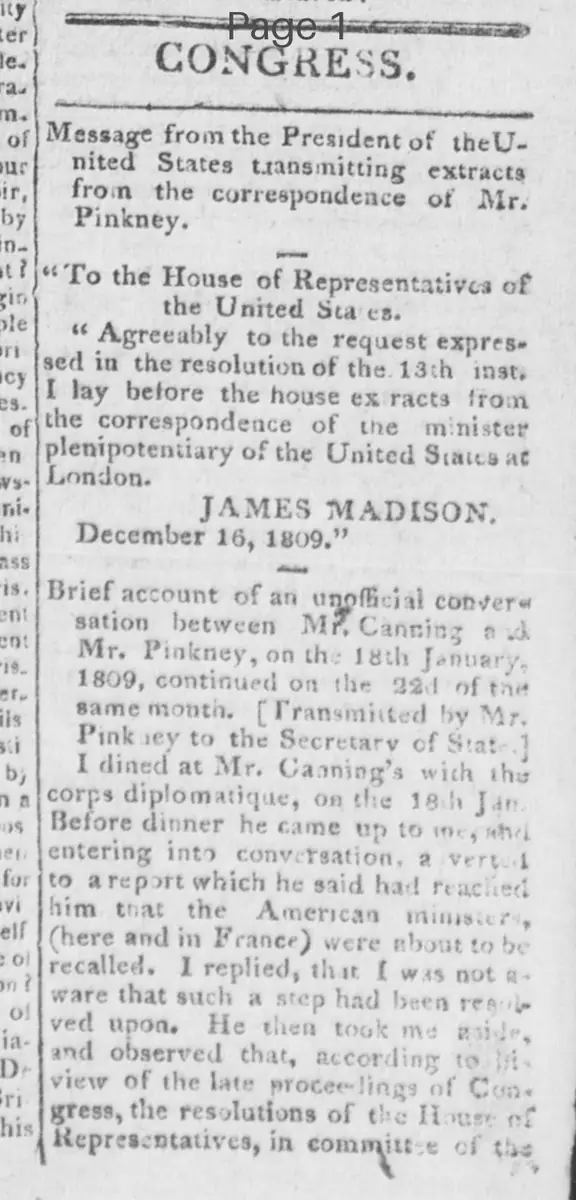
Message from the President of the United States transmitting extracts from the correspondence of Mr. Pinkney.
"To the House of Representatives of the United States.
"Agreeably to the request expressed in the resolution of the 13th inst. I lay before the house extracts from the correspondence of the minister plenipotentiary of the United States at London.
JAMES MADISON.
December 16, 1809."
Brief account of an unofficial conversation between Mr. Canning & Mr. Pinkney, on the 18th January, 1809, continued on the 22d of the same month. Transmitted by Mr. Pinkney to the Secretary of State
I dined at Mr. Canning's with the corps diplomatique, on the 18th Jan. Before dinner he came up to me, without entering into conversation, adverted to a report which he said had reached him that the American ministers (here and in France) were about to be recalled. I replied, that I was not aware that such a step had been resolved upon. He then took me aside, and observed that, according to his view of the late proceedings of Congress, the resolutions of the House of Representatives, in committee of the
whole, appeared to be calculated, if passed into a law, to remove the impediments to arrangement with the United States, on the subjects of the orders in council and the Chesapeake, by taking away the discrimination between Great Britain and France in the exclusion of the vessels of war from American ports. He added that it was another favorable circumstance that the non-importation system which seemed to be in contemplation, was to be applied equally to both parties, instead of affecting as heretofore Great Britain alone.
I proposed to Mr. Canning, that I should call on him in the course of a day or two for the purpose of a free communication upon what he had suggested. To this he readily assented; and it was settled that I should see him on the Sunday following (the 22d) at 12 o'clock, at his own house.
In the interview of the 22d, Mr. Canning's impressions appeared to be in all respects the same with those which he had mentioned on the 15th; and I said every thing which I thought consistent with candor and discretion to confirm him in his disposition to seek the re-establishment of good understanding with us, and especially to see in the expected act of Congress, (if it should pass) an opening for reconciliation.
It was of some importance to turn their attention here, without loss of time, to the manner of any proceeding that might be in their contemplation. It seemed that the resolutions of the House of Representatives, if enacted into a law, might render it proper, if not indispensable, that the affair of the Chesapeake should be settled at the same time with the business of the orders and embargo, & I understood this to be Mr. Canning's opinion and wish. It followed that the whole matter ought to be settled at Washington, and, as this was moreover desirable on various other grounds, I suggested that it would be well, in case a special mission did not meet their approbation, that the necessary powers should be sent to Mr. Erskine.
In the course of the conversation, Mr. Canning proposed several questions relative to our late proposals: the principal were the two following:
1. In case they should wish either through me or through Mr. Erskine, to meet us upon the basis of our late overture, in what way was the effectual operation of our embargo as to France, &c. after it should be taken off as to Great Britain, to be secured? It was evident, he said, that if we should do no more than refuse clearances for the ports of France, &c. or prohibit under penalties voyages to such ports, the effect which my letter of the 23d of August, and my published instructions, proposed to have in view, would not be produced; for that vessels although cleared for British ports, might when once out go to France instead of coming here; that this would in fact be so, whatever the penalties which the American laws might denounce against offenders could not, he imagined be doubted; and he therefore presumed that the government of the United States would not, after it had itself declared a commerce with France, &c. illegal, and its citizens who should engage in it, delinquents, and after having given to Great Britain by compact an interest in the strict observation of the prohibition, complain if the naval force of this country should assist in preventing such a commerce.
2. He asked whether there would be any objection to making the repeal of the British orders and the American embargo cotemporaneous? He seemed to consider this as indispensable. Nothing could be less admissible, he said, than that Great Britain, after recinding her orders, should for any time, however short, be left subject to the embargo in common with France, whose decrees were subsisting, with a view to an experiment upon France, or with any other view. The United States could not upon their own principles apply the embargo to this country one moment after its orders were removed, or decline after that event to apply it exclusively to France, and the powers connected with her in system.
I took occasion towards the close of our conversation to mention the recent appointment of admiral Berkeley to the Lisbon station. Mr. Canning said, that whatever might be their inclination to consult the feelings of the American government on that subject it was impossible for the admiralty to resist the claim of that officer to be employed (no other objection existing against him) after such a lapse of time since his return from Halifax, without bringing him to a court martial. The gauge of the navy was in this respect different from that of the army. But I understood Mr. Canning to say that he might still be brought to a court martial; although I did not understand him to say that this would be case. He said that admiral Berkeley, in what he had done, had acted wholly without authority. I did not propose to enter into any discussion upon the subject, and therefore contented myself with speaking of the appointment as unfortunate.
In both of these conversations, Mr. Canning's language and manner were in the highest degree conciliatory.
Extract of a letter from William Pinkney, Esq. minister plenipotentiary of the United States in London, to the Secretary of State, dated London, May 28, 1809.
"In the interview which took place [on May 25] Mr Canning said, that the British minister had acted in his late negociation and engagements with you not only without authority, but in direct opposition to the most precise instructions; that the instructions actually given to him had been founded on his own letters received here in January, in which were set forth the particulars of several conversations that had passed between him and Mr. Madison, Mr. Gallatin and yourself, but especially the two last; that it appeared from these conversations, that, in the opinion of the persons with whom they were held, the government of the United States would be willing that Great Britain should consider the measures then contemplated by Congress, relative to non-intercourse, and the indiscriminate exclusion of belligerent vessels from our waters, as presenting an opening for the renewal of amicable discussions with this country; that it would be disposed, in the case of the Chesapeake, to receive as sufficient reparation, in addition to the prompt disavowal and recall of Ad. Berkeley, the restoration of the seamen forcibly taken out of that vessel; that, on the subject of the orders in council, it would have no objection in case they were revoked as regarded the United States to repeal the embargo and non-intercourse laws as to Great Britain, and to continue them as to France and Holland and such other countries as should have in force maritime edicts similar to those of France, so long as those edicts remained: that it would allow it to be understood that the British cruizers might capture American vessels attempting to violate the embargo and non-intercourse laws so modified; that it would even agree to abandon during the present war, all trade with enemies' colonies from which we were excluded in peace; that it was prepared to regulate by treaty, the commercial relations of the two countries, upon the basis of the most favored nation, or upon that of reciprocal equality; and, in a word, that it was extremely desirous of re-establishing the most perfect good understanding and the most friendly connection with Great Britain.
Mr. Canning proceeded to inform me that in consequence of these representations, some parts of which he said I had myself confirmed in two conversations in January, he had framed and transmitted to Mr. Erskine, two sets of instructions, dated the 23d of that month, but not forwarded till some time afterwards, the first of which related to the business of the Chesapeake, and the second to the orders in council, and the proposed commercial arrangements. These instructions together with the passages in Mr. Erskine's letter, written I believe in December last, which contained the above mentioned representations and some other details which I ought not to repeat, Mr. Canning read to me.
Although Mr. Canning made me acquainted with Mr. Erskine's instructions, he did not in any degree apprise me of the explanations, transmitted by that minister, of the grounds and motives of his proceedings; and I could not be sure, from any thing which Mr. Canning had stated to me, that I had been made to understand the exact nature and character of the transaction. I believed, therefore, that it behoved me to be particularly careful how I received what Mr. Canning thought fit to disclose to me. In looking back upon the past I discovered no inducement to a less cautious course. I remembered that Mr. Canning had not told me in our conversations in January [one of which occurred the day before the date of his letter to Mr. Erskine] that he intended to confer on him such powers as he must then have been in the act of preparing, or indeed any powers at all. That in our conferences in April, after the arrival of the Pacific, the same reserve was practised. That in the first of those conferences Mr. Canning admitted only (and that too upon being pressed by me) that in the business of the Chesapeake he had written to Mr. Erskine. in confidence with what he understood to be my wish, that the settlement of that affair should be transferred to Washington; that even then the time when he had done so was not mentioned; and that as to the orders in council, I was suffered to suppose that negociation in America had not been authorised. It occurred to me, moreover, that, as it had already been decided that Mr. Erskine was to be disavowed, and, as that decision had been made public through the board of trade, I could not hope to prevent that disavowal, and that with my imperfect knowledge of facts, it might be worse than useless by labored discussion to attempt it.
"With these impressions I could do little more than manifest my concern that conciliatory arrangements between the American secretary of state and his majesty's accredited minister at Washington, acting in consequence and professing to act in pursuance of orders from his court, were not likely to have that effect which was naturally to be expected from them. I undertook however to declare with confidence that the American government had met Mr. Erskine's proposals in a just and friendly spirit, and with a sincere desire that, while its own honor and essential interests were fairly consulted and maintained, a liberal respect should be shewn for those of Great Britain.
Extract of a letter from Mr. Pinkney to the Secretary of State, dated London, June 6, 1809.
Mr. Canning tells me that the conversations detailed in Mr. Erskine's letters did not, as I had supposed, suggest that the government of the United States would allow it to be understood that British cruizers might stop American vessels attempting to violate the embargo and non-intercourse, continuing as to France, &c. after they should be withdrawn as to Great Britain. They suggested that the United States would side with the power revoking its edicts against the power persevering. This Mr. Canning says he considered (although he did not so insist upon it in the recapitulation contained in his instructions to Mr. Erskine,) as comprehending what I thought he had represented the actual suggestion to be, and what he supposed I had said to him in an informal conversation, at his house in Bruton street, on the 22nd of January, in an answer to one of his inquiries.
It will, I am sure, occur to you, as the fact is, that the little which I may have thrown out upon that occasion did not look to the admission of Mr. Canning's object into any stipulation between the two countries, and that I viewed it only as a consequence that might, and would, if France persisted in her unjust decrees, grow out of arrangements similar to those offered by us in August last.
Having no longer any authority (as Mr. Canning knew) to speak officially upon that or any other point connected with the orders in council, and being desirous that this government should propose negociation at Washington, as well concerning the orders as the affair of the Chesapeake, I avoided as much as possible explanations upon details which would be best managed at home by the department of state, and endeavoured to speak upon what Mr. Canning proposed to me, in such a manner as that without justifying unsuitable expectations on his part, or forgetting what was due to the honor of my own government, I might contribute to produce an effort here towards friendly adjustment.
Extract of a letter from Mr. Pinkney to Mr. Smith, dated London, June 9, 1809.
"Mr. Erskine's instructions concerning the orders in council having been laid before the House of Commons are now printed. You will find them in the newspaper enclosed.
"It is not improbable that when Mr. Canning read these instructions to me I inferred from the manner in which the three points stated in the 5th, 6th and 7th paragraphs, are introduced & connected, that they were all considered as suggested by Mr. Erskine's "report of his conversations with Mr. Madison, Mr. Gallatin and Mr. Smith?" whether I was led by any other cause into the mistake of supposing that the third (as well as the first and second) was so suggested, I am not sure; and it is not very material.
"Mr Canning's misconception of some informal observations from me in January last, has been in part mentioned in my letter of the 6th instant. But the published instructions shew what I had not collected from hearing them read, that he understood me to have stated "that the American government was itself aware that without an enforcement, by the naval power of Great Britain, of the regulations of America with respect to France, those regulations must be altogether nugatory." It cannot be necessary to inform you that in this, as in the other particulars alluded to in my last letter, I have been misapprehended.
"I ought to mention that the strong and direct charge against the American government, of "manifest partiality" to France, introduced, without any qualification or management of expression, into a paper which Mr. Erskine was authorised to communicate in extenso to you, did not strike me when that paper was read to me by Mr. Canning.
Extract of a letter from Mr. Pinkney to the Secretary of State, dated June 23, 1809.
"I had an interview yesterday with Mr. Canning.
"In conversing upon the first of the conditions, upon the obtaining of which Mr. Erskine was to promise the repeal of the British orders in council and a special mission, I collected from what was said by Mr. Canning, that the exemption of Holland from the effect of our embargo and non-intercourse would not have been much objected to by the British government, if the government of the U. S had been willing to concede the 1st condition, subject to that exemption. Mr. Canning observed that the expedient of an actual blockade of Holland had occurred to them as being capable of meeting that exemption; but that Mr. Erskine had obtained no pledge, express or implied, or in any form, that we would enforce our non intercourse system against France and her dependencies; that our actual system would, if not re-enacted or continued as to France, terminate with the present session of Congress: that for aught that appeared to the contrary in your correspondence with Mr. Erskine or in the President's proclamation, the embargo and non intercourse laws might be suffered without any breach of faith to expire, or might even be repealed immediately, notwithstanding the perseverance of France in her Berlin and other edicts: and that Mr. Erskine had in truth secured nothing more, as the consideration of the recall of the orders in council, than the renewal of American intercourse with G. Britain.
Upon the second of the conditions mentioned in Mr. Erskine's instructions I made several remarks. I stated that it had no necessary connection with the principal subject; that it had lost its importance to Great Britain by the reduction of almost all the colonies of her enemies; that Batavia was understood not to be affected by it; that it could not apply to Guadaloupe (the only other unconquered colony) since it was admitted that we were not excluded from a trade with Guadaloupe in peace; that I did not know what the government of the United States would upon sufficient inducements, consent to do upon this point; but it could scarcely be expected to give the implied sanction, which this condition called upon it to give, to the rule of the war of 1756, without any equivalent or reciprocal stipulation whatsoever. Mr. Canning admitted that the second condition had no necessary connection with the orders in council, and he intimated that they would have been content to leave the subject of it to future discussion and arrangement. He added that this condition was inserted in Mr. Erskine's instructions, because it had appeared from his own report of conversations with official persons at Washington that there would be no difficulty in agreeing to it.
Upon the third condition I said a very few words. I re-stated what I had thrown out upon the matter of it in an informal conversation in January, and expressed my regret that it should have been misapprehended. Mr. Canning immediately said that he was himself of opinion that the idea upon which that condition turns could not well find its way into a stipulation; that he had nevertheless believed it proper to propose the condition to the United States; that he should have been satisfied with the rejection of it; and that the consequence would have been that they should have intercepted the commerce to which it referred, if any such commerce should be attempted."
What sub-type of article is it?
What keywords are associated?
What entities or persons were involved?
Where did it happen?
Domestic News Details
Primary Location
United States Congress
Event Date
December 16, 1809
Key Persons
Outcome
diplomatic discussions aimed at reconciliation on orders in council, chesapeake affair, and embargo; erskine disavowed; no final resolution detailed.
Event Details
President Madison transmits extracts of Pinkney's correspondence detailing conversations with Canning on US congressional resolutions, potential negotiations via Erskine, conditions for repealing orders and embargo, Chesapeake reparations, and clarifications on instructions and misconceptions in subsequent letters from May to June 1809.