Thank you for visiting SNEWPapers!
Sign up free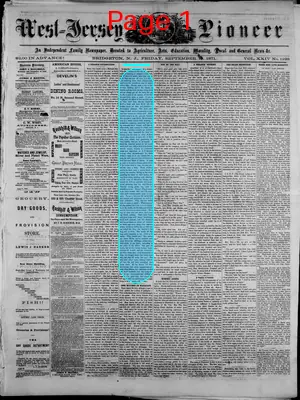
Story
September 15, 1871
West Jersey Pioneer
Bridgeton, Cumberland County, New Jersey
What is this article about?
Satirical sketch of a sewing woman's grueling life in New York, earning 90 cents a day for long hours, struggling with poverty, illness, and child-rearing as a widow, critiquing exploitative employers and societal neglect.
Clipping

OCR Quality
95%
Excellent
Full Text
BEING A SEWING WOMAN.
It must be a nice thing to be a woman.
Why there are women in this city who get ten
cents for making an unbasted linen coat,
and if they are smart, with long experience,
they can turn off nine in a day-
thus receiving from their philanthropic
employers the munificent sum of ninety
cents a day. Ninety cents a day is better
than nothing, and if the woman is
healthy and can work six days every week
and can always get all the work she can
do, she is sure of an income of five dollars
and forty cents a week. If she is
single and can afford to live on little better
than swill food, she can board for
$3.50 a week and have $1.90 left for
clothes, shoes, car fare, and pleasure. -
Particularly pleasure. But work can't
always be had, nor is it reasonable to suppose
that women are always well. Occasionally
snow is on the ground; now and
then excessive heat blinds the strongest;
once in a while clothes need washing. -
Sometimes a piercing headache lays one
up; now and then a violent cold lays another
down; and, strange to relate, some
of these creatures actually get married,
and when their husbands die they are
widows, just the same as other women;
and if they chance to have two or three
little ones, which they generally do,
then, indeed, they are to be envied. I
think the happiest person in the round
world must be a widow with three babies,
without money, lodging in a tenement
house, and dependent on A. T. Stewart
or some other philanthropist for three
dollars a week, or at the outside five, to
keep the wolf, not only from the door, but
from her very heart of hearts. It must
be jolly to be such a woman, particularly
if the eldest child is four, the next two,
and the baby a baby. These children
you know, have such a pretty knack of
getting the measles, falling on the stove.
upsetting hot water on their bodies, falling
down stairs, catching cold, diarrhoea
and all sorts of ridiculous things; and,
beyond all, with an aptitude that is positively
alarming, they cry with hunger,
literally crying, great, big, cries for
something to eat. Merry! Why it seems
to me that a woman who can't be merry
under such circumstances must be a lunatic.
To see a two-year old child, thin
with hunger and exhausted by heat is a
great stimulant. Why, any one would
work for such a child! What's easier?
All the mother has to do is to tie the baby
in the cradle, tie the sick one to a cot
and tie the four-year-old to a chair. They
may cry their eyes out while she's gone
but that's nothing. Their little heads
may grow dizzy with weary wonderings
about their mamma, and the thousand
and one accidents to which all children
are liable may come along--but this the
mother knows as well as we; so after she
has locked the door, she hurries to the
shop and to work. She works all day
long, never stopping to eat, drink or be
merry. Why should she? She makes
one dozen shirts, and is credited with
either five or ten shillings--either sixty-
three cents, or one dollar, according to
the price of the shirts. She gets no
money, but at six o'clock hurries home.
Perhaps all is well, and the three hungry
little chaps have cried themselves to
sleep; but hungry chicks don't sleep very
well, and they all wake but one. The
baby died about noon, having cried itself
into fits and then struggled into
gloom alone. On the whole, I'll drop
this curtain; but while imagination pictures
what follows, the reflection reveals
that such incidents are the every-day
life of our overworked and underpaid
masses. I'm quite sure that everybody
will agree with me that it must be a high
thing to be a woman. -N. Y. Star.
It must be a nice thing to be a woman.
Why there are women in this city who get ten
cents for making an unbasted linen coat,
and if they are smart, with long experience,
they can turn off nine in a day-
thus receiving from their philanthropic
employers the munificent sum of ninety
cents a day. Ninety cents a day is better
than nothing, and if the woman is
healthy and can work six days every week
and can always get all the work she can
do, she is sure of an income of five dollars
and forty cents a week. If she is
single and can afford to live on little better
than swill food, she can board for
$3.50 a week and have $1.90 left for
clothes, shoes, car fare, and pleasure. -
Particularly pleasure. But work can't
always be had, nor is it reasonable to suppose
that women are always well. Occasionally
snow is on the ground; now and
then excessive heat blinds the strongest;
once in a while clothes need washing. -
Sometimes a piercing headache lays one
up; now and then a violent cold lays another
down; and, strange to relate, some
of these creatures actually get married,
and when their husbands die they are
widows, just the same as other women;
and if they chance to have two or three
little ones, which they generally do,
then, indeed, they are to be envied. I
think the happiest person in the round
world must be a widow with three babies,
without money, lodging in a tenement
house, and dependent on A. T. Stewart
or some other philanthropist for three
dollars a week, or at the outside five, to
keep the wolf, not only from the door, but
from her very heart of hearts. It must
be jolly to be such a woman, particularly
if the eldest child is four, the next two,
and the baby a baby. These children
you know, have such a pretty knack of
getting the measles, falling on the stove.
upsetting hot water on their bodies, falling
down stairs, catching cold, diarrhoea
and all sorts of ridiculous things; and,
beyond all, with an aptitude that is positively
alarming, they cry with hunger,
literally crying, great, big, cries for
something to eat. Merry! Why it seems
to me that a woman who can't be merry
under such circumstances must be a lunatic.
To see a two-year old child, thin
with hunger and exhausted by heat is a
great stimulant. Why, any one would
work for such a child! What's easier?
All the mother has to do is to tie the baby
in the cradle, tie the sick one to a cot
and tie the four-year-old to a chair. They
may cry their eyes out while she's gone
but that's nothing. Their little heads
may grow dizzy with weary wonderings
about their mamma, and the thousand
and one accidents to which all children
are liable may come along--but this the
mother knows as well as we; so after she
has locked the door, she hurries to the
shop and to work. She works all day
long, never stopping to eat, drink or be
merry. Why should she? She makes
one dozen shirts, and is credited with
either five or ten shillings--either sixty-
three cents, or one dollar, according to
the price of the shirts. She gets no
money, but at six o'clock hurries home.
Perhaps all is well, and the three hungry
little chaps have cried themselves to
sleep; but hungry chicks don't sleep very
well, and they all wake but one. The
baby died about noon, having cried itself
into fits and then struggled into
gloom alone. On the whole, I'll drop
this curtain; but while imagination pictures
what follows, the reflection reveals
that such incidents are the every-day
life of our overworked and underpaid
masses. I'm quite sure that everybody
will agree with me that it must be a high
thing to be a woman. -N. Y. Star.
What sub-type of article is it?
Biography
Tragedy
Family Drama
What themes does it cover?
Misfortune
Family
Social Manners
What keywords are associated?
Sewing Woman
Low Wages
Poverty
Widowhood
Child Hardship
Working Conditions
Exploitation
What entities or persons were involved?
Sewing Woman
Widow
Where did it happen?
This City
Story Details
Key Persons
Sewing Woman
Widow
Location
This City
Story Details
Satirical depiction of a sewing woman's low wages, exhausting labor, and desperate family struggles as a widow with young children, ending in tragedy with the baby's death amid poverty.