Thank you for visiting SNEWPapers!
Sign up free
Daily National Intelligencer
Washington, District Of Columbia
What is this article about?
Newspaper article on Major-General Henry Dearborn's Republican candidacy for Massachusetts governor amid controversy over his War of 1812 military record. Publishes letters from 1813-1815 with Presidents Madison and Monroe, and Secretary Armstrong, defending his removal from command and requesting a court of inquiry into his conduct.
Clipping
OCR Quality
Full Text
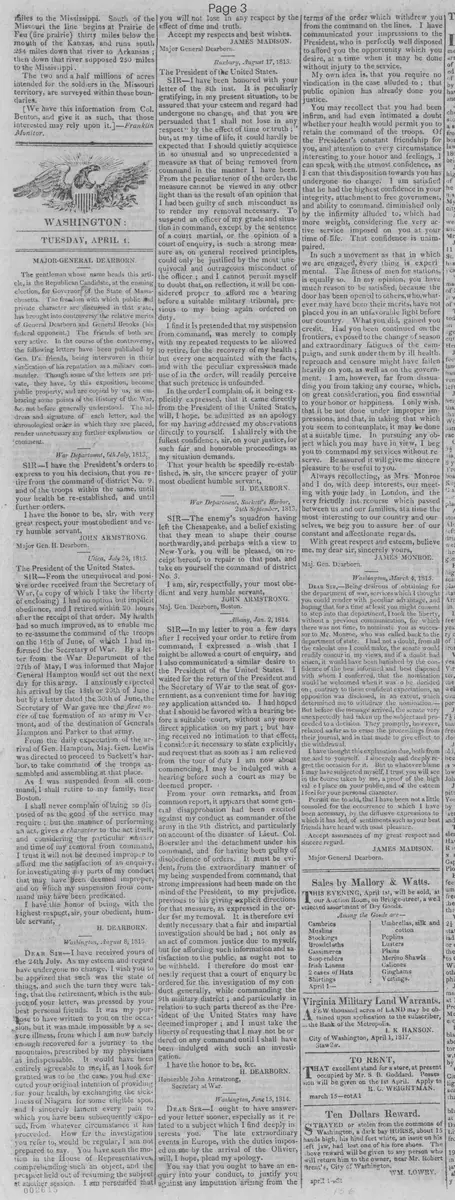
TUESDAY, APRIL 1.
MAJOR-GENERAL DEARBORN
The gentleman whose name heads this article, is the Republican Candidate, at the ensuing election, for Governor of the State of Massachusetts. The freedom with which public and private character are discussed in that state, has brought into controversy the relative merits of General Dearborn and General Brooks (his federal opponent.) The friends of both are very active. In the course of the controversy, the following letters have been published by Gen. D's. friends, being interwoven in their vindication of his reputation as a military commander. Though some of the letters are private, they have, by this exposition, become public property, and are copied by us, as embracing some points of the History of the War, &c. not before generally understood. The address and signature of each letter, and the chronological order in which they are placed, render unnecessary any further explanation or comment.
War Department, 6th July, 1813.
SIR—I have the President's orders to express to you his decision, that you retire from the command of district No. 9, and of the troops within the same, until your health be re-established, and until further orders.
I have the honor to be, sir, with very great respect, your most obedient and very humble servant,
JOHN ARMSTRONG.
Major Gen. H. Dearborn.
Utica, July 24, 1813.
The President of the United States.
SIR—From the unequivocal and positive order received from the Secretary of War, (a copy of which I take the liberty of enclosing) I had no option but implicit obedience, and I retired within 20 hours after the receipt of that order. My health had so much improved, as to enable me to re-assume the command of the troops on the 16th of June, of which I had informed the Secretary of War. By a letter from the War Department of the 27th of May, I was informed that Major General Hampton would set out the next day for this army. I anxiously expected his arrival by the 18th or 20th of June; but by a letter dated the 30th of June, the Secretary of War gave me the first notice of the formation of an army in Vermont, and of the destination of Generals Hampton and Parker to that army.
From the daily expectation of the arrival of Gen. Hampton, Maj. Gen. Lewis was directed to proceed to Sackett's Harbor, to take command of the troops assembled and assembling at that place.
As I was suspended from all command, I shall retire to my family, near Boston.
I shall never complain of being so disposed of as the good of the service may require; but the manner of performing an act, gives a character to the act itself, and considering the particular manner and time of my removal from command, I trust it will not be deemed improper to afford me the satisfaction of an enquiry, for investigating any parts of my conduct that may have been deemed improper, and on which my suspension from command may have been predicated.
I have the honor of being, with the highest respect, sir, your obedient, humble servant,
H. DEARBORN.
Washington, August 8, 1813.
DEAR SIR—I have received yours of the 24th July. As my esteem and regard have undergone no change, I wish you to be apprized that such was the state of things, and such the turn they were taking, that the retirement, which is the subject of your letter, was pressed by your best personal friends. It was my purpose to have written to you on the occasion, but it was made impossible by a severe illness, from which I am now barely enough recovered for a journey to the mountains, prescribed by my physicians as indispensable. It would have been entirely agreeable to me, if, as I took for granted was to be the case, you had executed your original intention of providing for your health, by exchanging the sickness of Niagara for some eligible spot, and I sincerely lament every pain to which you have been subsequently exposed, from whatever circumstance it has proceeded. How far the investigation you refer to, would be regular, I am not prepared to say. You have seen the motion in the House of Representatives, comprehending such an object, and the prospect held out of resuming the subject at another session. I am persuaded that you will not lose in any respect by the effect of time and truth.
Accept my respects and best wishes.
JAMES MADISON.
Major General Dearborn.
Roxbury, August 17, 1813.
The President of the United States.
SIR—I have been honored with your letter of the 8th inst. It is peculiarly gratifying, in my present situation, to be assured that your esteem and regard had undergone no change, and that you are persuaded that I shall not lose in any respect by the effect of time or truth; but, at my time of life, it could hardly be expected that I should quietly acquiesce in so unusual and so unprecedented a measure as that of being removed from command in the manner I have been.
From the peculiar tenor of the order, the measure cannot be viewed in any other light than as the result of an opinion that I had been guilty of such misconduct as to render my removal necessary. To suspend an officer of my grade and situation in command, except by the sentence of a court martial, or the opinion of a court of enquiry, is such a strong measure as, on general received principles, could only be justified by the most unequivocal and outrageous misconduct of the officer; and I cannot permit myself to doubt that, on reflection, it will be considered proper to afford me a hearing before a suitable military tribunal, previous to my being again ordered on duty.
I find it is pretended that my suspension from command, was merely to comply with my repeated requests to be allowed to retire, for the recovery of my health; but every one acquainted with the facts, and with the peculiar expressions made use of in the order, will readily perceive that such pretence is unfounded.
In the order I complain of, it being explicitly expressed, that it came directly from the President of the United States, will, I hope, be admitted as an apology for my having addressed my observations directly to yourself. I shall rely with the fullest confidence, sir, on your justice, for such fair and honorable proceedings as my situation demands.
That your health be speedily re-established, is, sir, the sincere prayer of your most obedient humble servant,
H. DEARBORN.
War Department, Sackett's Harbor, 24th September, 1813.
SIR—The enemy's squadron having left the Chesapeake, and a belief existing that they mean to shape their course northwardly, and perhaps with a view to New-York, you will be pleased, on receipt hereof, to repair to that post, and take on yourself the command of district No. 3.
I am, sir, respectfully, your most obedient and very humble servant,
JOHN ARMSTRONG.
Maj. Gen. Dearborn, Boston.
Albany, Jan. 2, 1814.
SIR—In my letter to you a few days after I received your order to retire from command, I expressed a wish that I might be allowed a court of enquiry, and I also communicated a similar desire to the President of the United States. I waited for the return of the President and the Secretary of War to the seat of government, as a convenient time for having my application attended to. I had hoped that I should be favored with a hearing before a suitable court, without any more direct application on my part; but having received no intimation to that effect, I consider it necessary to state explicitly, and request that as soon as I am relieved from the tour of duty I am now about commencing, I may be indulged with a hearing before such a court as may be deemed proper.
From your own remarks, and from common report, it appears that some general disapprobation had been excited against my conduct as commander of the army in the 9th district, and particularly on account of the disaster of Lieut. Col. Boerstler and the detachment under his command, and for having been guilty of disobedience of orders. It must be evident, from the extraordinary manner of my being suspended from command, that strong impressions had been made on the mind of the President, to my prejudice, previous to his giving explicit directions for that measure, as expressed in the order for my removal. It is therefore evidently necessary that a fair and impartial investigation should be had; not only as an act of common justice due to myself, but for affording such information and satisfaction to the public, as ought not to be withheld. I therefore do most earnestly request that a court of enquiry be ordered for the investigation of my conduct generally, while commanding the 9th military district; and particularly in relation to such parts thereof as the President of the United States may have deemed improper; and I must take the liberty of requesting that I may not be ordered on any command until I shall have been indulged with such an investigation.
I have the honor to be, &c.
H. DEARBORN.
Honorable John Armstrong, Secretary at War.
Washington, June 15, 1814.
Dear Sir—I ought to have answered your letter sooner, especially as it related to a subject which I find deeply interests you. The late extraordinary events in Europe, with the duties imposed on me by the arrival of the Olivier, will, I hope, plead my apology.
You say that you ought to have an enquiry into your conduct, to justify you against any imputation arising from the terms of the order which withdrew you from the command on the lines. I have communicated your impressions to the President, who is perfectly well disposed to afford you the opportunity which you desire, at a time when it may be done without injury to the service.
My own idea is, that you require no vindication in the case alluded to; that public opinion has already done you justice.
You may recollect that you had been infirm, and had even intimated a doubt whether your health would permit you to retain the command of the troops. Of the President's constant friendship for you, and attention to every circumstance interesting to your honor and feelings, I can speak with the utmost confidence, as I can that this disposition towards you has undergone no change. I am satisfied that he had the highest confidence in your integrity, attachment to free government, and ability to command, diminished only by the infirmity alluded to, which had more weight, considering the very active service imposed on you at your time of life. That confidence is unimpaired.
In such a movement as that in which we are engaged, every thing is experimental. The fitness of men for stations, is equally so. In my opinion, you have much reason to be satisfied, because the door has been opened to others, who, whatever may have been their merits, have not placed you in an unfavorable light before our country. What you did, gained you credit. Had you been continued on the frontiers, exposed to the change of season and extraordinary fatigues of the campaign, and sunk under them by ill health, reproach and censure might have fallen heavily on you, as well as on the government. I am, however, far from dissuading you from taking any course, which, on great consideration, you find essential to your honor or happiness. I only wish, that it be not done under improper impressions, and that, in taking that which you seem to contemplate, it may be done at a suitable time. In pursuing any object which you may have in view, I beg you to command my services without reserve. Be assured it will give me sincere pleasure to be useful to you.
Always recollecting, as Mrs. Monroe and I do, with deep interest, our meeting with your lady in London, and the very friendly intercourse which passed between us and our families, at a time the most interesting to our country and ourselves, we beg you to assure her of our constant and affectionate regards.
With great respect and esteem, believe me, my dear sir, sincerely yours,
JAMES MONROE.
Maj. Gen. Dearborn.
Washington, March 4, 1815.
DEAR SIR,—Being desirous of obtaining for the department of war, services which I thought you could render with peculiar advantage, and hoping that for a time at least you might consent to step into that department, I took the liberty, without a previous communication, for which there was not time, to nominate you as successor to Mr. Monroe, who was called back to the department of state. I had not a doubt, from all the calculations I could make, the senate would readily concur in my views, and if a doubt had arisen, it would have been banished by the confidence of the best informed and best disposed with whom I conferred, that the nomination would be welcomed when it was to be decided on; contrary to these confident expectations, an opposition was disclosed, in an extent, which determined me to withdraw the nomination. But before the message arrived, the senate very unexpectedly had taken up the subject and proceeded to a decision. They promptly, however, relaxed so far as to erase the proceedings from their journal, and in that mode to give effect to the withdrawal.
I have thought this explanation due, both from me and to yourself. I sincerely and deeply regret the occasion for it. But to whatever blame I may have subjected myself, I trust you will see in the course taken by me, a proof of the high value I place on your public, and of the esteem I feel for your personal character.
Permit me to add, that I have been not a little consoled for the occurrence to which I have been accessory, by the diffusive expressions to which it has led, of sentiments such as your best friends have heard with most pleasure.
Accept assurances of my great respect and sincere regard.
JAMES MADISON.
Major General Dearborn.
What sub-type of article is it?
What themes does it cover?
What keywords are associated?
What entities or persons were involved?
Where did it happen?
Story Details
Key Persons
Location
United States, Massachusetts, Niagara, Sackett's Harbor, Boston, New York, Vermont
Event Date
1813 1815
Story Details
During his 1813-1815 military service in the War of 1812, Major-General Dearborn is removed from command of district No. 9 due to health concerns but requests a court of inquiry to clear his name from implied misconduct related to the Boerstler disaster and disobedience. Presidents Madison and Monroe affirm his integrity and support an investigation, while Secretary Armstrong issues orders. Later, Madison nominates and withdraws him for Secretary of War amid opposition. Letters published to vindicate his reputation amid 1816 gubernatorial campaign against General Brooks.