Thank you for visiting SNEWPapers!
Sign up free
Story
March 27, 1805
Virginia Argus
Richmond, Virginia
What is this article about?
Detailed announcement and calculations for a total solar eclipse of the Sun on June 15, 1805, visible in Norwich, Connecticut, highlighting its rarity and historical path across the Earth.
Merged-components note: These components describe the upcoming total solar eclipse, including calculations and elements. They form a cohesive scientific news article.
Clipping
OCR Quality
65%
Fair
Full Text
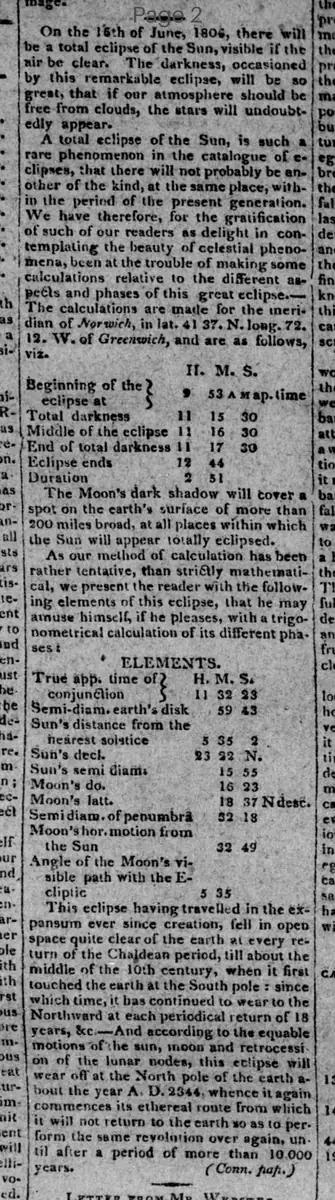
| Beginning of the eclipse at | 9 | 53 A.M. apparent time |
| Total darkness | 11 | 15 30 |
| Middle of the eclipse | 11 | 16 30 |
| End of total darkness | 11 | 17 30 |
| Eclipse ends | 12 | 44 |
| Duration | 2 | 51 |
On the 15th of June, 1805, there will be a total eclipse of the Sun, visible if the air be clear. The darkness, occasioned by this remarkable eclipse, will be so great, that if our atmosphere should be free from clouds, the stars will undoubtedly appear.
A total eclipse of the Sun, is such a rare phenomenon in the catalogue of eclipses, that there will not probably be another of the kind, at the same place, within the period of the present generation.
We have therefore, for the gratification of such of our readers as delight in contemplating the beauty of celestial phenomena, been at the trouble of making some calculations relative to the different aspects and phases of this great eclipse.—
The calculations are made for the meridian of Norwich, in lat. 41 37. N. long. 72. 12. W. of Greenwich, and are as follows, viz.
I. M. s.
The Moon's dark shadow will cover a spot on the earth's surface of more than 200 miles broad, at all places within which the Sun will appear totally eclipsed.
As our method of calculation has been rather tentative, than strictly mathematical, we present the reader with the following elements of this eclipse, that he may amuse himself, if he pleases, with a trigonometrical calculation of its different phases.
ELEMENTS
Nearest solstice 35
Sun's decl. 32N
Sun's semi diam 15-55
Moon's do. 16 3
Moon's latt. 18 37
Semidiam,of penumbra 18
Moon's hor. motion from the Sun
Angle of the Moon's visible path with the Eclipse
This eclipse having travelled in the expansum ever since creation, fell in open space quite clear of the earth at every return of the Chaldean period, till about the middle of the 10th century, when it first touched the earth at the South pole: since which time, it has continued to wear to the Northward at each periodical return of 18 years, &c --And according to the equable motions of the sun, moon and precession of the lunar nodes, this eclipse will wear off at the North pole of the earth about the year A. D. 2344, whence it again commences its ethereal route from which it will not return to the earth so as to perform the same revolution over again, until after a period of more than 10,000 years.
(Conn. haf.)
| True app. time of | H. M. S. |
| conjunction | 11 32 23 |
| Semi-diam. earth's disk | 59 43 |
| Sun's distance from the |
What sub-type of article is it?
Curiosity
Extraordinary Event
What themes does it cover?
Nature
What keywords are associated?
Solar Eclipse
Total Eclipse
June 1805
Norwich
Astronomical Calculations
Celestial Phenomenon
Where did it happen?
Norwich, In Lat. 41 37. N. Long. 72. 12. W. Of Greenwich
Story Details
Location
Norwich, In Lat. 41 37. N. Long. 72. 12. W. Of Greenwich
Event Date
15th Of June, 1805
Story Details
Announcement of a total solar eclipse on June 15, 1805, with timings for Norwich, description of its rarity, path across Earth from 10th century to 2344, and calculation elements provided.