Thank you for visiting SNEWPapers!
Sign up free
Norfolk Gazette And Publick Ledger
Norfolk, Virginia
What is this article about?
The London News reports on a British proclamation conceding the American demand to end searches of their warships for British deserters, while retaining the right for merchant ships. This aims to de-escalate tensions following Admiral Berkeley's actions in the Chesapeake incident, potentially averting war.
Clipping
OCR Quality
Full Text
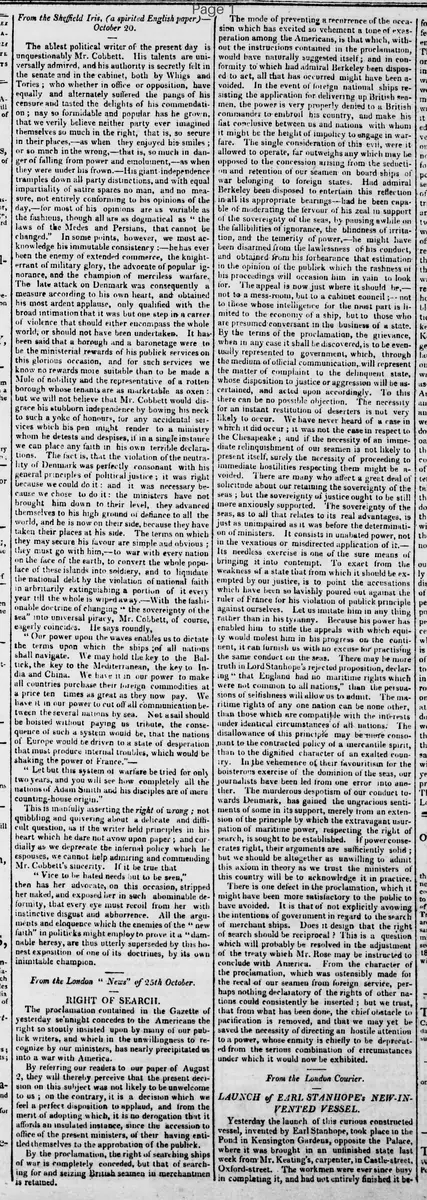
RIGHT OF SEARCH.
The proclamation contained in the Gazette of yesterday se'nnight concedes to the Americans the right so stoutly insisted upon by many of our public writers, and which in the unwillingness to recognize by our ministers, has nearly precipitated us into a war with America.
By referring our readers to our paper of August 2, they will thereby perceive that the present decision on this subject was not likely to be unwelcome to us; on the contrary, it is a decision which we feel a perfect disposition to applaud, and from the merit of adopting which, it is no derogation that it affords an insulated instance, since the accession to office of the present ministers, of their having entitled themselves to the approbation of the public.
By the proclamation, the right of searching ships of war is completely conceded, but that of searching for and seizing British seamen in merchantmen is retained.
The mode of preventing a recurrence of the occasion which has excited so vehement a tone of exasperation among the Americans, is that which, without the instructions contained in the proclamation, would have naturally suggested itself; and in conformity to which had admiral Berkeley been disposed to act, all that has occurred might have been avoided. In the event of foreign national ships resisting the application for delivering up British seamen, the power is very properly denied to a British commander to embroil his country, and make his fiat conclusive between us and nations with whom it might be the height of impolicy to engage in warfare. The single consideration of this evil, were it allowed to operate, far outweighs any which may be opposed to the concession arising from the seduction and retention of our seamen on board ships of war belonging to foreign states. Had admiral Berkeley been disposed to entertain this reflection in all its appropriate bearings—had he been capable of moderating the fervour of his zeal in support of the sovereignty of the seas, by pausing awhile on the fallibilities of ignorance, the blindness of irritation, and the temerity of power,—he might have been disarmed from the lawlessness of his conduct, and obtained from his forbearance that estimation in the opinion of the public which the rashness of his proceedings will occasion him in vain to look for. The appeal is now just where it should be,— not to a mess-room, but to a cabinet council;—not to those whose intelligence for the most part is limited to the economy of a ship, but to those who are presumed conversant in the business of a state.
By the terms of the proclamation, the grievance, when in any case it shall be discovered, is to be eventually represented to government, which, through the medium of official communication, will represent the matter of complaint to the delinquent state, whose disposition to justice or aggression will be ascertained, and acted upon accordingly. To this there can be no possible objection. The necessity for an instant restitution of deserters is not very likely to occur. We have never heard of a case in which it did occur; it was not the case in respect to the Chesapeake; and if the necessity of an immediate relinquishment of our seamen is not likely to present itself, surely the necessity of proceeding to immediate hostilities respecting them might be avoided. There are many who affect a great deal of solicitude about our retaining the sovereignty of the seas; but the sovereignty of justice ought to be still more anxiously supported. The sovereignty of the seas, as to all that relates to its real advantages, is just as unimpaired as it was before the determination of ministers. It consists in unabated power, not in the vexatious or misdirected application of it.— Its needless exercise is one of the sure means of bringing it into contempt. To exact from the weakness of a state that from which it should be exempted by our justice, is to point the accusations which have been so lavishly poured out against the ruler of France for his violation of public principle against ourselves. Let us imitate him in any thing rather than in his tyranny. Because his power has enabled him to stifle the appeals with which equity would molest him in his progress on the continent, it can furnish us with no excuse for practising the same conduct on the seas. There may be more truth in Lord Stanhope's rejected proposition, declaring "that England had no maritime rights which were not common to all nations," than the persuasions of selfishness will allow us to admit. The maritime rights of any one nation can be none other, than those which are compatible with the interests under identical circumstances of all nations: The disallowance of this principle may be more consonant to the contracted policy of a mercantile spirit, than to the dignified character of an exalted country. In the vehemence of their favouritism for the boisterous exercise of the dominion of the seas, our journalists have been led from one error into another. The murderous despotism of our conduct towards Denmark, has gained the ungracious sentiments of some in its support, merely from an extension of the principle by which the extravagant usurpation of maritime power, respecting the right of search, is sought to be established. If power consecrates right, their arguments are sufficiently solid; but we should be altogether as unwilling to admit this axiom in theory as we trust the ministers of this country will be to acknowledge it in practice.
There is one defect in the proclamation, which it might have been more satisfactory to the public to have avoided. It is that of not explicitly avowing the intentions of government in regard to the search of merchant ships. Does it design that the right of search should be reciprocal? This is a question which will probably be resolved in the adjustment of the treaty which Mr. Rose may be instructed to conclude with America. From the character of the proclamation, which was ostensibly made for the recall of our seamen from foreign service, perhaps nothing declaratory of the rights of other nations could consistently be inserted; but we trust, that from what has been done, the chief obstacle to pacification is removed, and that we may yet be saved the necessity of directing an hostile attention to a power, whose enmity is chiefly to be deprecated from the serious combination of circumstances under which it would now be exhibited.
What sub-type of article is it?
What keywords are associated?
What entities or persons were involved?
Where did it happen?
Foreign News Details
Primary Location
America
Event Date
25th October
Key Persons
Outcome
concession of right to search american ships of war; retention of search rights for merchant ships; potential avoidance of war with america; diplomatic representation of grievances instead of immediate action.
Event Details
British proclamation in the Gazette concedes to Americans the right not to have their warships searched for British seamen, following tensions from Admiral Berkeley's actions regarding the Chesapeake. Search and seizure rights retained for merchant ships. Grievances to be handled through official diplomatic channels rather than by individual commanders, aiming to prevent escalation to war.