Thank you for visiting SNEWPapers!
Sign up free
Story
October 26, 1902
The Worcester Spy
Worcester, Worcester County, Massachusetts
What is this article about?
Blind Boston author Charles Felton Pidgin, who wrote 'Quincy Adams Sawyer' while sightless, experiences gradual vision recovery, attributing it partly to hope inspired by his story's blind character Alice Pettengill regaining sight; the play tours to Worcester Jan 2-3.
Clipping
OCR Quality
98%
Excellent
Full Text
Quincy Adams Sawyer May Restore the Sight of Its Blind Author
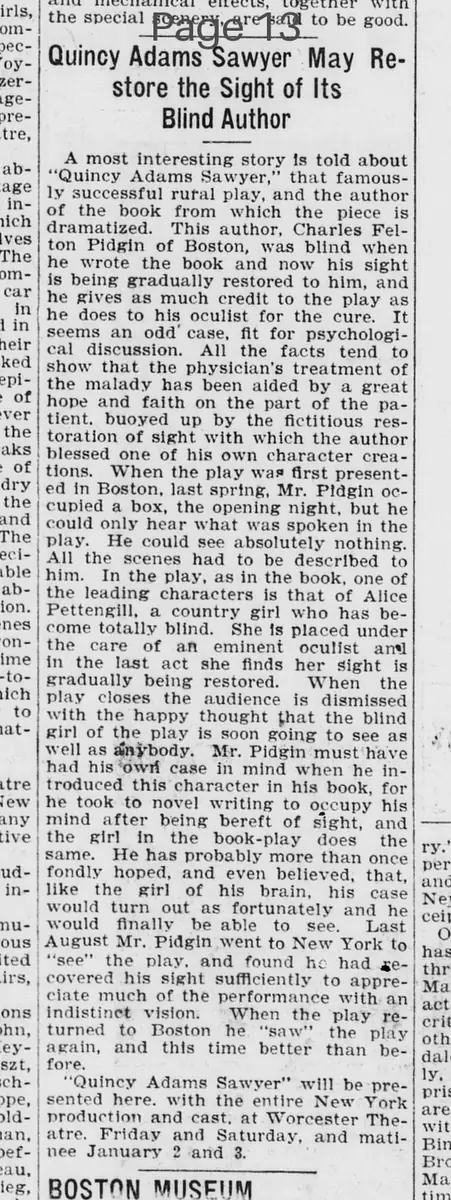
A most interesting story is told about "Quincy Adams Sawyer," that famously successful rural play, and the author of the book from which the piece is dramatized. This author, Charles Felton Pidgin of Boston, was blind when he wrote the book and now his sight is being gradually restored to him, and he gives as much credit to the play as he does to his oculist for the cure. It seems an odd case, fit for psychological discussion. All the facts tend to show that the physician's treatment of the malady has been aided by a great hope and faith on the part of the patient, buoyed up by the fictitious restoration of sight with which the author blessed one of his own character creations. When the play was first presented in Boston, last spring, Mr. Pidgin occupied a box, the opening night, but he could only hear what was spoken in the play. He could see absolutely nothing. All the scenes had to be described to him. In the play, as in the book, one of the leading characters is that of Alice Pettengill, a country girl who has become totally blind. She is placed under the care of an eminent oculist and in the last act she finds her sight is gradually being restored. When the play closes the audience is dismissed with the happy thought that the blind girl of the play is soon going to see as well as anybody. Mr. Pidgin must have had his own case in mind when he introduced this character in his book, for he took to novel writing to occupy his mind after being bereft of sight, and the girl in the book-play does the same. He has probably more than once fondly hoped, and even believed, that, like the girl of his brain, his case would turn out as fortunately and he would finally be able to see. Last August Mr. Pidgin went to New York to "see" the play, and found he had recovered his sight sufficiently to appreciate much of the performance with an indistinct vision. When the play returned to Boston he "saw" the play again, and this time better than before.
"Quincy Adams Sawyer" will be presented here, with the entire New York production and cast, at Worcester Theatre, Friday and Saturday, and matinee January 2 and 3.
A most interesting story is told about "Quincy Adams Sawyer," that famously successful rural play, and the author of the book from which the piece is dramatized. This author, Charles Felton Pidgin of Boston, was blind when he wrote the book and now his sight is being gradually restored to him, and he gives as much credit to the play as he does to his oculist for the cure. It seems an odd case, fit for psychological discussion. All the facts tend to show that the physician's treatment of the malady has been aided by a great hope and faith on the part of the patient, buoyed up by the fictitious restoration of sight with which the author blessed one of his own character creations. When the play was first presented in Boston, last spring, Mr. Pidgin occupied a box, the opening night, but he could only hear what was spoken in the play. He could see absolutely nothing. All the scenes had to be described to him. In the play, as in the book, one of the leading characters is that of Alice Pettengill, a country girl who has become totally blind. She is placed under the care of an eminent oculist and in the last act she finds her sight is gradually being restored. When the play closes the audience is dismissed with the happy thought that the blind girl of the play is soon going to see as well as anybody. Mr. Pidgin must have had his own case in mind when he introduced this character in his book, for he took to novel writing to occupy his mind after being bereft of sight, and the girl in the book-play does the same. He has probably more than once fondly hoped, and even believed, that, like the girl of his brain, his case would turn out as fortunately and he would finally be able to see. Last August Mr. Pidgin went to New York to "see" the play, and found he had recovered his sight sufficiently to appreciate much of the performance with an indistinct vision. When the play returned to Boston he "saw" the play again, and this time better than before.
"Quincy Adams Sawyer" will be presented here, with the entire New York production and cast, at Worcester Theatre, Friday and Saturday, and matinee January 2 and 3.
What sub-type of article is it?
Biography
Medical Curiosity
Personal Triumph
What themes does it cover?
Recovery
Fate Providence
Triumph
What keywords are associated?
Blind Author
Sight Restoration
Quincy Adams Sawyer
Play Production
Medical Recovery
What entities or persons were involved?
Charles Felton Pidgin
Alice Pettengill
Where did it happen?
Boston
Story Details
Key Persons
Charles Felton Pidgin
Alice Pettengill
Location
Boston
Event Date
Last Spring; Last August; Friday And Saturday, And Matinee January 2 And 3
Story Details
Blind author Charles Felton Pidgin wrote 'Quincy Adams Sawyer' and credits the play's success and a fictional character's sight restoration for aiding his own gradual recovery of vision, supported by his oculist's treatment and personal hope.