Thank you for visiting SNEWPapers!
Sign up free
Kentucky Gazette
Lexington, Fayette County, Kentucky
What is this article about?
Report from London on stalled peace negotiations at Ghent between American and British commissioners during the War of 1812, including dispatch of USS John Adams for instructions, exchanged treaty projects, and rebuttal to claims of Britain's economic distress amid the conflict.
Clipping
OCR Quality
Full Text
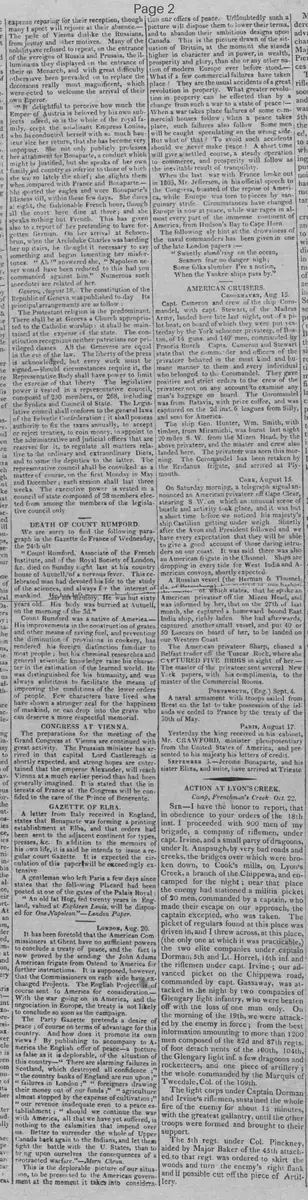
It has been foretold that the American Commissioners at Ghent have no sufficient powers to conclude a treaty of peace, and the fact is now proved by the sending the John Adams American frigate from Ostend to America for further instructions. It is supposed, however, that the Commissioners on each side have exchanged Projects. The English Project is of course sent to America for consideration.—With the war going on in America, and the negociation in Europe, the treaty is not likely to conclude so soon as the campaign.
The Party Gazette pretends a desire of peace; of course on terms of advantage for this country. And how does it promote its own views? By publishing to accompany to America the English offer of peace—a picture as false as it is deplorable, of the situation of this country—“There are alarming failures in Scotland, which destroyed all confidence;” “the country banks of England are run upon;” “failures in London;” “foreigners drawing their money out of our funds;” “agriculture almost stopped by the expense of cultivation;” “our revenue inadequate even to a peace establishment;” should we continue the war with America, all that we have yet suffered, is nothing to the calamities that impend over us. Better to surrender the whole of Upper Canada back again to the Indians, and let them fight the battle with the U. States, than to bring upon ourselves the consequences of a protracted warfare.”—Morn Chron.
This is the deplorable picture of our situation, to be presented to the American government at the moment it takes into consideration our offers of peace. Undoubtedly such a picture will dispose them to lower their terms, and to abandon their ambitious designs upon Canada. This is the picture drawn of the situation of Britain, at the moment she stands higher in character and in power, in wealth, prosperity and glory, than she or any other nation of modern Europe ever before stood.—What if a few commercial failures have taken place? They are the usual accidents of a great revolution in property. What greater revolution in property can be effected than by a change from such a war to a state of peace?—When a war takes place failures of some commercial houses follow; when a peace takes place, such failures also follow. Some men will be caught speculating on the wrong side. But what of that? To avoid such accidents should we never make peace? A short time will give a settled course, a steady operation to commerce, and prosperity will follow as the inevitable result of tranquility.
When the last war with France broke out in 1803, Mr Jefferson, in his official speech to the Congress, boasted of the repose of America, while Europe was torn to pieces by sanguinary strife. Circumstances have changed. Europe is now at peace, while war rages in almost every part of the immense continent of America, from Hudson's Bay to Cape Horn.
The following sly hint at the drowsiness of the naval commanders has been given in one of the late London papers:
“Sweetly slumb'ring on the ocean,
Seamen fear no danger nigh;
Some folks slumber I've a notion,
When the Yankee ships pass by.”
What sub-type of article is it?
What keywords are associated?
What entities or persons were involved?
Where did it happen?
Foreign News Details
Primary Location
Ghent
Event Date
Aug. 20
Key Persons
Outcome
ongoing negotiations with exchanged projects; english project sent to america for consideration; treaty not likely to conclude soon
Event Details
American Commissioners at Ghent lack sufficient powers to conclude treaty, proved by sending John Adams frigate from Ostend to America for instructions. Commissioners exchanged projects. Critique of Party Gazette's portrayal of Britain's dire economic situation to accompany peace offer, suggesting surrender of Upper Canada. Response asserts Britain's high prosperity despite minor commercial failures, normal in wartime to peacetime transitions. Contrast with 1803 when Jefferson boasted of America's peace amid European war; now Europe at peace while America at war. Hint at naval commanders' inactivity allowing Yankee ships to pass.