Thank you for visiting SNEWPapers!
Sign up free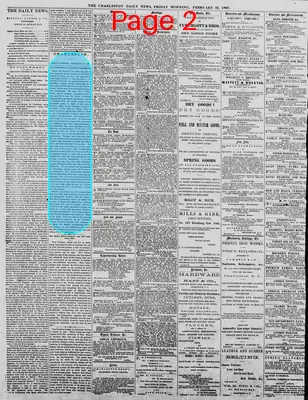
The Charleston Daily News
Charleston, Charleston County, South Carolina
What is this article about?
1869 Charleston article on utilizing local nodular phosphate deposits as fertilizer, per French expert M. Adolphe Robierre, who advocates pulverizing and direct application or mixing with manure for soil enrichment, offering a cost-effective alternative to acid-treated superphosphates amid Southern farmers' economic challenges.
Clipping
OCR Quality
Full Text
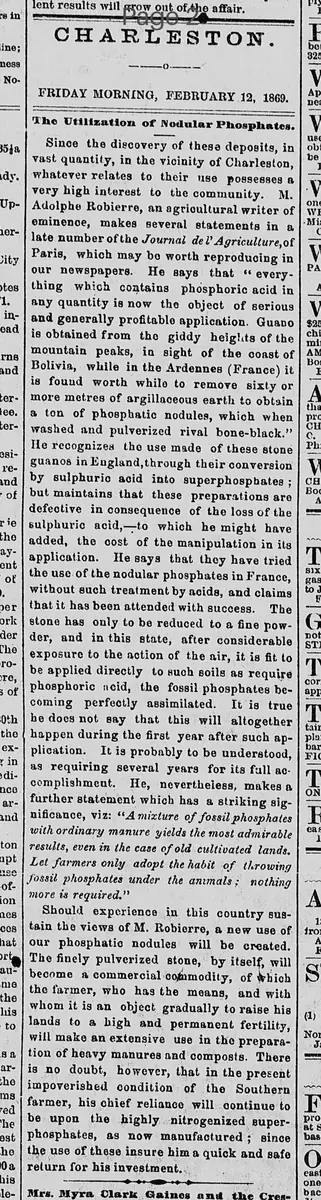
FRIDAY MORNING, FEBRUARY 12, 1869.
The Utilization of Nodular Phosphates.
Since the discovery of these deposits, in vast quantity, in the vicinity of Charleston, whatever relates to their use possesses a very high interest to the community. M. Adolphe Robierre, an agricultural writer of eminence, makes several statements in a late number of the Journal d'Agriculture, of Paris, which may be worth reproducing in our newspapers. He says that "everything which contains phosphoric acid in any quantity is now the object of serious and generally profitable application. Guano is obtained from the giddy heights of the mountain peaks, in sight of the coast of Bolivia, while in the Ardennes (France) it is found worth while to remove sixty or more metres of argillaceous earth to obtain a ton of phosphatic nodules, which when washed and pulverized rival bone-black." He recognizes the use made of these stone guanos in England, through their conversion by sulphuric acid into superphosphates; but maintains that these preparations are defective in consequence of the loss of the sulphuric acid,—to which he might have added, the cost of the manipulation in its application. He says that they have tried the use of the nodular phosphates in France, without such treatment by acids, and claims that it has been attended with success. The stone has only to be reduced to a fine powder, and in this state, after considerable exposure to the action of the air, it is fit to be applied directly to such soils as require phosphoric acid, the fossil phosphates becoming perfectly assimilated. It is true he does not say that this will altogether happen during the first year after such application. It is probably to be understood, as requiring several years for its full accomplishment. He, nevertheless, makes a further statement which has a striking significance, viz: "A mixture of fossil phosphates with ordinary manure yields the most admirable results, even in the case of old cultivated lands. Let farmers only adopt the habit of throwing fossil phosphates under the animals; nothing more is required." Should experience in this country sustain the views of M. Robierre, a new use of our phosphatic nodules will be created. The finely pulverized stone, by itself, will become a commercial commodity, of which the farmer, who has the means, and with whom it is an object gradually to raise his lands to a high and permanent fertility, will make an extensive use in the preparation of heavy manures and composts. There is no doubt, however, that in the present impoverished condition of the Southern farmer, his chief reliance will continue to be upon the highly nitrogenized superphosphates, as now manufactured; since the use of those insure him a quick and safe return for his investment.
What sub-type of article is it?
What themes does it cover?
What keywords are associated?
What entities or persons were involved?
Where did it happen?
Story Details
Key Persons
Location
Vicinity Of Charleston; Ardennes (France); England; France
Event Date
February 12, 1869
Story Details
Article discusses the discovery of vast nodular phosphate deposits near Charleston and their potential agricultural uses, citing M. Adolphe Robierre's views on applying pulverized phosphates directly to soil or mixing with manure for fertility, contrasting with acid-treated superphosphates.