Thank you for visiting SNEWPapers!
Sign up free
Letter to Editor
April 12, 1841
The Madisonian
Washington, District Of Columbia
What is this article about?
A letter to the Madisonian highlights War of 1812 veterans Major John C. Camp and Col. John A. Rogers who attended President William Henry Harrison's funeral, recounting their shared battles and contributions, including at Thames, Chippewa, and Lundy's Lane. It also notes Major Thomas Harrison's absence due to injury.
Clipping
OCR Quality
98%
Excellent
Full Text
FOR THE MADISONIAN.
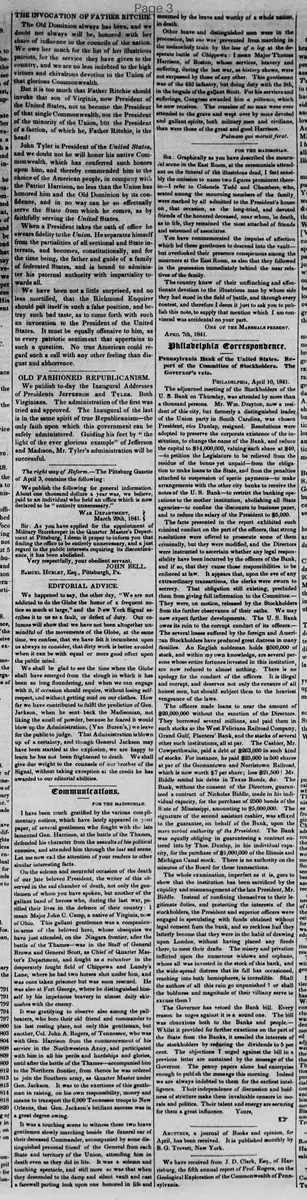
I have been much gratified by the various complimentary notices, which have lately appeared in your paper, of several gentlemen who fought with the late lamented Gen. Harrison, at the battle of the Thames, defended his character from the assaults of his political enemies, and attended him through the last sad scene.
Let me now call the attention of your readers to other similar interesting facts.
On the solemn and mournful occasion of the death of our late beloved President, the writer of this observed in the sad chamber of death, not only the gentlemen of whom you have spoken, but another of the gallant band of heroes who, during the last war, perilled their lives in the defence of their country: I mean Major John C. Camp, a native of Virginia, now of Ohio. This gallant gentleman was a companion-in-arms of the beloved hero, whose obsequies we have just attended, on the Niagara frontier, after the battle of the Thames—was in the Staff of General Brown and General Scott, as Chief of Quarter Master's Department, and fought as a volunteer in the desperately fought field of Chippewa and Lundy's Lane, where he had two horses shot under him, and was once taken prisoner but was soon rescued. He was also at Fort George, where he distinguished himself by his impetuous bravery in almost daily skirmishes with the enemy.
It was gratifying to observe also among the pall-bearers, who bore their old friend and commander to his last resting place, not only this gentleman, but another, Col. John A. Rogers, of Tennessee, who was with Gen. Harrison from the commencement of his service in the Northwestern Army, and participated with him in all his perils and hardships and glories, until after the battle of the Thames—accompanied him to the Northern frontier, from thence he was ordered to join the Southern army, as Quarter Master under Gen. Jackson. It was to the exertions of this gentleman in raising, on his own responsibility, money and means to transport the 6,000 Tennessee troops to New Orleans, that Gen. Jackson's brilliant success was in a great degree owing.
It was a touching scene to witness these two brave gentlemen slowly marching beside the funeral car of their deceased Commander, accompanied by some distinguished personal friend of the General from each State and territory of the Union, attending him in death even as they did in life. It was a solemn and touching spectacle, and still more so was that when they descended to the damp and silent vault and cast a farewell parting look upon one honored in life and mourned by the brave and worthy of a whole nation, in death.
Other brave and distinguished men were in the procession, but one was prevented from marching in the melancholy train by the loss of a leg at the desperate battle of Chippewa: I mean Major Thomas Harrison, of Boston, whose services, bravery and suffering, during the last war, as history shows, were not surpassed by those of any other. This gentleman was of the 42d infantry, but doing duty with the 9th, in the brigade of the gallant Scott. For his services and sufferings, Congress awarded him a pittance, which he now receives. The remains of no man were ever attended to the grave and wept over by more devoted and gallant spirits, both military men and civilians, than were those of the great and good Harrison.
Palmam qui meruit ferat.
I have been much gratified by the various complimentary notices, which have lately appeared in your paper, of several gentlemen who fought with the late lamented Gen. Harrison, at the battle of the Thames, defended his character from the assaults of his political enemies, and attended him through the last sad scene.
Let me now call the attention of your readers to other similar interesting facts.
On the solemn and mournful occasion of the death of our late beloved President, the writer of this observed in the sad chamber of death, not only the gentlemen of whom you have spoken, but another of the gallant band of heroes who, during the last war, perilled their lives in the defence of their country: I mean Major John C. Camp, a native of Virginia, now of Ohio. This gallant gentleman was a companion-in-arms of the beloved hero, whose obsequies we have just attended, on the Niagara frontier, after the battle of the Thames—was in the Staff of General Brown and General Scott, as Chief of Quarter Master's Department, and fought as a volunteer in the desperately fought field of Chippewa and Lundy's Lane, where he had two horses shot under him, and was once taken prisoner but was soon rescued. He was also at Fort George, where he distinguished himself by his impetuous bravery in almost daily skirmishes with the enemy.
It was gratifying to observe also among the pall-bearers, who bore their old friend and commander to his last resting place, not only this gentleman, but another, Col. John A. Rogers, of Tennessee, who was with Gen. Harrison from the commencement of his service in the Northwestern Army, and participated with him in all his perils and hardships and glories, until after the battle of the Thames—accompanied him to the Northern frontier, from thence he was ordered to join the Southern army, as Quarter Master under Gen. Jackson. It was to the exertions of this gentleman in raising, on his own responsibility, money and means to transport the 6,000 Tennessee troops to New Orleans, that Gen. Jackson's brilliant success was in a great degree owing.
It was a touching scene to witness these two brave gentlemen slowly marching beside the funeral car of their deceased Commander, accompanied by some distinguished personal friend of the General from each State and territory of the Union, attending him in death even as they did in life. It was a solemn and touching spectacle, and still more so was that when they descended to the damp and silent vault and cast a farewell parting look upon one honored in life and mourned by the brave and worthy of a whole nation, in death.
Other brave and distinguished men were in the procession, but one was prevented from marching in the melancholy train by the loss of a leg at the desperate battle of Chippewa: I mean Major Thomas Harrison, of Boston, whose services, bravery and suffering, during the last war, as history shows, were not surpassed by those of any other. This gentleman was of the 42d infantry, but doing duty with the 9th, in the brigade of the gallant Scott. For his services and sufferings, Congress awarded him a pittance, which he now receives. The remains of no man were ever attended to the grave and wept over by more devoted and gallant spirits, both military men and civilians, than were those of the great and good Harrison.
Palmam qui meruit ferat.
What sub-type of article is it?
Historical
Reflective
Emotional
What themes does it cover?
Military War
What keywords are associated?
William Henry Harrison
War Of 1812
Battle Of The Thames
Chippewa
Lundys Lane
Funeral
Veterans
John C Camp
John A Rogers
What entities or persons were involved?
The Madisonian
Letter to Editor Details
Recipient
The Madisonian
Main Argument
the letter draws attention to additional war of 1812 heroes, such as majors john c. camp and thomas harrison and col. john a. rogers, who attended president harrison's funeral and served alongside him in key battles, honoring their contributions to the nation's defense.
Notable Details
Mentions Battles: Thames, Chippewa, Lundy's Lane, Fort George, New Orleans
Describes Funeral Scene With Pall Bearers And Procession
Latin Phrase: 'Palmam Qui Meruit Ferat' (Let Him Bear The Palm Who Has Earned It)