Thank you for visiting SNEWPapers!
Sign up free
Editorial
June 28, 1882
National Republican (Washington City
Washington, District Of Columbia
What is this article about?
This editorial addresses ongoing labor troubles, portraying Capital and Labor as partners who should share profits fairly. It advocates for wage increases to match living costs, mutual concessions in bargaining, and arbitration to prevent discontent and ensure stability for both sides.
Clipping
OCR Quality
95%
Excellent
Full Text
The Labor Troubles
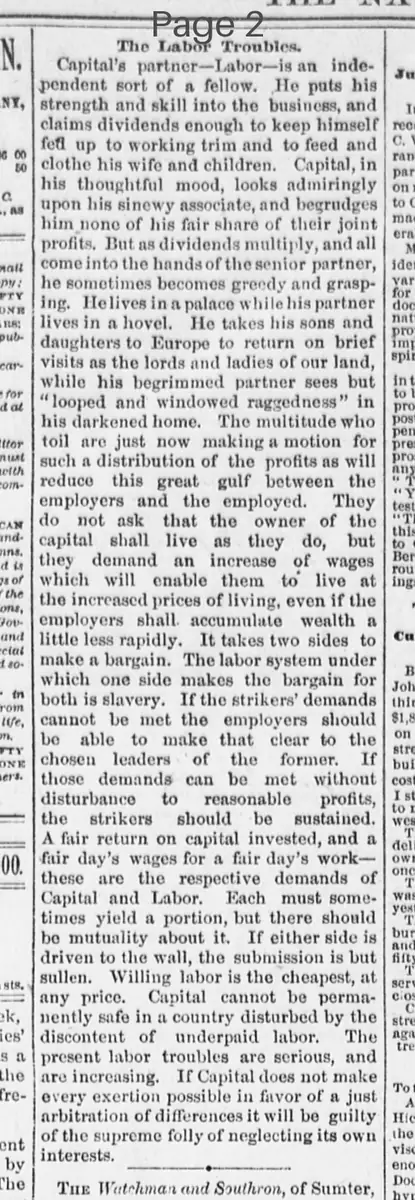
Capital's partner—Labor—is an independent sort of a fellow. He puts his strength and skill into the business, and claims dividends enough to keep himself well up to working trim and to feed and clothe his wife and children. Capital, in his thoughtful mood, looks admiringly upon his sinewy associate, and begrudges him none of his fair share of their joint profits. But as dividends multiply, and all come into the hands of the senior partner, he sometimes becomes greedy and grasping. He lives in a palace while his partner lives in a hovel. He takes his sons and daughters to Europe to return on brief visits as the lords and ladies of our land, while his begrimmed partner sees but "looped and windowed raggedness" in his darkened home. The multitude who toil are just now making a motion for such a distribution of the profits as will reduce this great gulf between the employers and the employed. They do not ask that the owner of the capital shall live as they do, but they demand an increase of wages which will enable them to live at the increased prices of living, even if the employers shall accumulate wealth a little less rapidly. It takes two sides to make a bargain. The labor system under which one side makes the bargain for both is slavery. If the strikers' demands cannot be met the employers should be able to make that clear to the chosen leaders of the former. If those demands can be met without disturbance to reasonable profits, the strikers should be sustained.
A fair return on capital invested, and a fair day's wages for a fair day's work—these are the respective demands of Capital and Labor. Each must sometimes yield a portion, but there should be mutuality about it. If either side is driven to the wall, the submission is but sullen. Willing labor is the cheapest, at any price. Capital cannot be permanently safe in a country disturbed by the discontent of underpaid labor. The present labor troubles are serious, and are increasing. If Capital does not make every exertion possible in favor of a just arbitration of differences it will be guilty of the supreme folly of neglecting its own interests.
Capital's partner—Labor—is an independent sort of a fellow. He puts his strength and skill into the business, and claims dividends enough to keep himself well up to working trim and to feed and clothe his wife and children. Capital, in his thoughtful mood, looks admiringly upon his sinewy associate, and begrudges him none of his fair share of their joint profits. But as dividends multiply, and all come into the hands of the senior partner, he sometimes becomes greedy and grasping. He lives in a palace while his partner lives in a hovel. He takes his sons and daughters to Europe to return on brief visits as the lords and ladies of our land, while his begrimmed partner sees but "looped and windowed raggedness" in his darkened home. The multitude who toil are just now making a motion for such a distribution of the profits as will reduce this great gulf between the employers and the employed. They do not ask that the owner of the capital shall live as they do, but they demand an increase of wages which will enable them to live at the increased prices of living, even if the employers shall accumulate wealth a little less rapidly. It takes two sides to make a bargain. The labor system under which one side makes the bargain for both is slavery. If the strikers' demands cannot be met the employers should be able to make that clear to the chosen leaders of the former. If those demands can be met without disturbance to reasonable profits, the strikers should be sustained.
A fair return on capital invested, and a fair day's wages for a fair day's work—these are the respective demands of Capital and Labor. Each must sometimes yield a portion, but there should be mutuality about it. If either side is driven to the wall, the submission is but sullen. Willing labor is the cheapest, at any price. Capital cannot be permanently safe in a country disturbed by the discontent of underpaid labor. The present labor troubles are serious, and are increasing. If Capital does not make every exertion possible in favor of a just arbitration of differences it will be guilty of the supreme folly of neglecting its own interests.
What sub-type of article is it?
Labor
Economic Policy
Social Reform
What keywords are associated?
Labor Troubles
Fair Wages
Capital Labor Relations
Strikes
Arbitration
Wage Increases
Mutual Concessions
Working Conditions
What entities or persons were involved?
Capital
Labor
Strikers
Employers
Editorial Details
Primary Topic
Labor Troubles And Fair Wages
Stance / Tone
Advocacy For Mutual Concessions And Arbitration Between Capital And Labor
Key Figures
Capital
Labor
Strikers
Employers
Key Arguments
Labor Deserves Fair Share Of Joint Profits To Maintain Living Standards
Capital Becomes Greedy When Hoarding All Dividends
Workers Demand Wage Increases To Match Rising Living Costs Without Slowing Capital Accumulation
Bargains Must Involve Both Sides; Unilateral Decisions Amount To Slavery
Employers Should Explain If Demands Cannot Be Met Or Sustain Workers If Feasible
Fair Return On Capital And Fair Wages For Fair Work Require Mutual Yielding
Underpaid Labor Leads To Discontent And Threatens Capital's Safety
Arbitration Is Essential To Resolve Increasing Labor Troubles