Thank you for visiting SNEWPapers!
Sign up free
Story
May 1, 1891
The Charlotte Democrat
Charlotte, Mecklenburg County, North Carolina
What is this article about?
Promotional article on cultivating Lima beans as a profitable farm crop, highlighting ease of growth, market demand, soil needs, planting methods, and suitability for remote farmers.
Clipping
OCR Quality
98%
Excellent
Full Text
Lima Beans as a Farm Crop.
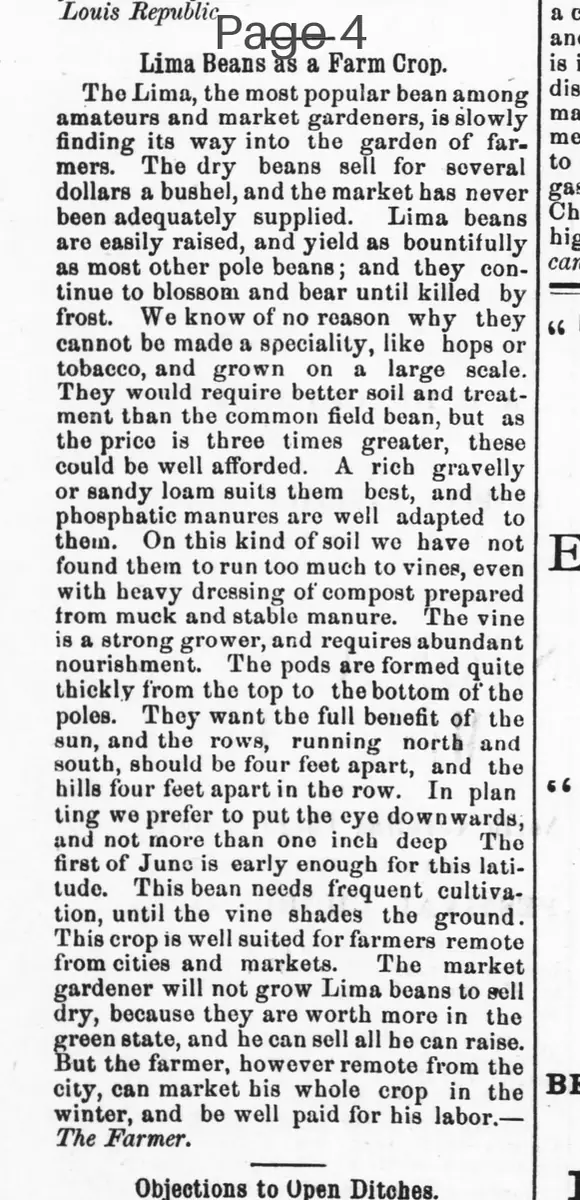
The Lima, the most popular bean among amateurs and market gardeners, is slowly finding its way into the garden of farmers. The dry beans sell for several dollars a bushel, and the market has never been adequately supplied. Lima beans are easily raised, and yield as bountifully as most other pole beans; and they continue to blossom and bear until killed by frost. We know of no reason why they cannot be made a speciality, like hops or tobacco, and grown on a large scale.
They would require better soil and treatment than the common field bean, but as the price is three times greater, these could be well afforded. A rich gravelly or sandy loam suits them best, and the phosphatic manures are well adapted to them. On this kind of soil we have not found them to run too much to vines, even with heavy dressing of compost prepared from muck and stable manure. The vine is a strong grower, and requires abundant nourishment. The pods are formed quite thickly from the top to the bottom of the poles. They want the full benefit of the sun, and the rows, running north and south, should be four feet apart, and the hills four feet apart in the row. In planting we prefer to put the eye downwards, and not more than one inch deep. The first of June is early enough for this latitude. This bean needs frequent cultivation, until the vine shades the ground.
This crop is well suited for farmers remote from cities and markets. The market gardener will not grow Lima beans to sell dry, because they are worth more in the green state, and he can sell all he can raise. But the farmer, however remote from the city, can market his whole crop in the winter, and be well paid for his labor.-The Farmer.
The Lima, the most popular bean among amateurs and market gardeners, is slowly finding its way into the garden of farmers. The dry beans sell for several dollars a bushel, and the market has never been adequately supplied. Lima beans are easily raised, and yield as bountifully as most other pole beans; and they continue to blossom and bear until killed by frost. We know of no reason why they cannot be made a speciality, like hops or tobacco, and grown on a large scale.
They would require better soil and treatment than the common field bean, but as the price is three times greater, these could be well afforded. A rich gravelly or sandy loam suits them best, and the phosphatic manures are well adapted to them. On this kind of soil we have not found them to run too much to vines, even with heavy dressing of compost prepared from muck and stable manure. The vine is a strong grower, and requires abundant nourishment. The pods are formed quite thickly from the top to the bottom of the poles. They want the full benefit of the sun, and the rows, running north and south, should be four feet apart, and the hills four feet apart in the row. In planting we prefer to put the eye downwards, and not more than one inch deep. The first of June is early enough for this latitude. This bean needs frequent cultivation, until the vine shades the ground.
This crop is well suited for farmers remote from cities and markets. The market gardener will not grow Lima beans to sell dry, because they are worth more in the green state, and he can sell all he can raise. But the farmer, however remote from the city, can market his whole crop in the winter, and be well paid for his labor.-The Farmer.
What sub-type of article is it?
Agricultural Guide
What keywords are associated?
Lima Beans
Farm Crop
Cultivation
Market Demand
Pole Beans
Soil Treatment
Story Details
Story Details
Lima beans promoted as a specialty farm crop with high market value, easy cultivation, bountiful yields until frost, requiring rich soil, phosphatic manures, specific planting in June, and suited for remote farmers to sell dry in winter.