Thank you for visiting SNEWPapers!
Sign up free
The Gazette
Portland, Cumberland County, Maine
What is this article about?
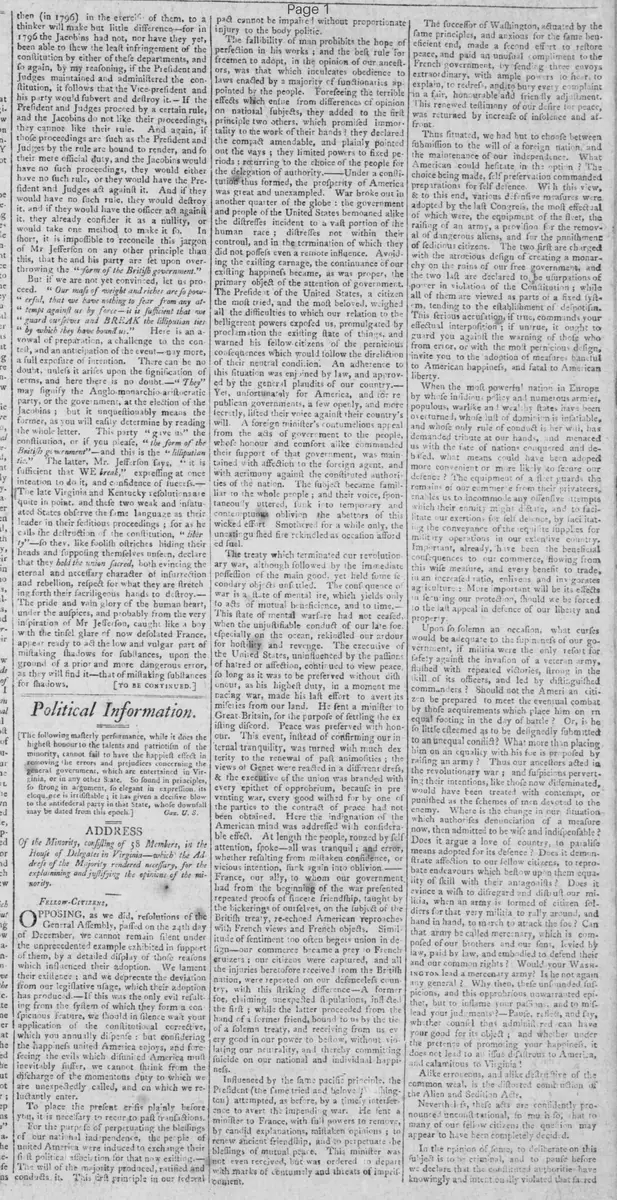
Address by the minority (58 members) in Virginia's House of Delegates defending federal measures like neutrality, treaties with Britain and France, and the Alien and Sedition Acts against majority resolutions passed December 24, arguing they protect American independence and liberty.
Merged-components note: This is a continuation of the 'Address of the Minority' from the Virginia House of Delegates, a formal political document on national government issues, best classified as domestic_news.
Clippings
1 of 2
OCR Quality
Full Text
[The following masterly performance, while it does the highest honour to the talents and patriotism of the minority, cannot fail to have the happiest effect in removing the errors and prejudices concerning the general government, which are entertained in Virginia, or in any other State. So sound in principles, so strong in argument, so elegant in expression, its eloquence is irresistible; it has given a decisive blow to the antifederal party in that State, whose downfall may be dated from this epoch.]
Gaz. U. S.
ADDRESS
Of the Minority, consisting of 58 Members, in the House of Delegates in Virginia—which the Address of the Majority rendered necessary, for the explaining and justifying the opinions of the minority.
Fellow-Citizens,
OPPOSING, as we did, resolutions of the General Assembly, passed on the 24th day of December, we cannot remain silent under the unprecedented example exhibited in support of them, by a detailed display of those reasons which influenced their adoption. We lament their existence; and we deprecate the deviation from our legislative usage, which their adoption has produced.—If this was the only evil resulting from the system of which they form a conspicuous feature, we should in silence wait your application of the constitutional corrective, which you annually dispense: but considering the happiness united America enjoys, and foreseeing the evils which disunited America must inevitably suffer, we cannot shrink from the discharge of the momentous duty to which we are unexpectedly called, and on which we reluctantly enter.
To place the present crisis plainly before you, it is necessary to recur to past transactions. For the purpose of perpetuating the blessings of our national independence, the people of united America were induced to exchange their former political association for that now existing.—The will of the majority produced, ratified and conducts it. This trust principle in our federal pact cannot be impaired without proportionate injury to the body politic.
The fallibility of man prohibits the hope of perfection in his works; and the best rule for freemen to adopt, in the opinion of our ancestors, was that which inculcates obedience to laws enacted by a majority of functionaries appointed by the people. Foreseeing the terrible effects which ensue from differences of opinion on national subjects, they added to the first principle two others, which promised immortality to the work of their hands! they declared the compact amendable, and plainly pointed out the ways; they limited powers to fixed periods; recurring to the choice of the people for the delegation of authority.—Under a constitution thus formed, the prosperity of America was great and unexampled. War broke out in another quarter of the globe: the government and people of the United States bemoaned alike the distress incident to a vast portion of the human race; distress not within their controul, and in the termination of which they did not possess even a remote influence. Avoiding the existing carnage, the continuance of our existing happiness became, as was proper, the primary object of the attention of government.
The President of the United States, a citizen the most tried, and the most beloved, weighed all the difficulties to which our relation to the belligerent powers exposed us, promulgated by proclamation the existing state of things, and warned his fellow-citizens of the pernicious consequences which would follow the dereliction of their neutral condition. An adherence to this situation was enjoined by law, and approved by the general plaudits of our country.—Yet, unfortunately for America, and for republican governments, a few openly, and more secretly, lifted their voice against their country's will. A foreign minister's contumelious appeal from the acts of government to the people, whose honour and comfort alike commanded their support of that government, was maintained with affection to the foreign agent, and with acrimony against the constituted authorities of the nation. The subject became familiar to the whole people; and their voice, spontaneously uttered, sunk into temporary and contemptuous oblivion the abettors of this wicked effort. Smothered for a while only, the unextinguished fire rekindled as occasion afforded fuel.
The treaty which terminated our revolutionary war, although followed by the immediate possession of the main good, yet held some secondary objects unsettled. The consequence of war is a state of mental ire, which yields only to acts of mutual beneficence, and to time.—This state of mental warfare had most ceased, when the unjustifiable conduct of our late foe, especially on the ocean, rekindled our ardour for hostility and revenge. The executive of the United States, uninfluenced by the passions of hatred or affection, continued to view peace, so long as it was to be preserved without dishonour, as his highest duty, in a moment menacing war, made his last effort to avert its miseries from our land. He sent a minister to Great Britain, for the purpose of settling the existing discord. Peace was preserved with honour. This event, instead of confirming our internal tranquility, was turned with much dexterity to the renewal of past animosities: the views of Genet were reacted in a different dress, & the executive of the union was branded with every epithet of opprobrium, because in preventing war, every good wished for by one of the parties to the contract of peace had not been obtained. Here the indignation of the American mind was addressed with considerable effect. At length the people, roused by self attention, spoke—all was tranquil; and error, whether resulting from mistaken confidence, or vicious intention, sunk again into oblivion.—France, our ally, to whom our government had from the beginning of the war presented repeated proofs of sincere friendship, taught by the bickerings of ourselves, on the subject of the British treaty, re-echoed American reproaches with French views and French objects. Similarity of sentiment too often begets union in design: our commerce became a prey to French cruizers: our citizens were captured, and all the injuries heretofore received from the British nation, were repeated on our defenceless country, with this striking difference—A former foe, claiming unexpected stipulations, inflicted the first: while the latter proceeded from the hand of a former friend, bound to us by the tie of a solemn treaty, and receiving from us every good in our power to bestow, without violating our neutrality, and thereby committing suicide on our national and individual happiness.
Influenced by the same pacific principle, the President (the same tried and beloved Washington) attempted, as before, by a timely interference to avert the impending war. He sent a minister to France, with full powers to remove, by candid explanations, mistaken opinions; to renew ancient friendship, and to perpetuate the blessings of mutual peace. This minister was not even received, but was ordered to depart with marks of contumely and threats of imprisonment,
The successor of Washington, actuated by the same principles, and anxious for the same beneficent end, made a second effort to restore peace, and paid an unusual compliment to the French government, by sending three envoys extraordinary, with ample powers to hear, to explain, to redress, and to bury every complaint in a fair, honourable and friendly adjustment. This renewed testimony of our desire for peace, was returned by increase of insolence and affront.
Thus situated, we had but to choose between submission to the will of a foreign nation, and the maintenance of our independence. What American could hesitate in the option? The choice being made, self preservation commanded preparations for self defence. With this view, & to this end, various defensive measures were adopted by the last Congress, the most effectual of which were, the equipment of the fleet, the raising of an army, a provision for the removal of dangerous aliens, and for the punishment of seditious citizens. The two first are charged with the atrocious design of creating a monarchy on the ruins of our free government, and the two last are declared to be usurpations of power in violation of the Constitution; while all of them are viewed as parts of a fixed system, tending to the establishment of despotism.
This serious accusation, if true, commands your effectual interposition; if untrue, it ought to guard you against the warning of those who from error, or with the most pernicious design, invite you to the adoption of measures, baneful to American happiness, and fatal to American liberty.
When the most powerful nation in Europe by whose insidious policy and numerous armies, populous, warlike and wealthy states have been overturned, whose lust of dominion is insatiable, and whose only rule of conduct is her will, has demanded tribute at our hands, and menaced us with the fate of nations conquered and debased, what means could have been adopted more convenient or more likely to secure our defence? The equipment of a fleet guards the remains of our commerce from their privateers, enables us to incommodate any offensive attempts which their enmity might dictate, and to facilitate our exertion, for self defence, by facilitating the conveyance of the requisite supplies for military operations in our extensive country. Important, already, have been the beneficial consequences to our commerce, flowing from this wise measure, and every benefit to trade, in an increased ratio, enlivens and invigorates agriculture: More important will be its effects in ensuring our protection, should we be forced to the last appeal in defence of our liberty and property.
Upon so solemn an occasion, what resources would be adequate to the supplies of our government, if militia were the only resort for safety against the invasion of a veteran army, flushed with repeated victories, strong in the skill of its officers, and led by distinguished commanders? Should not the American citizen be prepared to meet the eventual combat by those acquirements which place him on an equal footing in the day of battle? Or, is he so little esteemed as to be designedly submitted to an unequal conflict? What more than placing him on an equality with his foe is proposed by raising an army? Thus our ancestors acted in the revolutionary war; and suspicions perverting their intentions, like those now disseminated, would have been treated with contempt, or punished as the schemes of men devoted to the enemy. Where is the change in our situation which authorizes denunciation of a measure now, then admitted to be wise and indispensable? Does it argue a love of country, to paralyze means adopted for its defence? Does it demonstrate affection to our fellow citizens, to reprobate endeavours which bestow upon them equality of skill with their antagonists? Does it evince a wish to disregard and distrust our militia, when an army is formed of citizen soldiers for that very militia to rally around, and hand in hand, to march to attack the foe? Can that army be called mercenary, which is composed of our brothers and our sons, levied by law, paid by law, and embodied to defend their and our common rights? Would your WASHINGTON lead a mercenary army? Is he not again any general? Why then, these unfounded suspicions, and this opprobrious unwarranted epithet, but to inflame your passions, and to mislead your judgments?—Pause, reflect, and say, whether counsel thus administered can have your good for its object; and whether under the pretence of promoting your happiness, it does not lead to an issue disastrous to America, and calamitous to Virginia!
Alike erroneous, and alike destructive of the common weal, is the distorted construction of the Alien and Sedition Acts. Nevertheless, these acts are confidently pronounced unconstitutional, so much so, that to many of our fellow citizens the question may appear to have been completely decided. In the opinion of some, to deliberate on this subject is to be criminal, and to pause before we declare that the constituted authorities have knowingly and intentionally violated that sacred
that tenor by which they hold their political exist.
en e.is to be inimic to that republican liberty,
which constitutes the pride and happiness of our
country, and which can only be preserved by
preserving that government which is now so
boldly arraigned. Had the measures which
profess their origin from these laws been confined to ordinary, peaceable and constitutional
efforts to effect their repeal; had a decent re-
pect for the real majority of the American peo-
ple been maintained no opposition would have
been made by those who now address you.—
But when a partial irritation, in some degree
produced by misconception, is sought to be ex-
cited into general hostility against the govern-
ment of our country; is seized as affording a
fair occasion for proceedings which may sap the
foundation of our union, we must, in obedience
to that duty which gave birth to this reply, sub-
mit to our fellow citizens some reflections on
these laws:
The act concerning aliens makes it lawful
for the President of the United States to order
all such aliens as he shall judge dangerous to
the peace & safety of the United States, or shall
have reasonable grounds to suspect are concerned
in any treasonable or secret machinations a-
gainst the government thereof, to depart out
of the territory of the United States, within
such time as shall be expressed in such order.
This law has been declared to be unconstitutional, because—First, It transcends the powers
of Congress;—2d, It violates that article which
restrains the prohibition of migration till 1808;
—3d, It unites legislative, executive & judiciary
powers in the chief magistrate;—4th, It de-
prives aliens of the constitutional right of trial
by jury.
Time will not allow a minute investigation of
this subject; the several objections will be but
briefly reviewed.
1st. It is alleged to be an exercise of a pow-
er not delegated. The Constitution of the Uni-
ted States is in its organization dissimilar to any
scheme of government which has heretofore
been devised.
It presents to us for many purposes an en-
tire nation, and for other purposes several dis-
tinct and perfect sovereignties. Perpetual peace
among ourselves: a complete participation of
privileges through all the states; and, above
all, safety from abroad, were perhaps the stron-
gest motives which induced America to unite
under one government. All objects which are
general in their nature, which interest all A.
merica, which are connected with the general
safety: all external objects can only be obtained
by the co-operation of the whole, and therefore
the powers necessary for their attainment
would be naturally vested in the government of
the whole. The mass of social and interior re-
gulations can be most beneficially attended to
by the state sovereignties—and therefore the
government of the union is and ought to be
excluded from participating in their forma.
tion.
When we examine the situation of the United
States, & the object, for which its government
must necessarily have been formed, the mind is
irresistibly led to the demarcation of a plain
line of partition between the general and partic-
ular sovereignties. Since the general and state
governments equally represent the people, and
are alike accountable to them for misconduct,
those powers which are essential to our happi-
ness and protection may, with equal safety as
to their abuse, be trusted to the one or the oth-
er. It is therefore rational to suppose, that
they are placed where they can be exercised
most beneficially, and that they are given to
that government which is destined to effect the
particular object for which those powers are
calculated. This obvious principle seems to
have actuated those who framed our constitu-
tion: the powers of peace, war and commerce,
of external intercourse in all its variety of forms,
of calling out and directing the force & wealth
of the nation, are placed in the general government. They are rightly placed, because to that
government we look for protection from ene-
mies of every denomination.
With respect to these objects, America is one
nation, and therefore the state governments are
restrained from interfering with these great acts
of sovereignty: the power of protecting the na-
tion from the intrigues and conspiracies of dan-
gerous aliens who may have introduced them-
selves into the bosom of our country, seems to
be of the class with those necessarily delegated
to the general government: security to the
union from their wicked machinations, cannot
otherwise be ensured, and this security is essen-
tial to the common good. The means of ob-
taining intelligence of their plots are in possession only of the general government, nor can any
one state do more than repel them from its
territory—their right of residence is not unfre-
quently provided for in treaties, and treaties
can only be formed or dissolved by the general
government. If in the act of removing them,
unjustifiable injuries be committed, reparation
is demandable by the sovereignty of their nation.
The reparation is demandable, not from state,
but from the United States' government—All
America,therefore, is interested in the man-
ner in which this power shall be exercised, and
would consequently choose to place it in the
hands which all America, chooses and con-
trols.
In conformity then with this general theory
of our government, the power of protecting us
from the conspiracies of aliens should be acted
in the same hands with the nation. and the
general power of protection from hostility of
every kind. Yet it is admitted. that if in the
formation of our Constitution. a different ar-
rangement is made, that arrangement, however
What sub-type of article is it?
What keywords are associated?
What entities or persons were involved?
Where did it happen?
Domestic News Details
Primary Location
Virginia
Event Date
Following Resolutions Passed On The 24th Day Of December
Key Persons
Event Details
The minority of 58 members in the Virginia House of Delegates issued an address defending the federal government's neutrality policy, treaties with Britain and France, military preparations, and the Alien and Sedition Acts against the majority's resolutions, arguing these measures protect American independence and liberty from foreign threats.