Thank you for visiting SNEWPapers!
Sign up free
Story
October 2, 1914
The Midland Journal
Rising Sun, Cecil County, Maryland
What is this article about?
W. Milton Kelly's article highlights dairy cows' role in producing wholesome food and enhancing soil fertility via crop rotation, legumes, and manure, advocating systematic management, record-keeping, and pure-bred selection for profitable farming.
Clipping
OCR Quality
95%
Excellent
Full Text
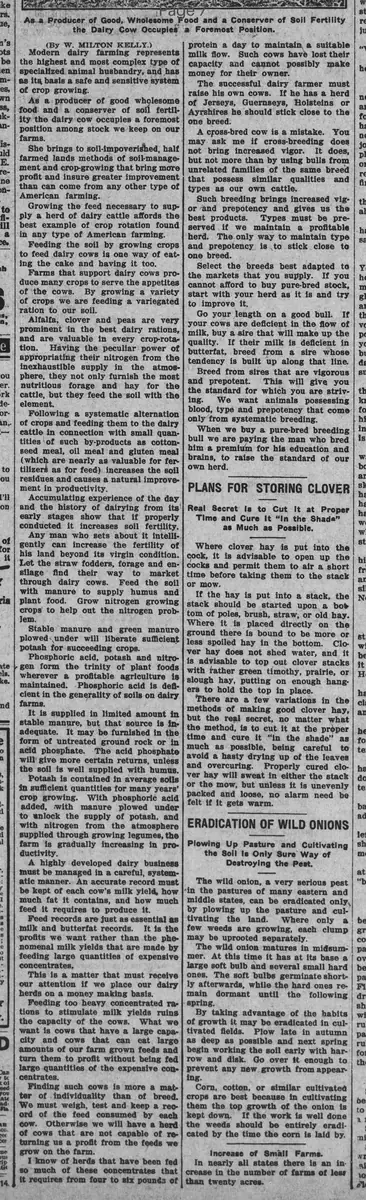
As a Producer of Good, Wholesome Food and a Conserver of Soil Fertility the Dairy Cow Occupies a Foremost Position.
(By W. MILTON KELLY)
Modern dairy farming represents the highest and most complex type of specialized animal husbandry, and has as its basis a safe and sensitive system of crop growing.
As a producer of good wholesome food, and a conserver of soil fertility the dairy cow occupies a foremost position among stock we keep on our farms.
She brings to soil-impoverished, half farmed lands methods of soil-management and crop-growing that bring more profit and insure greater improvement than can come from any other type of American farming.
Growing the feed necessary to supply a herd of dairy cattle affords the best example of crop rotation found in any type of American farming.
Feeding the soil by growing crops to feed dairy cows is one way of eating the cake and having it too.
Farms that support dairy cows produce many crops to serve the appetites of the cows. By growing a variety of crops we are feeding a variegated ration to our soil.
Alfalfa, clover and peas are very prominent in the best dairy rations, and are valuable in every crop-rotation. Having the peculiar power of appropriating their nitrogen from the inexhaustible supply in the atmosphere, they not only furnish the most nutritious forage and hay for the cattle, but they feed the soil with the element.
Following a systematic alternation of crops and feeding them to the dairy cattle in connection with small quantities of such by-products as cotton-seed meal, oil meal and gluten meal (which are nearly as valuable for fertilizers as for feed) increases the soil residues and causes a natural improvement in productivity.
Accumulating experience of the day and the history of dairying from its early stages show that if properly conducted it increases soil fertility.
Any man who sets about it intelligently can increase the fertility of his land beyond its virgin condition.
Let the straw fodders, forage and ensilage find their way to market through dairy cows. Feed the soil with manure to supply humus and plant food. Grow nitrogen growing crops to help out the nitrogen problem.
Stable manure and green manure plowed under will liberate sufficient potash for succeeding crops.
Phosphoric acid, potash and nitrogen form the trinity of plant foods wherever a profitable agriculture is maintained. Phosphoric acid is deficient in the generality of soils on dairy farms.
It is supplied in limited amount in stable manure, but that source is inadequate. It may be furnished in the form of untreated ground rock or in acid phosphate. The acid phosphate will give more certain returns, unless the soil is well supplied with humus.
Potash is contained in average soils in sufficient quantities for many years' crop growing. With phosphoric acid added, with manure plowed under to unlock the supply of potash, and with nitrogen from the atmosphere supplied through growing legumes, the farm is gradually increasing in productivity.
A highly developed dairy business must be managed in a careful, systematic manner. An accurate record must be kept of each cow's milk yield, how much fat it contains, and how much feed it requires to produce it.
Feed records are just as essential as milk and butterfat records. It is the profits we want rather than the phenomenal milk yields that are made by feeding large quantities of expensive concentrates.
This is a matter that must receive our attention if we place our dairy herds on a money making basis.
Feeding too heavy concentrated rations to stimulate milk yields ruins the capacity of the cows. What we want is cows that have a large capacity and cows that can eat large amounts of our farm grown feeds and turn them to profit without being fed large quantities of the expensive concentrates.
Finding such cows is more a matter of individuality than of breed.
We must weigh, test and keep a record of the feed consumed by each cow. Otherwise we will have a herd of cows that are not capable of returning us a profit from the feeds we grow on the farm.
I know of herds that have been fed so much of these concentrates that it requires from four to six pounds of protein a day to maintain a suitable milk flow. Such cows have lost their capacity and cannot possibly make money for their owner.
The successful dairy farmer must raise his own cows. If he has a herd of Jerseys, Guernseys, Holsteins or Ayrshires he should stick close to the one breed.
A cross-bred cow is a mistake. You may ask me if cross-breeding does not bring increased vigor. It does, but not more than by using bulls from unrelated families of the same breed that possess similar qualities and types as our own cattle.
Such breeding brings increased vigor and prepotency and gives us the best products. Types must be preserved if we maintain a profitable herd. The only way to maintain type and prepotency is to stick close to one breed.
Select the breeds best adapted to the markets that you supply. If you cannot afford to buy pure-bred stock, start with your herd as it is and try to improve it.
Go your length on a good bull. If your cows are deficient in the flow of milk, buy a sire that will make up the quality. If their milk is deficient in butterfat, breed from a sire whose tendency is built up along that line.
Breed from sires that are vigorous and prepotent. This will give you the standard for which you are striving. We want animals possessing blood, type and prepotency that come only from systematic breeding.
When we buy a pure-bred breeding bull we are paying the man who bred him a premium for his education and brains to raise the standard of our own herd.
(By W. MILTON KELLY)
Modern dairy farming represents the highest and most complex type of specialized animal husbandry, and has as its basis a safe and sensitive system of crop growing.
As a producer of good wholesome food, and a conserver of soil fertility the dairy cow occupies a foremost position among stock we keep on our farms.
She brings to soil-impoverished, half farmed lands methods of soil-management and crop-growing that bring more profit and insure greater improvement than can come from any other type of American farming.
Growing the feed necessary to supply a herd of dairy cattle affords the best example of crop rotation found in any type of American farming.
Feeding the soil by growing crops to feed dairy cows is one way of eating the cake and having it too.
Farms that support dairy cows produce many crops to serve the appetites of the cows. By growing a variety of crops we are feeding a variegated ration to our soil.
Alfalfa, clover and peas are very prominent in the best dairy rations, and are valuable in every crop-rotation. Having the peculiar power of appropriating their nitrogen from the inexhaustible supply in the atmosphere, they not only furnish the most nutritious forage and hay for the cattle, but they feed the soil with the element.
Following a systematic alternation of crops and feeding them to the dairy cattle in connection with small quantities of such by-products as cotton-seed meal, oil meal and gluten meal (which are nearly as valuable for fertilizers as for feed) increases the soil residues and causes a natural improvement in productivity.
Accumulating experience of the day and the history of dairying from its early stages show that if properly conducted it increases soil fertility.
Any man who sets about it intelligently can increase the fertility of his land beyond its virgin condition.
Let the straw fodders, forage and ensilage find their way to market through dairy cows. Feed the soil with manure to supply humus and plant food. Grow nitrogen growing crops to help out the nitrogen problem.
Stable manure and green manure plowed under will liberate sufficient potash for succeeding crops.
Phosphoric acid, potash and nitrogen form the trinity of plant foods wherever a profitable agriculture is maintained. Phosphoric acid is deficient in the generality of soils on dairy farms.
It is supplied in limited amount in stable manure, but that source is inadequate. It may be furnished in the form of untreated ground rock or in acid phosphate. The acid phosphate will give more certain returns, unless the soil is well supplied with humus.
Potash is contained in average soils in sufficient quantities for many years' crop growing. With phosphoric acid added, with manure plowed under to unlock the supply of potash, and with nitrogen from the atmosphere supplied through growing legumes, the farm is gradually increasing in productivity.
A highly developed dairy business must be managed in a careful, systematic manner. An accurate record must be kept of each cow's milk yield, how much fat it contains, and how much feed it requires to produce it.
Feed records are just as essential as milk and butterfat records. It is the profits we want rather than the phenomenal milk yields that are made by feeding large quantities of expensive concentrates.
This is a matter that must receive our attention if we place our dairy herds on a money making basis.
Feeding too heavy concentrated rations to stimulate milk yields ruins the capacity of the cows. What we want is cows that have a large capacity and cows that can eat large amounts of our farm grown feeds and turn them to profit without being fed large quantities of the expensive concentrates.
Finding such cows is more a matter of individuality than of breed.
We must weigh, test and keep a record of the feed consumed by each cow. Otherwise we will have a herd of cows that are not capable of returning us a profit from the feeds we grow on the farm.
I know of herds that have been fed so much of these concentrates that it requires from four to six pounds of protein a day to maintain a suitable milk flow. Such cows have lost their capacity and cannot possibly make money for their owner.
The successful dairy farmer must raise his own cows. If he has a herd of Jerseys, Guernseys, Holsteins or Ayrshires he should stick close to the one breed.
A cross-bred cow is a mistake. You may ask me if cross-breeding does not bring increased vigor. It does, but not more than by using bulls from unrelated families of the same breed that possess similar qualities and types as our own cattle.
Such breeding brings increased vigor and prepotency and gives us the best products. Types must be preserved if we maintain a profitable herd. The only way to maintain type and prepotency is to stick close to one breed.
Select the breeds best adapted to the markets that you supply. If you cannot afford to buy pure-bred stock, start with your herd as it is and try to improve it.
Go your length on a good bull. If your cows are deficient in the flow of milk, buy a sire that will make up the quality. If their milk is deficient in butterfat, breed from a sire whose tendency is built up along that line.
Breed from sires that are vigorous and prepotent. This will give you the standard for which you are striving. We want animals possessing blood, type and prepotency that come only from systematic breeding.
When we buy a pure-bred breeding bull we are paying the man who bred him a premium for his education and brains to raise the standard of our own herd.
What sub-type of article is it?
Agricultural Essay
Farming Guide
What themes does it cover?
Triumph
Moral Virtue
What keywords are associated?
Dairy Farming
Soil Fertility
Crop Rotation
Manure
Breeding Practices
What entities or persons were involved?
W. Milton Kelly
Story Details
Key Persons
W. Milton Kelly
Story Details
Article promotes dairy farming as superior for producing wholesome food and conserving soil fertility through crop rotation, legume crops, manure, and systematic management, emphasizing breed consistency, record-keeping, and selective breeding for profitability.