Thank you for visiting SNEWPapers!
Sign up free
Literary
April 19, 1883
The Daily Cairo Bulletin
Cairo, Alexander County County, Illinois
What is this article about?
In a rural town, city visitor Harry Sanders scorns marrying local girl Helen Langley for a wealthy heiress, unaware she overhears and vows revenge. Helen transforms, befriends his companion Roger, then reappears as elegant Helen Weston at a seaside hotel, captivating Harry before revealing her identity and past hurt, leading to her reconciliation with Roger.
Clipping
OCR Quality
85%
Good
Full Text
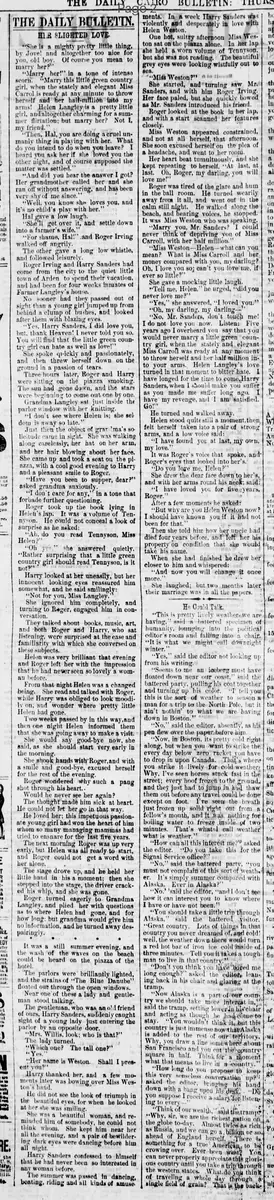
THE DAILY BULLETIN
HER SLIGHTED LOVE.
"She is a mighty pretty little thing.
by Jove! and altogether too nice for
you, old boy.
Of course you mean to
marry her?"
"Marry her!" in a tone of intense
scorn. "Marry this little green country
girl, when the stately and elegant Miss
Carrol is ready at any minute to throw
herself and her half-million into my
arms! Helen Langley is a pretty little
girl, and altogether charming for a sum-
mer flirtation; but marry her? Not I,
my friend."
"Then, Hal, you are doing a cruel un-
manly thing in playing with her. What
do you intend to do when you leave? I
heard you ask her if she loved you the
other night, and of course supposed the
matter was settled."
"And did you hear the answer I got?
Her grandmother called her and she
ran off without answering, and has been
very shy of me since.
"Well, you know she loves you, and
it's no child's play with her.
Hal gave a low laugh.
"She'll get over it, and settle down
into a farmer's wife.
"For shame, Hal!" and Roger Irving
walked off angrily.
The other gave a long low whistle,
and followed leisurely.
Roger Irving and Harry Sanders had
come from the city to the quiet little
town of Arden to spend their vacation,
and had been for four weeks inmates of
Farmer Langley's house.
No sooner had they passed out of
sight than a young girl jumped up from
behind a clump of bushes, and looked
after them with blazing eyes.
"Yes, Harry Sanders, I did love you,
but, thank Heaven! I never told you so.
You will find that the little green coun-
try girl can hate as well as love!'
She spoke quickly and passionately,
and then threw herself down on the
ground in a passion of tears.
Three hours later, Roger and Harry
were sitting on the piazza smoking.
The sun had gone down, and the stars
were beginning to come out one by one.
Grandma Langley sat just inside the
parlor window with her knitting.
"I don't see where Helen is; she sel-
dom is away so late."
Just then the object of Grandma's so-
licitude came in sight. She was walking
along carelessly, her hat on her arm,
and her hair blowing about her face.
She came up and took a seat on the pi-
azza, with a cool good evening to Harry
and a pleasant smile to Roger.
"Have you been to supper, dear?"
asked grandma anxiously.
"I don't care for any," in a tone that
forbade further questioning.
Roger took up the book lying in
Helen's lap. It was a volume of Ten-
ny son. He could not conceal a look of
surprise as he asked:
"Ah, do you read Tennyson, Miss
Helen?"
"Oh yes."
she answered quietly.
"Rather surprising that a little green
country girl should read Tennyson, is it
not?"
Harry looked at her uneasily, but her
innocent looking eyes reassured him
somewhat, and he said smilingly:
"Not for you, Miss Langley."
She ignored him completely, and
turning to Roger, engaged him in con-
versation.
They talked about books, music, art.
and both Roger and Harry, who sat
listening, were surprised at the ease and
familiarity with which she conversed on
these subjects.
Helen was very brilliant that evening
and Roger left her with the impression
that he had never seen so lovely a wom-
an before.
From that night Helen was a changed
being. She read and talked with Roger,
while Harry was obliged to look moodi-
ly on, and wonder where pretty little
Helen had gone.
Two weeks passed by in this way, and
then one night Helen informed them
that she was going away to make a visit.
She would say good-bye now, she
said, as she should start very early in
the morning.
She shook hands with Roger, and with
a smile and good-bye, excused herself
for the rest of the evening.
Roger wondered why such a pang
shot through his heart.
Would he never see her again?
The thought made him sick at heart.
He could not let her go in that way.
He loved her; this impetuous passion-
ate young girl had won the heart of him
whom so many managing mammas had
tried to ensnare for the last five years.
The next morning Roger was up very
early, but Helen was all ready to start,
and Roger could not get a word with
her alone.
The stage drove up, and he held her
little hand in his a moment; then she
stepped into the stage, the driver crack-
ed his whip, and she was gone.
Roger turned eagerly to Grandma
Langley, and plied her with questions
as to where Helen had gone, and for
how long; but grandma would give him
no information, and he turned away des-
pairingly.
It was a still summer evening, and
the wash of the waves on the beach
could be heard on the piazza of the
hotel.
The parlors were brilliantly lighted,
and the strains of "The Blue Danube"
floated out through the open windows.
Near one of these a lady and gentle-
man stood talking.
The gentleman, who was an old friend
of ours, Harry Sanders, suddenly caught
sight of a young lady just entering the
parlor by an opposite door.
"Mrs. Willis, look; who is that?"
The lady turned.
"Which one?
The tall one?"
"Yes."
"Her name is Weston. Shall I pres-
ent you?"
Harry thanked her, and a few mo-
ments later was bowing over Miss Wes-
ton's hand.
He did not see the look of triumph in
the beautiful eyes, for when he looked
at her she was smiling.
She was a beautiful woman, and re-
minded him of somebody, he could not
think whom. She kept him near her
all the evening, and a pair of bewilder-
ing dark eyes were dancing before him
all night.
Harry Sanders confessed to himself
that he had never been so interested in
any woman before.
The summer was passed in dancing,
boating, riding and all kinds of amuse-
ments. In a week Harry Sanders was
violently and desperately in love with
Helen Weston.
One hot, sultry afternoon Miss Wes-
ton sat on the piazza alone. In her lap
she held a worn volume of Tennyson,
but she was not reading. The beautiful
grey eyes were looking wistfully out to
sea.
"Miss Weston?" a voice said to him.
She started, and turning saw Mr.
Sanders, and with him Roger Irving.
Her face paled, but she quickly bowed
as Mr. Sanders introduced his friend.
Roger looked at the book in her lap,
and with a start scanned her features
closely.
Miss Weston appeared constrained
and not at all herself that afternoon.
She soon excused herself on the plea of
a headache, and went to her room.
Her heart beat tumultuously, and she
kept repeating to herself, "At last, at
last. Oh, Roger, my darling, you will
love me!"
Roger was tired of the glare and hum
in the ball room. He turned wearily
away from it all, and went out in the
calm still night. He walked along the
beach, and hearing voices, he stopped.
It was Miss Weston who was speaking.
"Marrying you, Mr. Sanders? I could
never think of depriving you of Miss
Carroll, with her half million."
"Miss Weston-Helen-what can you
mean? What is Miss Carroll and her
money compared with you, my darling?
Oh, I love you so; can't you love me, if
ever so little?"
She gave a mocking little laugh.
"Tell me, Helen," he urged, "did you
never love me?"
"Yes," she answered, "I loved you."
"Oh, my darling, my darling"
"No, Mr. Sanders, don't touch me!
I do not love you now. Listen: Five
years ago I overheard you say that you
would never marry a little green coun-
try girl, when the stately and elegant
Miss Carrol was ready at any moment
to throw herself and her half million in-
to your arms. Helen Langley's love
turned in that moment to bitter hate. I
have longed for the time to come, Harry
Sanders, when I should make you suffer
as you made me suffer long ago. I
have my revenge, and I am satisfied.
Go!"
He turned and walked away.
Helen stood quite still a moment, then
felt herself taken into a pair of strong
arms, and a low voice said:
"I have found you at last, my own,
my love."
It was Roger's voice that spoke, and
Roger's eyes that looked into hers.
"Do you love me, Helen?"
She drew the dear face down to hers
and with her arms round his neck, said
"I have loved you for five years,
Roger."
After a few moments he asked:
"But why are you Helen Weston now?
I should have known you if it had not
been for that."
Then she told him how her uncle had
died four years before, and left her his
property on condition that she would
take his name.
When she had finished he drew her
closer to him and whispered:
"And now you will change it once
more."
She laughed; but two months later
their marriage was in all the papers.
HER SLIGHTED LOVE.
"She is a mighty pretty little thing.
by Jove! and altogether too nice for
you, old boy.
Of course you mean to
marry her?"
"Marry her!" in a tone of intense
scorn. "Marry this little green country
girl, when the stately and elegant Miss
Carrol is ready at any minute to throw
herself and her half-million into my
arms! Helen Langley is a pretty little
girl, and altogether charming for a sum-
mer flirtation; but marry her? Not I,
my friend."
"Then, Hal, you are doing a cruel un-
manly thing in playing with her. What
do you intend to do when you leave? I
heard you ask her if she loved you the
other night, and of course supposed the
matter was settled."
"And did you hear the answer I got?
Her grandmother called her and she
ran off without answering, and has been
very shy of me since.
"Well, you know she loves you, and
it's no child's play with her.
Hal gave a low laugh.
"She'll get over it, and settle down
into a farmer's wife.
"For shame, Hal!" and Roger Irving
walked off angrily.
The other gave a long low whistle,
and followed leisurely.
Roger Irving and Harry Sanders had
come from the city to the quiet little
town of Arden to spend their vacation,
and had been for four weeks inmates of
Farmer Langley's house.
No sooner had they passed out of
sight than a young girl jumped up from
behind a clump of bushes, and looked
after them with blazing eyes.
"Yes, Harry Sanders, I did love you,
but, thank Heaven! I never told you so.
You will find that the little green coun-
try girl can hate as well as love!'
She spoke quickly and passionately,
and then threw herself down on the
ground in a passion of tears.
Three hours later, Roger and Harry
were sitting on the piazza smoking.
The sun had gone down, and the stars
were beginning to come out one by one.
Grandma Langley sat just inside the
parlor window with her knitting.
"I don't see where Helen is; she sel-
dom is away so late."
Just then the object of Grandma's so-
licitude came in sight. She was walking
along carelessly, her hat on her arm,
and her hair blowing about her face.
She came up and took a seat on the pi-
azza, with a cool good evening to Harry
and a pleasant smile to Roger.
"Have you been to supper, dear?"
asked grandma anxiously.
"I don't care for any," in a tone that
forbade further questioning.
Roger took up the book lying in
Helen's lap. It was a volume of Ten-
ny son. He could not conceal a look of
surprise as he asked:
"Ah, do you read Tennyson, Miss
Helen?"
"Oh yes."
she answered quietly.
"Rather surprising that a little green
country girl should read Tennyson, is it
not?"
Harry looked at her uneasily, but her
innocent looking eyes reassured him
somewhat, and he said smilingly:
"Not for you, Miss Langley."
She ignored him completely, and
turning to Roger, engaged him in con-
versation.
They talked about books, music, art.
and both Roger and Harry, who sat
listening, were surprised at the ease and
familiarity with which she conversed on
these subjects.
Helen was very brilliant that evening
and Roger left her with the impression
that he had never seen so lovely a wom-
an before.
From that night Helen was a changed
being. She read and talked with Roger,
while Harry was obliged to look moodi-
ly on, and wonder where pretty little
Helen had gone.
Two weeks passed by in this way, and
then one night Helen informed them
that she was going away to make a visit.
She would say good-bye now, she
said, as she should start very early in
the morning.
She shook hands with Roger, and with
a smile and good-bye, excused herself
for the rest of the evening.
Roger wondered why such a pang
shot through his heart.
Would he never see her again?
The thought made him sick at heart.
He could not let her go in that way.
He loved her; this impetuous passion-
ate young girl had won the heart of him
whom so many managing mammas had
tried to ensnare for the last five years.
The next morning Roger was up very
early, but Helen was all ready to start,
and Roger could not get a word with
her alone.
The stage drove up, and he held her
little hand in his a moment; then she
stepped into the stage, the driver crack-
ed his whip, and she was gone.
Roger turned eagerly to Grandma
Langley, and plied her with questions
as to where Helen had gone, and for
how long; but grandma would give him
no information, and he turned away des-
pairingly.
It was a still summer evening, and
the wash of the waves on the beach
could be heard on the piazza of the
hotel.
The parlors were brilliantly lighted,
and the strains of "The Blue Danube"
floated out through the open windows.
Near one of these a lady and gentle-
man stood talking.
The gentleman, who was an old friend
of ours, Harry Sanders, suddenly caught
sight of a young lady just entering the
parlor by an opposite door.
"Mrs. Willis, look; who is that?"
The lady turned.
"Which one?
The tall one?"
"Yes."
"Her name is Weston. Shall I pres-
ent you?"
Harry thanked her, and a few mo-
ments later was bowing over Miss Wes-
ton's hand.
He did not see the look of triumph in
the beautiful eyes, for when he looked
at her she was smiling.
She was a beautiful woman, and re-
minded him of somebody, he could not
think whom. She kept him near her
all the evening, and a pair of bewilder-
ing dark eyes were dancing before him
all night.
Harry Sanders confessed to himself
that he had never been so interested in
any woman before.
The summer was passed in dancing,
boating, riding and all kinds of amuse-
ments. In a week Harry Sanders was
violently and desperately in love with
Helen Weston.
One hot, sultry afternoon Miss Wes-
ton sat on the piazza alone. In her lap
she held a worn volume of Tennyson,
but she was not reading. The beautiful
grey eyes were looking wistfully out to
sea.
"Miss Weston?" a voice said to him.
She started, and turning saw Mr.
Sanders, and with him Roger Irving.
Her face paled, but she quickly bowed
as Mr. Sanders introduced his friend.
Roger looked at the book in her lap,
and with a start scanned her features
closely.
Miss Weston appeared constrained
and not at all herself that afternoon.
She soon excused herself on the plea of
a headache, and went to her room.
Her heart beat tumultuously, and she
kept repeating to herself, "At last, at
last. Oh, Roger, my darling, you will
love me!"
Roger was tired of the glare and hum
in the ball room. He turned wearily
away from it all, and went out in the
calm still night. He walked along the
beach, and hearing voices, he stopped.
It was Miss Weston who was speaking.
"Marrying you, Mr. Sanders? I could
never think of depriving you of Miss
Carroll, with her half million."
"Miss Weston-Helen-what can you
mean? What is Miss Carroll and her
money compared with you, my darling?
Oh, I love you so; can't you love me, if
ever so little?"
She gave a mocking little laugh.
"Tell me, Helen," he urged, "did you
never love me?"
"Yes," she answered, "I loved you."
"Oh, my darling, my darling"
"No, Mr. Sanders, don't touch me!
I do not love you now. Listen: Five
years ago I overheard you say that you
would never marry a little green coun-
try girl, when the stately and elegant
Miss Carrol was ready at any moment
to throw herself and her half million in-
to your arms. Helen Langley's love
turned in that moment to bitter hate. I
have longed for the time to come, Harry
Sanders, when I should make you suffer
as you made me suffer long ago. I
have my revenge, and I am satisfied.
Go!"
He turned and walked away.
Helen stood quite still a moment, then
felt herself taken into a pair of strong
arms, and a low voice said:
"I have found you at last, my own,
my love."
It was Roger's voice that spoke, and
Roger's eyes that looked into hers.
"Do you love me, Helen?"
She drew the dear face down to hers
and with her arms round his neck, said
"I have loved you for five years,
Roger."
After a few moments he asked:
"But why are you Helen Weston now?
I should have known you if it had not
been for that."
Then she told him how her uncle had
died four years before, and left her his
property on condition that she would
take his name.
When she had finished he drew her
closer to him and whispered:
"And now you will change it once
more."
She laughed; but two months later
their marriage was in all the papers.
What sub-type of article is it?
Prose Fiction
What themes does it cover?
Love Romance
Social Manners
What keywords are associated?
Slighted Love
Country Girl
Revenge Romance
Social Class
Summer Flirtation
Literary Details
Title
Her Slighted Love.
Key Lines
"Marry Her!" In A Tone Of Intense Scorn. "Marry This Little Green Country Girl. When The Stately And Elegant Miss Carrol Is Ready At Any Minute To Throw Herself And Her Half Million Into My Arms!"
"Yes. Harry Sanders, I Did Love You, But, Thank Heaven! I Never Told You So. You Will Find That The Little Green Country Girl Can Hate As Well As Love!"
"I Loved You." She Answered, "I Loved You."
"No. Mr. Sanders, Don't Touch Me! I Do Not Love You Now. Listen: Five Years Ago I Overheard You Say That You Would Never Marry A Little Green Country Girl, When The Stately And Elegant Miss Carrol Was Ready At Any Moment To Throw Herself And Her Half Million Into Your Arms."