Thank you for visiting SNEWPapers!
Sign up free
Letter to Editor
December 15, 1803
Alexandria Daily Advertiser
Alexandria, Virginia
What is this article about?
The letter urges prompt action to repeal a burdensome militia law passed by Congress and critiques local governance proposals following a recent epidemic calamity. It opposes making the mayor a police and sanitation officer, advocating instead for a dedicated health inspector to address nuisances and prevent future outbreaks in the town.
Clipping
OCR Quality
98%
Excellent
Full Text
Communication.
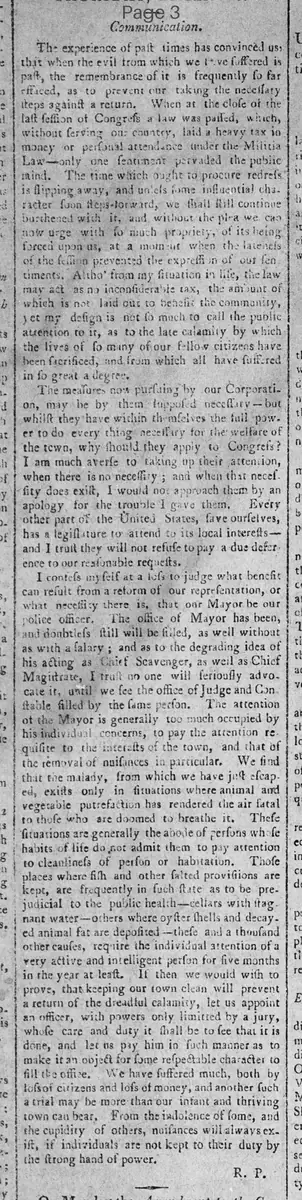
The experience of past times has convinced us that when the evil from which we have suffered is past, the remembrance of it is frequently so far effaced, as to prevent our taking the necessary steps against a return. When at the close of the last session of Congress a law was passed, which, without serving our country, laid a heavy tax in money or personal attendance under the Militia Law—only one sentiment pervaded the public mind. The time which ought to procure redress is slipping away, and unless some influential character soon steps forward, we shall still continue burdened with it, and without the plea we can now urge with so much propriety, of its being forced upon us, at a moment when the lateness of the session prevented the expression of our sentiments. Altho' from my Situation in life, the law may act as no inconsiderable tax, the amount of which is not laid out to benefit the community, yet my design is not so much to call the public attention to it, as to the late calamity by which the lives of so many of our fellow citizens have been sacrificed, and from which all have suffered in so great a degree.
The measures now pursuing by our Corporation, may be by them supposed necessary—but while they have within themselves the full power to do every thing necessary for the welfare of the town, why should they apply to Congress? I am much averse to taking up their attention, when there is no necessity; and when that necessity does exist, I would not approach them by an apology for the trouble I gave them. Every other part of the United States, as well as ourselves, has a legislature to attend to its local interests—and I trust they will not refuse to pay a due deference to our reasonable requests.
I confess myself at a loss to judge what benefit can result from a reform of our representation, or what necessity there is, that our Mayor be our police officer. The office of Mayor has been and doubtless still will be filled, as well without as with a salary; and as to the degrading idea of his acting as Chief Scavenger, as well as Chief Magistrate, I trust no one will seriously advocate it, until we see the office of Judge and Constable filled by the same person. The attention of the Mayor is generally too much occupied by his individual concerns, to pay the attention requisite to the interests of the town, and that of the removal of nuisances in particular. We find that the malady, from which we have just escaped, exists only in situations where animal and vegetable putrefaction has rendered the air fatal to those who are doomed to breathe it. These situations are generally the abode of persons whose habits of life do not admit them to pay attention to cleanliness of person or habitation. Those places where fish and other salted provisions are kept, are frequently in such state as to be prejudicial to the public health—cellars with stagnant water—others where oyster shells and decayed animal fat are deposited—these and a thousand other causes, require the individual attention of a very active and intelligent person for five months in the year at least. If then we would wish to prove, that keeping our town clean will prevent a return of the dreadful calamity, let us appoint an officer, whose care and duty it shall be to see that it is done, and let us pay him in such manner as to make it an object for some respectable character to fill the office. We have suffered much, both by loss of citizens and loss of money, and another such a trial may be more than our infant and thriving town can bear. From the indolence of some, and the cupidity of others, nuisances will always exist, if individuals are not kept to their duty by the strong hand of power.
R. P.
The experience of past times has convinced us that when the evil from which we have suffered is past, the remembrance of it is frequently so far effaced, as to prevent our taking the necessary steps against a return. When at the close of the last session of Congress a law was passed, which, without serving our country, laid a heavy tax in money or personal attendance under the Militia Law—only one sentiment pervaded the public mind. The time which ought to procure redress is slipping away, and unless some influential character soon steps forward, we shall still continue burdened with it, and without the plea we can now urge with so much propriety, of its being forced upon us, at a moment when the lateness of the session prevented the expression of our sentiments. Altho' from my Situation in life, the law may act as no inconsiderable tax, the amount of which is not laid out to benefit the community, yet my design is not so much to call the public attention to it, as to the late calamity by which the lives of so many of our fellow citizens have been sacrificed, and from which all have suffered in so great a degree.
The measures now pursuing by our Corporation, may be by them supposed necessary—but while they have within themselves the full power to do every thing necessary for the welfare of the town, why should they apply to Congress? I am much averse to taking up their attention, when there is no necessity; and when that necessity does exist, I would not approach them by an apology for the trouble I gave them. Every other part of the United States, as well as ourselves, has a legislature to attend to its local interests—and I trust they will not refuse to pay a due deference to our reasonable requests.
I confess myself at a loss to judge what benefit can result from a reform of our representation, or what necessity there is, that our Mayor be our police officer. The office of Mayor has been and doubtless still will be filled, as well without as with a salary; and as to the degrading idea of his acting as Chief Scavenger, as well as Chief Magistrate, I trust no one will seriously advocate it, until we see the office of Judge and Constable filled by the same person. The attention of the Mayor is generally too much occupied by his individual concerns, to pay the attention requisite to the interests of the town, and that of the removal of nuisances in particular. We find that the malady, from which we have just escaped, exists only in situations where animal and vegetable putrefaction has rendered the air fatal to those who are doomed to breathe it. These situations are generally the abode of persons whose habits of life do not admit them to pay attention to cleanliness of person or habitation. Those places where fish and other salted provisions are kept, are frequently in such state as to be prejudicial to the public health—cellars with stagnant water—others where oyster shells and decayed animal fat are deposited—these and a thousand other causes, require the individual attention of a very active and intelligent person for five months in the year at least. If then we would wish to prove, that keeping our town clean will prevent a return of the dreadful calamity, let us appoint an officer, whose care and duty it shall be to see that it is done, and let us pay him in such manner as to make it an object for some respectable character to fill the office. We have suffered much, both by loss of citizens and loss of money, and another such a trial may be more than our infant and thriving town can bear. From the indolence of some, and the cupidity of others, nuisances will always exist, if individuals are not kept to their duty by the strong hand of power.
R. P.
What sub-type of article is it?
Persuasive
Informative
Social Critique
What themes does it cover?
Health Medicine
Politics
Social Issues
What keywords are associated?
Militia Law
Epidemic Prevention
Town Cleanliness
Mayor Duties
Corporation Measures
Public Health Nuisances
What entities or persons were involved?
R. P.
Letter to Editor Details
Author
R. P.
Main Argument
the writer calls for repeal of the burdensome militia law and proposes appointing a dedicated officer to enforce town cleanliness and prevent future epidemics, while criticizing the corporation's appeal to congress and proposals to overburden the mayor with police and sanitation duties.
Notable Details
References To Last Session Of Congress And Militia Law
Description Of Recent Calamity As Malady From Putrefaction
Critique Of Nuisances Like Stagnant Water, Oyster Shells, And Decayed Fat
Analogy To Not Combining Judge And Constable Roles