Thank you for visiting SNEWPapers!
Sign up free
The National Intelligencer And Washington Advertiser
Washington, District Of Columbia
What is this article about?
Biographical anecdotes of poet Robert Bloomfield, abridged from brother George's letter to Capel Lofft. Details his rural childhood, father's death, brief schooling, apprenticeship as shoemaker in London, self-education through reading newspapers and books like Thomson's Seasons, early poetry, trade disputes, and inspiration for The Farmer's Boy amid family struggles.
Clipping
OCR Quality
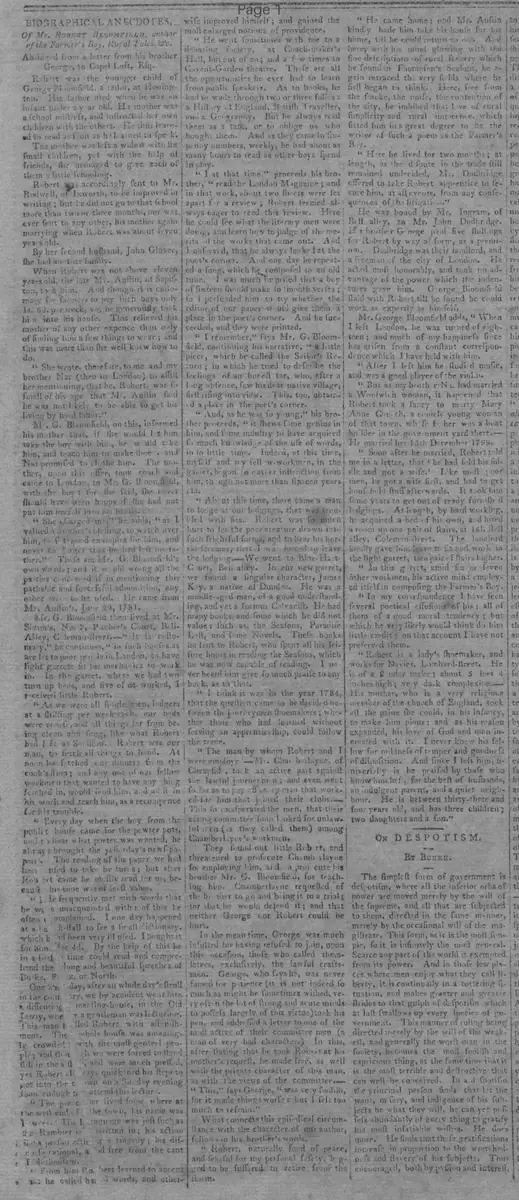
Full Text
Of Mr. ROBERT BLOOMFIELD, author
of the Farmer's Boy, Rural Tales, &c.
Abidged from a letter from his brother
George, to Capel Lofft, Esq.
Robert was the younger child of
George Bloomfield, a tailor, at Honington.
His father died when he was an
infant under a year old. His mother was
a school mistress, and instructed her own
children with the others. He thus learned
to read as soon as he learned to speak.
The mother was left a widow with six
small children, yet with the help of
friends, she managed to give each of
them a little schooling.
Robert was accordingly sent to Mr.
Rodwell, of Ixworth, to be improved in
writing; but he did not go to that school
more than two or three months, nor was
ever sent to any other, his mother again
marrying when Robert was about seven
years old.
By her second husband, John Glover,
she had another family.
When Robert was not above eleven
years old, the late Mr. Austin, of Sapiston,
took him. And though it is customary
for farmers to pay such boys only
1s. 6d. per week, yet he generously took
him into his house. This relieved his
mother of any other expense than only
of finding him a few things to wear; and
this was more than she well knew how to
do.
She wrote, therefore, to me and my
brother Nat (then in London) to assist
her mentioning, that he, Robert, was so
small of his age that Mr. Austin said
he was not likely to be able to get his
living by hard labor."
Mr. G. Bloomfield, on this, informed
his mother that, if she would let him
take the boy with him, he would take
him, and teach him to make shoes; and
Nat promised to clothe him. The mother,
upon this offer, took coach and
came to London, to Mr. G. Bloomfield,
with the boy: for she said, she never
should have been happy if she had not
put him herself into his hands.
"She charged me," he adds, "as I
valued a brother's blessing, to watch over
him, to set good examples for him, and
never to forget that he had lost his father."
These are Mr. G. Bloomfield's
own words; and it would wrong all the
parties concerned if in mentioning this
pathetic and successful admonition, any
other words were used. He came from
Mr. Austin's, June 29, 1781.
Mr. G. Bloomfield then lived at Mr.
Sivam's, No. 7 Pecher's Court, Bell-
Alley, Coleman-street.--"It is customary,"
he continues, "in such houses as
are let to poor people in London, to have
light garrets fit for mechanics to work
in. In the garret, where we had two
turn up beds, and five of us worked, I
received little Robert.
"As we were all single men, lodgers
at a shilling per week each, our beds
were clean, and all things far from being
clean and snug, like what Robert
had left at Saxilton. Robert was our
man, to fetch all things to hand. At
noon he fetched our dinners from the
cook's shop; and any one of our fellow
workmen that wanted to have anything
fetched in, would send him, and assist in
his work; and teach him, as a recompence
for his trouble.
Every day when the boy from the
public house came for the pewter pots,
and to hear what porter was wanted, he
always brought the yesterday's newspaper.
The reading of the paper we had
been used to take by turns; but after
Robert came he must read for us, because
his time was of least value.
He frequently met with words that
he was unacquainted with: of this he
often complained. One day he happened
at a stall to see a small dictionary,
which had been very ill used. I bought it
for him for 4d. By the help of this he
in a little time could read and comprehend
the long and beautiful speeches of
Burke, Fox, or North.
One Sunday day, after all whole day's stroll
in the country, we by accident went into
a meeting-house, in the Old
Jewry, where a gentleman was lecturing.
This filled Robert with astonishment.
The whole house was amazingly crowded
with the most genteel people; and though
we were forced to stand, and were much pressed,
yet Robert liked to get into the crowd enough to
attend the lecture. This was on a Sunday evening.
He lived some where at the west end of the town, his name was [illegible]. His language was just such as is written in; his action like in tragedy; his delivery rational, and free from the cant of Methodism.
From him Robert learned to accent
what he called hard words, and otherwise
improved himself; and gained the
most enlarged notions of providence.
"He went sometimes with me to a
debating society, at Coach-maker's
Hall, but not often; and a few times to
Covent-Garden theatre. These are all
the opportunities he ever had to learn
from public speakers. As to books, he
had to wade through two or three volumes:
a History of England, British Traveller,
and a Geography. But he always read
them as a task, or to oblige us who
bought them. And as they came in six-
penny numbers, weekly, he had about as
many hours to read as other boys spend
in play.
"I at that time," proceeds his brother,
"read the London Magazine; and
in that work, about two sheets were set
apart for a review; Robert seemed always
eager to read this review. Here
he could see what the literary men were
doing, and learn how to judge of the merits
of the works that came out. And
I observed, that he always looked at the
poet's corner. And one day he repeated
a song, which he composed to an old
tune. I was much surprised that a boy
of sixteen should make so smooth verses;
so I persuaded him to try whether the
editor of our paper would give them a
place in the poet's corner. And he succeeded,
and they were printed.
"I remember," says Mr. G. Bloomfield,
continuing his narrative, "a little
piece, which he called the Sailor's Return;
in which he tried to describe the
feelings of an honest tar, who, after a
long absence, saw his dear native village,
first rising into view. This, too, obtained
a place in the poet's corner.
"And, as he was so young," his brother
proceeds, "it shows nice genius in
him, and more industry to have acquired
so much knowledge of the use of words,
in so little time. Indeed, at this time,
myself and Nat fellow-workmen, in the
garret, began to gather instruction from
him, though not more than sixteen years
old.
"About this time, there came a man
to lodge at our lodgings, that was troubled
with fits. Robert was so much
hurt to see the poor creature drawn into
such frightful forms, and to hear his horrid
screams, that I was forced to leave
the lodging.--We went to Blue-Hart-
Court, Bell-alley. In our new garret,
we found a singular character, James
Kay, a native of Dundee. He was a
middle-aged man, of a good understanding,
and yet a curious Calvinist. He had
many books, and some which he did not
value: such as, the Seasons, Paradise
Lost, and some Novels. These books
he lent to Robert, who spent all his leisure
hours in reading the Seasons, which
he was now capable of reading. I never
heard him give so much praise to any
book, as to that.
"I think it was in the year 1784,
that the question came to be decided between
the journeymen shoemakers; whether
those who had learned without
serving an apprenticeship, could follow
the trade.
"The man by whom Robert and I
were employed--Mr. Chamberlain, of
Cheapside, took an active part against
the lawful journeymen; and even went
so far as to pay 5s. to every man that worked
for him that joined their clubs.--
This so exasperated the men, that their
acting committee soon looked for unlawful
men (as they called them) among
Chamberlain's workmen.
They found out little Robert, and
threatened to prosecute Chamberlain
for employing him, and to prosecute his
brother Mr. G. Bloomfield, for teaching
him. Chamberlain requested of
the brother to go and bring it to a trial;
for that he would defend it; and that
neither George nor Robert could be
hurt.
In the mean time, George was much
insulted for having refused to join, upon
this occasion, those who called themselves,
exclusively, the lawful craftsmen.
George, who says, was never
famed for patience (it is not indeed so
much as might be sometimes wished, very
often the lot of strong and acute minds
to possess largely of this virtue) took his
pen, and addressed a letter to one of the
most active of their committee men (a
man of very bad character.) In this.
after stating that he took Robert at his
mother's request, he made free, as well
with the private character of this man.
as with the views of the committee.--
"This," says George, "was very foolish,
for it made things worse: but I felt too
much to refrain."
What connects this episodical circumstance
with the character of our author,
follows in his brother's words.
"Robert, naturally fond of peace,
and fearful for my personal safety, begged
to be suffered to retire from the
storm.
"He came home: and Mr. Austin
kindly bade him take his house for his
home, till he could return to London. And
here, with his mind glowing with the
fine descriptions of rural scenery which
he found in Thomson's Seasons, he again
retraced those very fields where he
first began to think. Here, free from
the smoke, the noise, the contention of
the city, he imbibed that love of rural
simplicity and rural innocence, which
fitted him in a great degree to be the
writer of such a poem as the Farmer's
Boy.
"Here he lived for two months; at
length, as he did not like the trade still
remained undecided, Mr. Dudbridge
offered to take Robert apprentice to secure
him, at all events, from any consequences
of the litigation."
He was bound by Mr. Ingram, of
Bell-alley, to Mr. John Dudbridge.
His brother George paid five shillings
for Robert by way of form, as a premium.
Dudbridge was their landlord, and
a freeman of the city of London. He
acted most honorably, and took no advantage
of the power which the indentures
gave him. George Bloomfield
staid with Robert till he found he could
work as expertly as himself.
Mr. George Bloomfield adds, "When
I left London, he was turned of eighteen;
and much of my happiness since
has arisen from a constant correspondence
which I have held with him.
"After I left him he studied music,
and was a good player of the violin.
"But as my brother Nat. had married
a Woolwich woman, it happened that
Robert took a fancy to marry Mary
Anne Church, a comely young woman
of that town, whose father was a boat
builder in the government yard there.--
He married her 13th December 1789.
"Soon after he married, Robert told
me in a letter, that he had sold his fiddle
and got a wife." Like most poor
men, he got a wife first, and had to get
household stuff afterwards. It took him
some years to get out of ready furnished
lodgings. At length, by hard working,
he acquired a bed of his own, and hired
a room up one pair of stairs, at 14l. Bell
Alley, Coleman-street. The landlord
kindly gave him leave to sit and work in
the light garret, two pair of stairs higher.
"In this garret, amid six or even
other workmen, his active mind employed
itself in composing the Farmer's Boy.
"In my correspondence I have seen
several poetical effusions of his; all of
them of a good moral tendency; but
which he very likely would think do him
little credit; on that account I have not
preserved them.
"Robert is a ladies' shoemaker, and
works for Davies, Lombard-street. He
is of a slender make; about 5 feet 4
inches high; very dark complexion.-
His mother, who is a very religious
member of the church of England, took
all the pains she could, in his infancy,
to make him pious; and as his reason
expanded, his love of God and man increased
with it. I never knew his fellow
for mildness of temper and goodness
of disposition. And since I left him, universally
is he praised by those who
know him best, for the best of husbands,
an indulgent parent, and a quiet neighbour.
He is between thirty-three and
four years old, and has three children;
two daughters and a son."
What sub-type of article is it?
What themes does it cover?
What keywords are associated?
What entities or persons were involved?
Literary Details
Title
Biographical Anecdotes, Of Mr. Robert Bloomfield, Author Of The Farmer's Boy, Rural Tales, &C.
Author
Abidged From A Letter From His Brother George, To Capel Lofft, Esq.
Subject
Biographical Sketch Of Robert Bloomfield's Early Life And Self Education
Form / Style
Prose Biographical Narrative
Key Lines