Thank you for visiting SNEWPapers!
Sign up free
The Hillsborough Recorder
Hillsboro, Orange County, North Carolina
What is this article about?
General Gaines reports on conferences with Creek Indian factions at Flint River and Broken Arrow, resolving differences over the February 1825 treaty. Both parties agree to peace, property restoration, and no retaliation. He advises against surveying ceded lands until 1826 removal and no need for Georgia militia.
Clipping
OCR Quality
Full Text
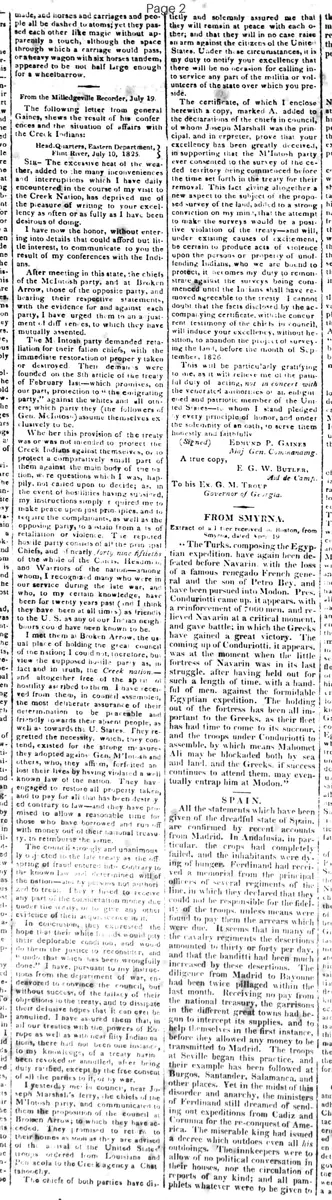
The following letter from general Gaines, shews the result of his conferences and the situation of affairs with the Creek Indians:
Head-Quarters, Eastern Department, Flint River, July 10, 1825.
Sir—The excessive heat of the weather, added to the many inconveniences and interruptions which I have daily encountered in the course of my visit to the Creek Nation, has deprived me of the pleasure of writing to your excellency as often or as fully as I have been desirous of doing.
I have now the honor, without entering into details that could afford but little interest, to communicate to you the result of my conferences with the Indians.
After meeting in this state, the chiefs of the McIntosh party, and at Broken Arrow, those of the opposite party, and hearing their respective statements, with the evidence for and against each party, I have urged them to an adjustment of differences, to which they have mutually assented.
The McIntosh party demanded retaliation for their fallen chiefs, with the immediate restoration of property taken or destroyed. Their demands were founded on the 5th article of the treaty of February last—which promises, on our part, protection to 'the emigrating party,' against the whites and all others; which party they (the followers of Gen. McIntosh) assume themselves exclusively to be.
Whether this provision of the treaty was or was not intended to protect the Creek Indians against themselves, or to protect a comparatively small part of them against the main body of the nation, were questions which I was, happily, not called upon to decide; as, in the event of hostilities having subsided, my instructions simply required me to make peace upon just principles, and to require the complainants, as well as the opposing party, to abstain from acts of retaliation or violence. The reputed hostile party consists of all the principal Chiefs, and nearly forty-nine fiftieths of the whole of the Chiefs, Headmen, and Warriors of the nation—among whom, I recognized many who were in our service during the late war, and who, to my certain knowledge, have been for twenty years past (and I think they have been at all times) as friendly to the U. S. as any of our Indian neighbours could have been known to be.
I met them at Broken Arrow, the usual place of holding the great council of the nation; I could not, therefore, but view the supposed hostile party as, in fact and in truth, the Creek nation—and altogether free of the spirit of hostility ascribed to them. I have received from them, in council assembled, the most deliberate assurance of their determination to be peaceable and friendly towards their absent people, as well as towards the U. States. They regretted the necessity, which, they contend, existed for the strong measures—they adopted against Gen. McIntosh and others, who, they affirm, forfeited and lost their lives by having violated a well known law of the nation. They have engaged to restore all property taken, and to pay for all that has been destroyed contrary to law—and they have promised to allow a reasonable time for those who have borrowed and run off with money out of their national treasury, to reimburse the same.
The council strongly and unanimously objected to the late treaty as the offspring of fraud entered into contrary to the known law and determined will of the nation—and, by persons not authorized to treat. They refused to receive any part of the consideration money due under the treaty, or to give any other evidence of their acquiescence in it.
In conclusion, they expressed the hope that their white friends would pity their deplorable condition, and would do them the justice to reconsider, and 'undo, that which has been wrongfully done.' I have, pursuant to my instructions from the department of war, endeavored to convince the council, but without success, of the fallacy of their objections to the treaty, and to dissipate their delusive hopes that it can ever be annulled. I have assured them that, in all our treaties with the powers of Europe as well as with nearly fifty Indian nations, there had not been one instance, to my knowledge, of a treaty having been revoked or annulled, after being duly ratified, except by the free consent of all the parties to it, or by war.
I yesterday met in council, near Joseph Marshall's ferry, the chiefs of the McIntosh party, and communicated to them the proposition of the council at Broken Arrow: to which they have acceded. They promised to return to their homes as soon as they are advised of the arrival of the United States' gunboats ordered from Louisiana and Pensacola to the Creek agency at Chat tahoochee.
The chiefs of both parties have strictly and solemnly assured me that they will remain at peace with each other; and that they will in no case raise an arm against the citizens of the United States. Under these circumstances, it is my duty to notify your excellency that there will be no occasion for calling into service any part of the militia or volunteers of the state over which you preside.
The certificate, of which I enclose herewith a copy, marked A, added to the declarations of the chiefs in council, of whom Joseph Marshall was the principal, and interpreter, prove that your excellency has been greatly deceived, in supposing that the McIntosh party ever consented to the survey of the ceded territory being commenced before the time set forth in the treaty for their removal. This fact giving altogether a new aspect to the subject of the proposed survey of the land, added to a strong conviction on my mind, that the attempt to make the surveys would be a positive violation of the treaty—and will, under existing causes of excitement, be certain to produce acts of violence upon the persons or property of unoffending Indians, who we are bound to protect, it becomes my duty to remonstrate against the surveys being commenced until the Indians shall have removed agreeable to the treaty. I cannot doubt that the facts disclosed by the accompanying certificate, with the concurrent testimony of the chiefs in council, will induce your excellency, without hesitation, to abandon the project of surveying the land, before the mouth of September, 1826.
This will be particularly gratifying to me, as it will relieve me of the painful duty of acting, not in concert with the venerated authorities of a cultivated and patriotic member of the United States—to whom I stand pledged, by every principle of honor, and under the solemnity of an oath, to serve them honestly and faithfully.
(Signed) EDMUND P. GAINES, Maj. Gen. Commanding.
A true copy,
E. G. W. BUTLER, A. D. C.
To his Ex. G. M. TROUP, Governor of Georgia.
What sub-type of article is it?
What keywords are associated?
What entities or persons were involved?
Where did it happen?
Domestic News Details
Primary Location
Creek Nation, Flint River
Event Date
July 10, 1825
Key Persons
Outcome
peace assured between parties; property to be restored and paid for; no retaliation; no need for militia; surveys of ceded territory to be delayed until september 1826; treaty objections noted but not annulled.
Event Details
General Gaines held conferences with McIntosh party chiefs and opposing party at Broken Arrow and Joseph Marshall's ferry, urging adjustment of differences over the February 1825 treaty. Both parties assented to peace, with the main council viewing the treaty as fraudulent and unauthorized. McIntosh party acceded to propositions and will return home upon gunboat arrival. Gaines remonstrates against premature land surveys to avoid violence.