Thank you for visiting SNEWPapers!
Sign up free
Alexandria Gazette
Alexandria, Alexandria County, District Of Columbia
What is this article about?
U.S. Senate session on July 17 debated and adopted a resolution changing meeting time to 10 o'clock except Saturdays; discussed Sub-treasury and Florida defenses bills; debated Treasury note issuance amid revenue concerns from tariff reductions; postponed Treasury note bill; resumed Tariff reduction bill debate.
Clipping
OCR Quality
Full Text
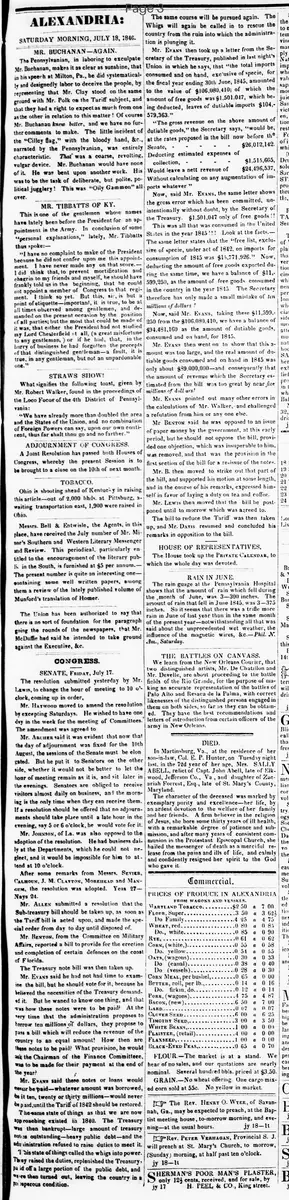
SENATE, FRIDAY, July 17.
The resolution submitted yesterday by Mr. Lewis, to change the hour of meeting to 10 o'clock, coming up in order,
Mr. Harwood moved to amend the resolution by excepting Saturdays. He wished to have one day in the week for the meeting of Committees.
The amendment was agreed to.
Mr. Archer said it was evident that now that the day of adjournment was fixed for the 10th August, the sessions of the Senate must be elongated. But he put it to Senators on the other side, whether it would not be better to let the hour of meeting remain as it is, and sit later in the evenings. Senators are obliged to receive visitors almost daily on business, and the morning is the only time when they can receive them.
If a resolution should be offered that no adjournments should take place until a late hour in the evening, say 5 or 6 o'clock, he would vote for it.
Mr. Johnson, of La. was also opposed to the adoption of the resolution. He had business daily at the Departments, which he could not neglect, and it would be impossible for him to attend at 10 o'clock.
After some remarks from Messrs. Sevier, Calhoun, J. M. Clayton, Morehead and Mangum, the resolution was adopted. Yeas 27—Nays 24.
Mr. Allen submitted a resolution that the Sub-treasury bill should be taken up, as soon as the Tariff bill is acted upon, and made the special order from day to day until disposed of.
Mr. Benton, from the Committee on Military Affairs, reported a bill to provide for the erection and completion of certain defences on the coast of Florida.
The Treasury note bill was then taken up.
Mr. Evans said he had not had time to examine the bill, but he should vote for it, because he believed the necessities of the Treasury demanded it. But he wanted to know one thing, and that was how these notes were to be paid? At the very time that the administration proposes to borrow ten millions of dollars, they propose to pass a bill which will reduce the revenue of the country to an equal amount! How then are these notes to be paid? What provision, he would ask the Chairman of the Finance Committee, was to be made for their payment at the end of the year?
Mr. Evans said those notes or loans would never be paid—whatever amount was borrowed, be it ten, twenty or thirty millions—would never be paid, until the Tariff of 1842 should be restored.
The same state of things as that we are now approaching existed in 1840. The Treasury was then bankrupt—large amount of treasury notes outstanding—heavy public debt—and the administration refused to raise duties to meet it.
This state of things called the whigs into power.
They raised the duties, replenished the Treasury, paid off a large portion of the public debt, and were then turned out, leaving the country in a prosperous condition.
The same course will be pursued again. The Whigs will again be called in to rescue the country from the ruin into which the administration is plunging it.
Mr. Evans then took up a letter from the Secretary of the Treasury, published in last night's Union in which he says, that "the total imports consumed and on hand, exclusive of specie, for the fiscal year ending 30th June, 1845, amounted to the value of $106,080,410; of which the amount of free goods was $1,501,047, which being deducted, leaves of dutiable imports $104,579,363."
"The gross revenue on the above amount of dutiable goods," the Secretary says, "would be, at the rates proposed in the bill now before the Senate,
$26,012,142.
Deducting estimated expenses of collection,
$1,515,605,
Would leave a nett revenue of
$24,496,537,
Without calculating on any augmentation of imports whatever"
Now, said Mr. Evans, the same letter shows the gross error which has been committed, unintentionally without doubt, by the Secretary of the Treasury. $1,501,047 only of free goods!! This was all that was consumed in the United States in the year 1845!!! Look at the facts.-
The same letter states that the "free list, exclusive of specie, under act of 1842, on imports for consumption of 1845 was $15,771,926."
Now,
deducting the amount of free goods exported during the same time, we have a balance of $11,599,250, as the amount of free goods consumed in the country in the year 1845. The Secretary therefore has only made a small mistake of ten millions of dollars!
Now, said Mr. Evans, taking these $11,599,250 from the $106,080,410, we have a balance of $94,481,160 as the amount of dutiable goods, consumed and on hand, for 1845.
Mr. Evans then went on to show that this amount was too large, and the real amount of dutiable goods consumed and on hand in 1845 was only about $89,000,000—and consequently that the amount of revenue which the Secretary estimated from the bill was too great by near five millions of dollars!
Mr. Evans pointed out many other errors in the calculations of Mr. Walker, —and challenged a refutation from him or any one else.
Mr. Benton said he was opposed to an issue of paper money by the government, at this early period, but he should not oppose the bill, provided one objection, which was insuperable to him, was removed, and that was the provision in the first section of the bill for a re-issue of the notes.
Mr. B. then moved to strike out that part of the bill, and supported his motion at some length, and in the course of his remarks, expressed himself in favor of laying a duty on tea and coffee.
Mr. Lewis then moved that the bill be postponed until to-morrow which was agreed to.
The bill to reduce the Tariff was then taken up, and Mr. Davis resumed and concluded his remarks in opposition to the bill.
What sub-type of article is it?
What keywords are associated?
What entities or persons were involved?
Domestic News Details
Event Date
Friday, July 17.
Key Persons
Outcome
resolution to change meeting hour to 10 o'clock (except saturdays) adopted 27-24; sub-treasury bill resolution submitted; florida defenses bill reported; treasury note bill debated and postponed to tomorrow; tariff reduction bill taken up with mr. davis concluding opposition remarks.
Event Details
Senate proceedings included debate on changing meeting time, submission of resolutions on Sub-treasury and Florida defenses bills, debate on Treasury note bill with criticisms of revenue estimates and tariff impacts, and resumption of Tariff reduction bill debate.