Thank you for visiting SNEWPapers!
Sign up free
Story
March 15, 1884
Southern Standard
Mcminnville, Warren County, Tennessee
What is this article about?
In 1884, a Franklin farmer shares weather woes delaying spring planting, recalls 1843's heavy snow, and offers expert advice on cultivating sorghum cane for high yields, including land prep, seeding, and dual-crop timing.
Clipping
OCR Quality
98%
Excellent
Full Text
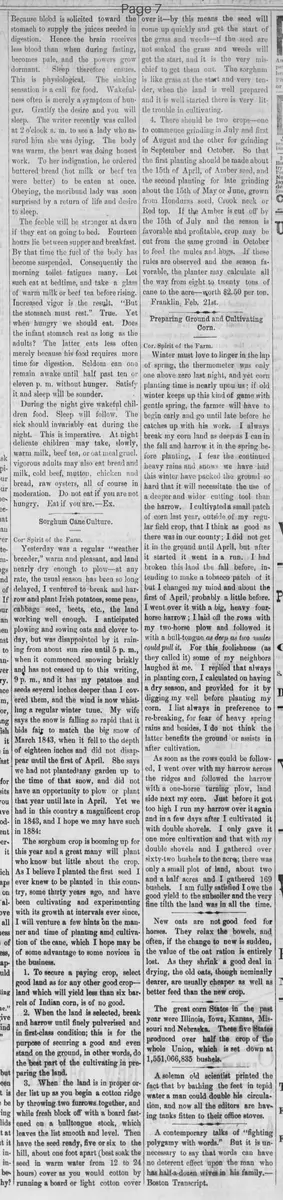
Sorghum Cane Culture.
Yesterday was a regular "weather breeder," warm and pleasant, and land nearly dry enough to plow—at any rate, the usual season has been so long delayed, I ventured to break and harrow and plant Irish potatoes, some peas, cabbage seed, beets, etc., the land working well enough. I anticipated plowing and sowing oats and clover to-day, but was disappointed by it raining from about sun rise until 5 p. m., when it commenced snowing briskly and has not ceased up to this writing, 9 p. m., and it has my potatoes and seeds several inches deeper than I covered them, and the wind is now whistling a regular winter tune. My wife says the snow is falling so rapid that it bids fair to match the big snow of March 1843, when it fell to the depth of eighteen inches and did not disappear until the first of April. She says we had not planted any garden up to the time of that snow, and did not have an opportunity to plow or plant that year until late in April. Yet we had in this country a magnificent crop in 1843, and I hope we may have such in 1884.
The sorghum crop is booming up for this year and a great many will plant who know but little about the crop. As I believe I planted the first seed I ever knew to be planted in this country, some thirty years ago, and have been cultivating and experimenting with its growth at intervals ever since, I will venture a few hints on the manner and time of planting and cultivation of the cane, which I hope may be of some advantage to some novices in the business.
1. To secure a paying crop, select good land as for any other good crop—land which will yield less than six barrels of Indian corn, is of no good.
2. When the land is selected, break and harrow until finely pulverised and in first-class condition; this is for the purpose of securing a good and even stand on the ground, in other words, do the best part of the cultivating in preparing the land.
3. When the land is in proper order list up as you begin a cotton ridge by throwing two furrows together, and while fresh block off with a board fastened on a bulltongue stock, which leaves the list smooth and level. Then have the seed ready, five or six to the hill, about one foot apart (best soak the seed in warm water from 12 to 24 hours) cover as you would cotton by running a board or light cotton cover over it—by this means the seed will come up quickly and get the start of the grass and weeds—if the seed are not soaked the grass and weeds will get the start, and it is the very mischief to get them out. The sorghum is like grass at the start and very tender, when the land is well prepared and it is well started there is very little trouble in cultivating.
4. There should be two crops—one to commence grinding in July and first of August and the other for grinding in September and October. So that the first planting should be made about the 15th of April, of Amber seed, and the second planting for late grinding about the 15th of May or June, grown from Honduras seed. Crook neck or Red top. If the Amber is cut off by the 15th of July and the season is favorable and profitable, crop may be cut from the same ground in October to feed the mules and hogs. If these rules are observed and the season favorable, the planter may calculate all the way from eight to twenty tons of cane to the acre—worth $2.50 per ton.
Franklin Feb. 21st.
Yesterday was a regular "weather breeder," warm and pleasant, and land nearly dry enough to plow—at any rate, the usual season has been so long delayed, I ventured to break and harrow and plant Irish potatoes, some peas, cabbage seed, beets, etc., the land working well enough. I anticipated plowing and sowing oats and clover to-day, but was disappointed by it raining from about sun rise until 5 p. m., when it commenced snowing briskly and has not ceased up to this writing, 9 p. m., and it has my potatoes and seeds several inches deeper than I covered them, and the wind is now whistling a regular winter tune. My wife says the snow is falling so rapid that it bids fair to match the big snow of March 1843, when it fell to the depth of eighteen inches and did not disappear until the first of April. She says we had not planted any garden up to the time of that snow, and did not have an opportunity to plow or plant that year until late in April. Yet we had in this country a magnificent crop in 1843, and I hope we may have such in 1884.
The sorghum crop is booming up for this year and a great many will plant who know but little about the crop. As I believe I planted the first seed I ever knew to be planted in this country, some thirty years ago, and have been cultivating and experimenting with its growth at intervals ever since, I will venture a few hints on the manner and time of planting and cultivation of the cane, which I hope may be of some advantage to some novices in the business.
1. To secure a paying crop, select good land as for any other good crop—land which will yield less than six barrels of Indian corn, is of no good.
2. When the land is selected, break and harrow until finely pulverised and in first-class condition; this is for the purpose of securing a good and even stand on the ground, in other words, do the best part of the cultivating in preparing the land.
3. When the land is in proper order list up as you begin a cotton ridge by throwing two furrows together, and while fresh block off with a board fastened on a bulltongue stock, which leaves the list smooth and level. Then have the seed ready, five or six to the hill, about one foot apart (best soak the seed in warm water from 12 to 24 hours) cover as you would cotton by running a board or light cotton cover over it—by this means the seed will come up quickly and get the start of the grass and weeds—if the seed are not soaked the grass and weeds will get the start, and it is the very mischief to get them out. The sorghum is like grass at the start and very tender, when the land is well prepared and it is well started there is very little trouble in cultivating.
4. There should be two crops—one to commence grinding in July and first of August and the other for grinding in September and October. So that the first planting should be made about the 15th of April, of Amber seed, and the second planting for late grinding about the 15th of May or June, grown from Honduras seed. Crook neck or Red top. If the Amber is cut off by the 15th of July and the season is favorable and profitable, crop may be cut from the same ground in October to feed the mules and hogs. If these rules are observed and the season favorable, the planter may calculate all the way from eight to twenty tons of cane to the acre—worth $2.50 per ton.
Franklin Feb. 21st.
What sub-type of article is it?
Agricultural Advice
Personal Anecdote
What keywords are associated?
Sorghum Cane
Planting
Cultivation
Weather Delay
Snowstorm
Crop Yield
What entities or persons were involved?
Narrator
Narrator's Wife
Where did it happen?
Franklin
Story Details
Key Persons
Narrator
Narrator's Wife
Location
Franklin
Event Date
1884
Story Details
The narrator describes unseasonal weather delaying planting, recalls the 1843 snowstorm, and provides detailed advice on selecting land, preparing soil, planting methods, timing for two crops using Amber and Honduras seeds, and expected yields for sorghum cane.