Thank you for visiting SNEWPapers!
Sign up free
The Rhode Island American, And General Advertiser
Providence, Providence County, Rhode Island
What is this article about?
General Harrison reports the successful defense of Fort Sandusky by Major Croghan against a British-Indian assault on August 2, 1813. The enemy stormed the fort but was decimated by cannon fire, suffering heavy casualties and retreating, while the garrison had minimal losses.
Clipping
OCR Quality
Full Text
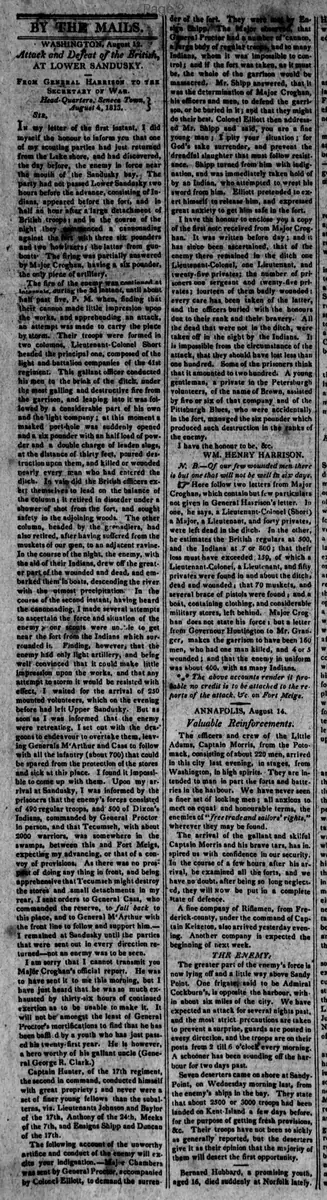
WASHINGTON, August 12.
Attack and Defeat of the British
AT LOWER SANDUSKY.
From General Harrison to the
Secretary of War.
Head-Quarters, Seneca Town,
August 4, 1813.
SIR,
In my letter of the first instant, I did
myself the honour to inform you that one
of my scouting parties had just returned
from the lake shore, and had discovered,
the day before, the enemy in force near
the mouth of the Sandusky bay. The
party had not passed Lower Sandusky two
hours before the advance, consisting of In-
dians, appeared before the fort, and in
half an hour after a large detachment of
British troops; and in the course of the
night they commenced a cannonading
against the fort with three six pounders
and two howitzers, the latter from gun-
boats. The firing was partially answered
by Major Croghan, having a six pounder.
the only piece of artillery.
The fire of the enemy was continued at
intervals, during the 2d instant, until about
half past five, P. M. when, finding that
their cannon made little impression upon
the works, and apprehending an attack,
an attempt was made to carry the place
by storm. Their troops were formed in
two columns, Lieutenant-Colonel Short
headed the principal one, composed of the
light and battalion companies of the 41st
regiment. This gallant officer conducted
his men to the brink of the ditch, under
the most galling and destructive fire from
the garrison, and leaping into it was fol-
lowed by a considerable part of his own
and the light company; at this moment a
masked port-hole was suddenly opened
and a six pounder with half load of pow-
der and a double charge of leaden slugs,
at the distance of thirty feet, poured des-
struction upon them, and killed or wounded
nearly every man who had entered the
ditch. In vain did the British officers ex-
ert themselves to lead on the balance of
the column; it retired in disorder under a
shower of shot from the fort, and sought
safety in the adjoining woods. The other
column, headed by the grenadiers, had
also retired, after having suffered from the
muskets of our men, to an adjacent ravine.
In the course of the night, the enemy, with
the aid of their Indians, drew off the great-
er part of the wounded and dead, and em-
barked them in boats, descending the river
with the utmost precipitation. In the
course of the second instant, having heard
the cannonading, I made several attempts
to ascertain the force and situation of the
enemy; our scouts were unable to get
near the fort from the Indians which sur-
rounded it. Finding, however, that the
enemy had only light artillery, and being
well convinced that it could make little
impression upon the works, and that any
attempt to storm it would be resisted with
effect, I waited for the arrival of 250
mounted volunteers, which on the evening
before had left Upper Sandusky. But as
soon as I was informed that the enemy
were retreating, I set out with the dra-
goons to endeavour to overtake them, leav-
ing Generals McArthur and Cass to follow
with all the infantry (about 700) that could
be spared from the protection of the stores
and sick at this place. I found it impossi-
ble to come up with them. Upon my ar-
rival at Sandusky, I was informed by the
prisoners that the enemy's forces consisted
of 490 regular troops, and 500 of Dixon's
Indians, commanded by General Proctor
in person, and that Tecumseh, with about
200 warriors, was somewhere in the
swamps, between this and Fort Meigs,
expecting my advancing, or that of a con-
voy of provisions: As there was no pros-
pect of doing any thing in front, and being
apprehensive that Tecumseh might destroy
the stores and small detachments in my
rear, I sent orders to General Cass, who
commanded the reserve, to fall back to
this place, and to General McArthur with
the front line to follow and support him.
I remained at Sandusky until the parties
that were sent out in every direction re-
turned—not an enemy was to be seen.
I am sorry that I cannot transmit you
Major Croghan's official report. He was
to have sent it to me this morning, but I
have just heard that he was so much ex-
haused by thirty-six hours of continued
exertion as to be unable to make it. It
will not be amongst the least of General
Proctor's mortifications to find that he has
been baffled by a youth who has just pass-
ed his twenty-first year. He is however,
a hero worthy of his gallant uncle (Gene-
ral George R. Clark.)
Captain Hunter, of the 17th regiment,
the second in command, conducted himself
with great propriety; and never were a
set of finer young fellows than the subal-
terns, viz. Lieutenants Johnson and Baylor
of the 17th, Anthony of the 24th, Meeks
of the 7th, and Ensigns Shipp and Duncan
of the 17th.
The following account of the unworthy
artifice and conduct of the enemy will ex-
citc your indignation.—Major Chambers
was sent by General Proctor, accompanied
by Colonel Elliott, to demand the surred-
der of the fort. They were met by En-
sign Shipp, The Major observed, that
General Proctor had number of cannon,
a large body of regular troops and so many
Indians, whom it was impossible to con-
trol; and if the fort was taken, as it must
be, the whole of the garrison would be
massacred. Mr. Shipp answered, that it
was the determination of Major Croghan,
his officers and men, to defend the garri-
son, or be buried in it; and that they might
do their best, Colonel Elliott then address-
ed Mr. Shipp and said, you are a fine
young man; I pity your situation; for
God's sake surrender, and prevent the
dreadful slaughter that must follow resist-
anc. Shipp turned from him with indig-
nation, and was immediately taken hold of
by an Indian, who attempted to wrest his
sword from him, Elliott pretended to ex-
ert himself to release him, and expressed
great anxiety to get him safe in the fort.
I have the honour to enclose you a copy
of the first note received from Major Crog-
han. It was written before day; and it
has since been ascertained, that of the
enemy there remained in the ditch one
Lieutenant-Colonel, one Lieutenant, and
twenty-five privates; the number of pri-
soners one sergeant and twenty-five pri-
vates; fourteen of them badly wounded:
every care has been taken of the latter
and the officers buried with the honours
due to their rank and their bravery. All
the dead that were not in the ditch, were
taken off in the night by the Indians. It
is impossible from the circumstance of the
attack, that they should have lost less than
one hundred. Some of the prisoners think
that it amounted to two hundred. A young
gentleman, a private in the Petersburgh
volunteers, of the name of Brown, assisted
by five or six of that company, and of the
Pittsburgh Blues, who were accidentally
in the fort, managed the six pounder which
produced such destruction in the ranks of
the enemy,
I have the honour to be, &c.
WM. HENRY HARRISON.
N. B.—Of our few wounded men there
is but one that will not be well in six days,
Here follow two letters from Major
Croghan, which contain but few particulars
not given in General Harrison's letter. In
one, he says, a Lieutenant-Colonel (Short)
a Major, a Lieutenant, and forty privates.
were left dead in the ditch. In the other,
he estimates the British regulars at 500,
and the Indians at 700 or 800; that their
loss must have exceeded 150, of which a
Lieutenant-Colonel, a Lieutenant, and fifty
privates were found in and about the ditch,
dead and wounded; that 70 muskets, and
several brace of pistols were found, and a
boat, containing clothing, and considerable
military stores, left behind. Major Crog-
han does not state his force; but a letter
from Governor Huntington to Mr. Gran-
ger, makes the garrison to have been 160
men, who had one man killed, and 4 or 5
wounded; and that the enemy in uniform
was about 400, with as many Indians.
The above accounts render it pro-
bable no credit is to be attached to the re-
ports of the attack, &c. on Fort Meigs.
What sub-type of article is it?
What themes does it cover?
What keywords are associated?
What entities or persons were involved?
Where did it happen?
Story Details
Key Persons
Location
Lower Sandusky, Sandusky Bay, Seneca Town
Event Date
August 2, 1813
Story Details
British forces under General Proctor, with Indians led by Tecumseh, attacked Fort Sandusky defended by Major Croghan's garrison. After cannonading, they attempted a storming assault but were repelled with heavy losses in the ditch from a six-pounder blast. The enemy retreated, leaving prisoners and dead.