Thank you for visiting SNEWPapers!
Sign up free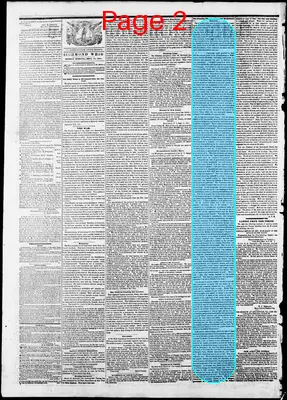
Daily Richmond Whig
Richmond, Virginia
What is this article about?
A letter from a Charlottesville gentleman to a friend in an Eastern State, written after the Battle of Manassas, argues that the North's coercive war against the South is futile and unjust, as secession is a constitutional right when the government fails its purposes, referencing the Declaration of Independence and failed peace proposals.
Clipping

OCR Quality
Full Text
The following letter, sent us by a correspondent residing in Albemarle County, exhibits, in a clear light, the indefensible position of the North in the current war.— It was written, without any view to publication, soon after the Battle of Manassas, by a gentleman in Charlottesville, to his friend in one of the Eastern States. The irregularities of mail transmission rendering its receipt uncertain, it may reach the eyes of him for whom it was intended by its publication here, and may, thereby, disclose to such of the honest men of the North, as may chance to see it, the folly and wickedness of persistence in a contest, which—whatever the issue—can only end in their discomfiture and ruin:
I have been much gratified to learn that the coercive policy of the Administration at Washington, towards the South, developing itself in this unnecessary and unnatural war upon us, does not meet your approbation. I certainly expected as much from the known moderation and manliness of your sentiments and character. Good sense, no less than proper feeling and sound policy, would seem to demonstrate to every man, of even fair intelligence, that among such a people as those who inhabit these Southern States, the sword can never preserve or restore the Government under which we once lived. The withdrawal of so many as one or two of the States from the common bond of government, is an evil not medicable by any such remedy, and the disease is far less manageable by that mode of treatment when the recusant members embrace, as in the present instance, a population of some 12,000,000 people. An emeute may be crushed in the bud; slender barricades can easily be demolished by a few discharges of artillery; but a revolution—un fait accompli—that is quite another affair. What the French Deputies said to the Duchess de Berri is here applicable: 'Il est trop tard.' "Revolutions don't go backward"—and if you were in any of our Southern States for a week, you would agree with me that this will not; and that to conquer the South or even force her to bow the neck to the yoke of the Federal Union, which she now thoroughly detests, is certainly in the calendar of impossibilities.
But, indulge me a moment longer. Did our fathers, indeed, invent and establish for us, for all time, and to be a perpetual obligation, a government which was never to be altered or changed? Was it really intended that the Constitution of the United States should never be superseded, abolished or destroyed? We can hardly presume so to assert, seeing that they incorporated into the document itself prescribed modes of amendment, and this power of amendment could easily be so used, by successive or immediate changes, as to alter, abolish and destroy it. It was at first a government by consent. It was designed so to continue; and hence amendments could only become binding by the consent prescribed.— This was one mode of altering, changing and abolishing the Constitution, if need be. It was, however, not the only mode open, on grounds and for reasons not declared on the face of it. They had previously and solemnly declared to the world that "governments derived their just powers from the consent of the governed"—and that "whenever any form of government becomes destructive" of certain enumerated ends and objects for which they were formed, "it is the right to alter or abolish it and to institute a new government, laying its foundation on such principles and organizing its powers in such form as to them shall seem most likely to effect their safety and happiness." Now this Constitution of the United States was ordained to perform "a more perfect union," to "establish justice," to "ensure domestic tranquility" and "secure the blessings of liberty to ourselves and to our posterity." The Constitution then and the Union which it created was a means to an end—not the end itself. It was the process—the means employed to ensure the end and object—'the blessings of liberty' by establishing justice, by ensuring domestic tranquility &c. Now, let us suppose, that by the means employed— or by the perverseness of the parties to the covenant, if you please, this government had become "destructive of these ends." It did not perform a more perfect union— it did not establish justice, and it did not ensure domestic tranquility—what is the remedy? Is it supposed to lie in changes and amendments under the provisions of the Constitution? If so, may we not enquire—Did not the aggrieved States—and the Border States—appeal to this remedy? They said they would accept Mr. Crittenden's amendments; they proposed them or the Peace Congress propositions as the basis of a friendly settlement. The Northern and Eastern States, having the majority in both Houses by decided votes, spurned and repudiated all these propositions, refusing even contemptuously to submit them for consideration to their constituents, imitating, in this respect, the offensive conduct of the Ministry and Parliament of England towards our fathers in the Revolutionary struggle of 1776.
In vain we showed to our defiant or stolidly indifferent "Northern brethren" that "justice," far from being "established" or observed, in respect to the just partition and government of our common Territories, was flagrantly disregarded and outraged. That as we were denied justice and equal rights, we could not secure for ourselves or transmit to our children "the blessings of liberty and independence"—that as to domestic tranquility, which the Government, by the Constitution, undertook to "insure," for nearly half a century it had ceased to exist; and that dissensions, angry debates, and the most violent discord reigned unchecked throughout the opposing sections of a distracted country, and consequently and finally, no real "union," based on sentiments of respect, good-will and fraternity any longer existed.
All these facts are too well known to be denied. They are of recent origin and are known to us all. Now, in such a case, what remedy remained to the parties aggrieved? Was there any alternative but separation, peaceably if we could, forcibly if we must?
I do not stop to enquire whether the South had sufficient provocation to justify this last resort, for her security and protection, because that is a question of which she alone was, of right, to judge. Would Washington and his compeers, at any period of our revolutionary struggle, have agreed to submit to the arbitrament of France or Spain, or any power on earth, the question of the sufficiency of the causes which drove them into revolution? Undoubtedly, the principles embodied in the Declaration of Independence, and in the various bills of right of the several State governments, no less than the objects and purposes set forth in the preamble to the Federal Constitution itself, declared that, in such a contingency, it was the right and the duty of the Southern people to alter and abolish their government as to their federal relations and affairs, and devise new guards for their liberty and safety. It was as States they had become parties to the compact, and it was as States they had the right to retire, and, 'according to the express conditions of ratification by New York, Virginia, and other States to resume the powers hereby conferred on the Federal Government.'
Under such a state of things, and in the light of these historical truths, how false as well as absurd the pretences set up by Northern presses and politicians, and countenanced by Messrs. Lincoln and Seward, that this is, on their part, a war of defence—a war undertaken in defence of the capital, and made to prevent the Southern institution of slavery from being forced on them! We are said to have begun the war—the attack on Fort Sumter is said to have been the "first blow"—the occupation of Harper's Ferry, Norfolk navy-yard, &c., the "overt act," Now, these forts were all on our soil. They were originally ours. We contributed them as our quota to the general defence and safety, but especially, as the terms of cession will always show, for purposes of protection and fortification of our own coast and soil against a foreign foe. In the same way, Rhode Island added the site of Fort Adams, and Massachusetts and New York the forts in their territory. When retiring from the Confederacy had we not the right to resume the possession and occupation of our own? We left you in peaceful possession of your soil and property. The Southern Commissioners proposed, indeed, to the Washington government an equitable division of all the Federal
What sub-type of article is it?
What themes does it cover?
What keywords are associated?
What entities or persons were involved?
Letter to Editor Details
Author
A Gentleman In Charlottesville
Recipient
Friend In One Of The Eastern States
Main Argument
the north's war to coerce the south is futile and unjust, as the constitution and declaration of independence justify secession when the government fails to ensure justice, tranquility, and liberty; peaceful separation was preferable, but the south had the right to resume control of its forts.
Notable Details