Thank you for visiting SNEWPapers!
Sign up free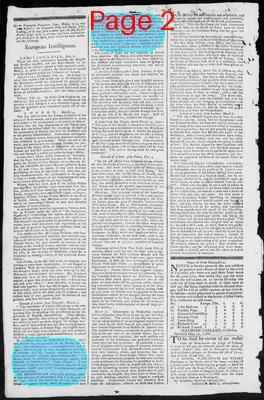
Editorial
May 25, 1786
Fowle's New Hampshire Gazette And General Advertiser
Portsmouth, Rockingham County, New Hampshire
What is this article about?
Editorial criticizes relaxation of principles of freedom, contrasting forefathers' views on unconstitutional standing army with Mr. Dundas's proposal for arbitrary power; mocks Ministerialists' debt relief claims as illusory; notes actual revenue deficiency despite surplus in old taxes.
Clipping
OCR Quality
98%
Excellent
Full Text
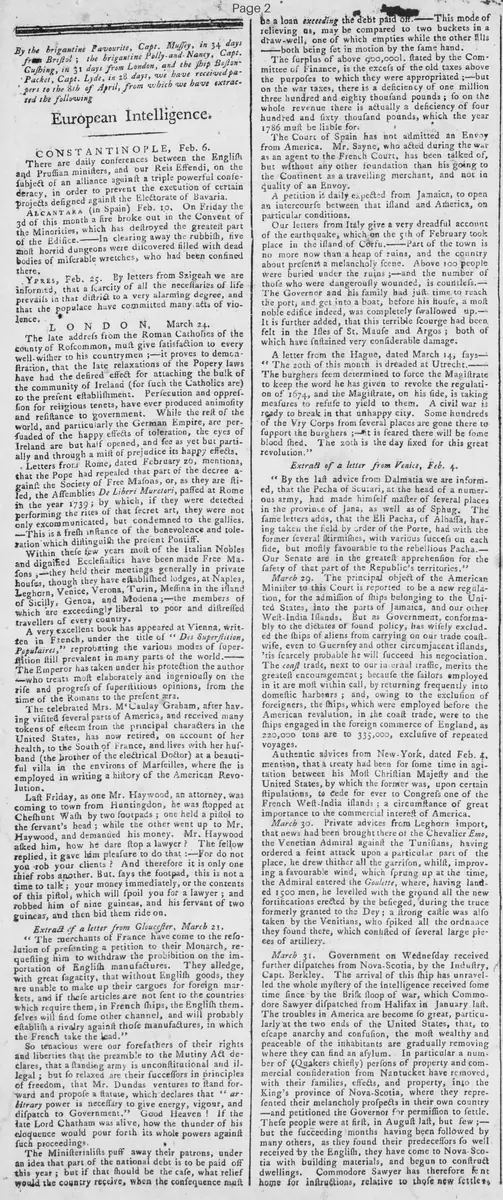
So tenacious were our forefathers of their rights and liberties that the preamble to the Mutiny Act declares, that a standing army is unconstitutional and illegal; but so relaxed are their successors in principles of freedom, that Mr. Dundas ventures to stand forward and propose a statute, which declares that "arbitrary power is necessary to give energy, vigour, and dispatch to Government." Good Heaven! If the late Lord Chatham was alive, how the thunder of his eloquence would pour forth its whole powers against such proceedings.
The Ministerialists puff away their patrons, under an idea that part of the national debt is to be paid off this year; but if that should be the case, what relief would the country receive, when the consequence must be a loan exceeding the debt paid off. This mode of relieving us, may be compared to two buckets in a draw-well, one of which empties while the other fills -- both being set in motion by the same hand.
The surplus of above 900,000l. stated by the Committee of Finance, is the excess of the old taxes above the purposes to which they were appropriated; but on the war taxes, there is a deficiency of one million three hundred and eighty thousand pounds: so on the whole revenue there is actually a deficiency of four hundred and sixty thousand pounds, which the year 1786 must be liable for.
The Ministerialists puff away their patrons, under an idea that part of the national debt is to be paid off this year; but if that should be the case, what relief would the country receive, when the consequence must be a loan exceeding the debt paid off. This mode of relieving us, may be compared to two buckets in a draw-well, one of which empties while the other fills -- both being set in motion by the same hand.
The surplus of above 900,000l. stated by the Committee of Finance, is the excess of the old taxes above the purposes to which they were appropriated; but on the war taxes, there is a deficiency of one million three hundred and eighty thousand pounds: so on the whole revenue there is actually a deficiency of four hundred and sixty thousand pounds, which the year 1786 must be liable for.
What sub-type of article is it?
Constitutional
Economic Policy
Partisan Politics
What keywords are associated?
Standing Army
Arbitrary Power
National Debt
War Taxes
Revenue Deficiency
Mutiny Act
Ministerialists
What entities or persons were involved?
Mr. Dundas
Lord Chatham
Ministerialists
Committee Of Finance
Editorial Details
Primary Topic
Criticism Of Arbitrary Power And Financial Mismanagement
Stance / Tone
Strongly Opposed To Government Proposals
Key Figures
Mr. Dundas
Lord Chatham
Ministerialists
Committee Of Finance
Key Arguments
Standing Army Declared Unconstitutional In Mutiny Act Preamble
Mr. Dundas Proposes Statute Endorsing Arbitrary Power For Government Efficiency
Lord Chatham Would Oppose Such Proceedings
Debt Payoff Would Require Larger Loan, Providing No Real Relief
Financial Relief Likened To Two Buckets In A Draw Well
Surplus In Old Taxes Of Over 900,000l.
Deficiency In War Taxes Of 1,380,000l.
Overall Revenue Deficiency Of 460,000l. For 1786