Thank you for visiting SNEWPapers!
Sign up free
The Virginia Gazette
Richmond, Williamsburg, Richmond County, Virginia
What is this article about?
On October 23, 1775, Stephen Sayre, Esq., was arrested in London on charges of high treason for allegedly plotting to seize King George III and the Tower. King's messengers searched his home, seizing papers. Examined by Lord Rochford and Sir John Fielding based on informer Richardson's accusation, Sayre denied the charges and was committed to the Tower despite offering bail.
Clipping
OCR Quality
Full Text
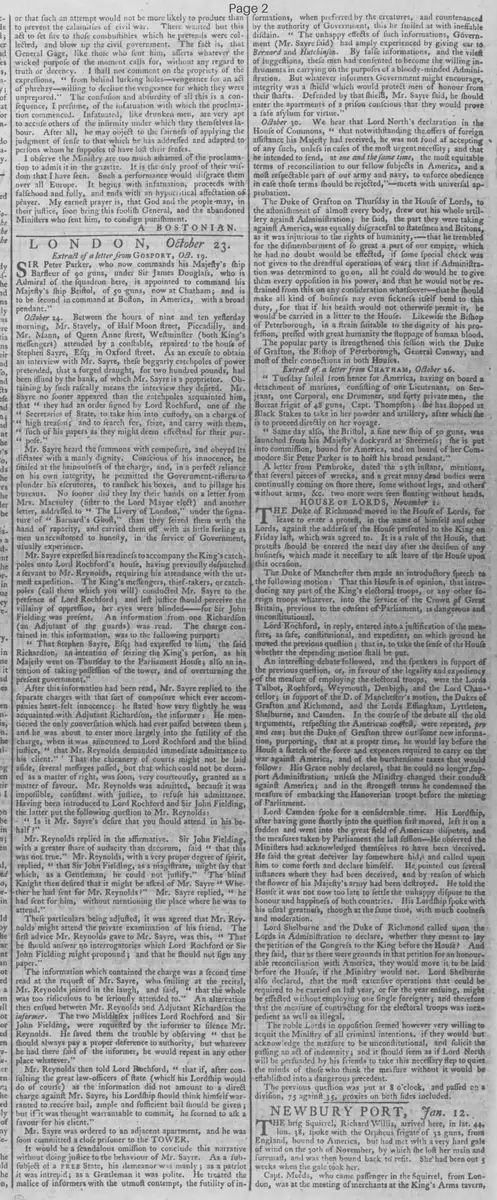
Mr. Sayre heard the summons with composure, and obeyed its dictates with a manly dignity. Conscious of his innocence, he smiled at the heinousness of the charge, and, in a perfect reliance on his own integrity, he permitted the Government-riflers to plunder his escritoires, to ransack his boxes, and to pillage his bureaus. No sooner did they lay their hands on a letter from Mrs. Macaulay (sister to the Lord Mayor elect) and another letter, addressed to "The Livery of London," under the signature of "Barnard's Ghost," than they seized them with the hand of rapacity, and carried them off with as little feeling as men unaccustomed to honesty, in the service of Government, usually experience.
Mr. Sayre expressed his readiness to accompany the King's catchpoles unto Lord Rochford's house, having previously dispatched a servant to Mr. Reynolds, requiring his attendance with the utmost expedition. The King's messengers, thief-takers, or catchpoles (call them which you will) conducted Mr. Sayre to the presence of Lord Rochford; and lest justice should perceive the villainy of oppression, her eyes were blinded for Sir John Fielding was present. An information from one Richardson (an Adjutant of the guards) was read. The charge contained in this information, was to the following purport:
"That Stephen Sayre, Esq; had expressed to him, the said Richardson, an intention of seizing the King's person, as his Majesty went on Thursday to the Parliament House; also an intention of taking possession of the tower, and of overturning the present government."
After this information had been read, Mr. Sayre replied to the separate charges with that sort of composure which ever accompanies heart-felt innocence; he stated how very slightly he was acquainted with Adjutant Richardson, the informer: He mentioned the only conversation which had ever passed between them; and he was about to enter more largely into the futility of the charge, when it was announced to Lord Rochford and the blind justice, "that Mr. Reynolds demanded immediate admittance to his client." That the chicanery of courts might not be laid aside, several messages passed, but that which could not be deemed as a matter of right, was soon, very courteously, granted as a matter of favour. Mr. Reynolds was admitted, because it was impossible, consistent with justice, to refuse his admittance.
Having been introduced to Lord Rochford and Sir John Fielding, the latter put the following question to Mr. Reynolds:
"Is it Mr. Sayre's desire that you should attend in his behalf?"
Mr. Reynolds replied in the affirmative. Sir John Fielding, with a greater share of audacity than decorum, said "that this was not true." Mr. Reynolds, with a very proper degree of spirit, replied, "that Sir John Fielding, as a magistrate, might say that which, as a Gentleman, he could not justify." The blind Knight then desired that it might be asked of Mr. Sayre "Whether he had sent for Mr. Reynolds?" Mr. Sayre replied, "he had sent for him, without mentioning the place where he was to attend."
These particulars being adjusted, it was agreed that Mr. Reynolds might attend the private examination of his friend. The first advice Mr. Reynolds gave to Mr. Sayre, was this, "That he should answer no interrogatories which Lord Rochford or Sir John Fielding might propound; and that he should not sign any paper."
The information which contained the charge was a second time read at the request of Mr. Sayre, who smiling at the recital, Mr. Reynolds joined in the laugh, and said, "that the whole was too ridiculous to be seriously attended to." An altercation then ensued between Mr. Reynolds and Adjutant Richardson the informer. The two Middlesex justices Lord Rochford and Sir John Fielding, were requested by the informer to silence Mr. Reynolds. He saved them the trouble by observing "that he should always pay a proper deference to authority, but whatever he had there said of the informer, he would repeat in any other place whatever."
Mr. Reynolds then told Lord Rochford, "that if, after consulting the great law-officers of state (which his Lordship would do of course) as the information did not amount to a direct charge against Mr. Sayre, his Lordship should think himself war- ranted to receive bail, ample and sufficient bail should be given; but if it was thought warrantable to commit, he scorned to ask a favour for his client."
Mr. Sayre was ordered to an adjacent apartment, and he was soon committed a close prisoner to the TOWER.
It would be a scandalous omission to conclude this narrative without doing justice to the behaviour of Mr. Sayre. As a subject of a FREE State, his demeanor was manly; as a patriot it was intrepid; as a Gentleman it was polite. He treated the malice of informers with the utmost contempt, the futility of in- formations, when preferred by the creatures, and countenanced by the authority of Government, this he smiled at with ineffable disdain. "The unhappy effects of such informations, Government (Mr. Sayre said) had amply experienced by giving ear to Bernard and Hutchinson. By false informations, and the vilest of suggestions, these men had consented to become the willing in- struments in carrying on the purposes of a bloody-minded Admini- stration. But whatever informers Government might encourage, integrity was a shield which would protect men of honour from their shafts. Defended by that shield, Mr. Sayre said, he should enter the apartments of a prison conscious that they would prove a safe asylum for virtue."
What sub-type of article is it?
What keywords are associated?
What entities or persons were involved?
Where did it happen?
Foreign News Details
Primary Location
London
Event Date
Between The Hours Of Nine And Ten Yesterday Morning, October 24
Key Persons
Outcome
mr. sayre committed as a close prisoner to the tower
Event Details
King's messengers arrested Stephen Sayre on high treason charge based on informer Richardson's accusation of plotting to seize the King, take the Tower, and overturn the government. They searched his home, seizing letters from Mrs. Macaulay and 'Barnard's Ghost'. Examined by Lord Rochford and Sir John Fielding, with lawyer Mr. Reynolds present. Sayre denied charges and was imprisoned in the Tower.