Thank you for visiting SNEWPapers!
Sign up free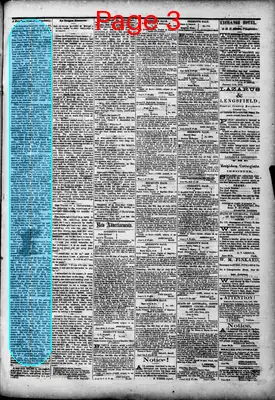
Rapides Gazette
Alexandria, Rapides County, Louisiana
What is this article about?
Early settler Judge West in Western New York entrusts his young grandson to a Oneida chief for three days to prove his peaceful intentions. The chief returns the boy safely, attired as a young chief, establishing lasting friendship and peace with the tribe.
Clipping

OCR Quality
Full Text
The following beautiful story is old but literally true, and was first published in a lecture delivered by William Tracy, Esq., of Utica, N. Y., on the early history of Oneida county:
One of the first settlers in Western New York was Judge West, who established himself at Whitestown, about four miles from Utica. He brought his family with him, among whom was a widowed daughter with only one child, a fine boy about four years old. You will recollect, the country around was an unbroken forest, and this was the domain of the savage tribes.
Judge West saw the necessity of keeping on good terms with the Indians, for, as he was nearly alone, he was completely at their mercy. Accordingly he took every opportunity to assure them of his kindly feelings. Several chiefs came to see him, and all appeared pacific. But there was one thing that troubled him; an aged chief of the Oneida tribe, and one of great influence, who resided at a distance of a dozen miles, had not yet been to see him nor could he ascertain the views and feelings of the sachem in respect to his settlement in that region. At last he sent him a message, and the answer was that the chief would visit him on the morrow.
True to his appointment the sachem came. Judge West received him with marks of respect, and introduced his wife, his daughter and little boy. The interview that followed was interesting. Upon its result, the judge was convinced that his security might depend, and he was therefore exceedingly anxious to make a favorable impression upon the distinguished chief. He expressed his desire to settle in the country: to live on terms of amity and good fellowship with the Indians, and to be useful to them by introducing among them the arts of civilization.
The chief heard him out and then said: "Brother, you ask much and you promise much. What pledge can you give of your faith? The white man's word may be good for the white man, yet it is but wind when spoken to the Indian!"
"I have put my life in your hands," said the judge; "is not that an evidence of my good intentions! I have placed confidence in the Indian, and will not believe that he will abuse or betray the trust that is thus reposed."
"So much is well," replied the chief; "the Indian will repay confidence for confidence; if you will trust him he will trust you. Let this boy go with me to my wigwam--I will bring him back in three days with my answer!"
If an arrow had pierced the bosom of the mother she could not have felt a deeper pang than went to her heart as the Indian made this proposal. She sprang forward, and, running to the boy, who stood at the side of the sachem, looking into his face with pleased wonder and admiration, she encircled him in her arms, and pressing him to her bosom, was about to fly from the room. A gloomy and ominous frown came over the sachem's brow, but he did not speak.
But not so with Judge West. He knew that the success of their enterprise, the lives of his family depended on the decision of a moment.
"Stay, stay, my daughter," he said. "Bring back the boy, I beseech you. He is no more to you than me. I would not risk a hair of his head. But my child, he must go with the chief. God will watch over him! He will be as safe in the sachem's wigwam as beneath our own roof."
The agonized mother hesitated for a moment and then slowly returned, placing the boy on the knee of the chief and kneeling at his feet, burst into a flood of tears. The gloom passed from the sachem's brow. He arose and departed.
I shall not attempt to describe the agony of the mother for the ensuing days. She was agitated by contending hopes and fears. In the night she awoke from sleep; seeming to hear the screams of her child calling on its mother for help. But the time wore away slowly--and the third day came. How slowly did the hours pass. The morning waned away, noon arrived; yet the sachem came not. There was a gloom over the whole household. The mother was pale and silent. Judge West walked the floor to and fro, going every few minutes to the door, and looking through the opening in the forest toward the sachem's abode.
At last as the rays of the setting sun were thrown upon the tops of the trees around, the eagle feathers of the chief were seen dancing above the bushes in the distance. He advanced rapidly--and the little boy was at his side. He was gayly attired as a young chief--his feet being dressed in moccasins, a fine beaver skin was on his shoulders, and eagle feathers was stuck in his hair. He was in excellent spirits, and so proud was he of his honors, that he seemed about two inches taller than he was before. He was soon in his mother's arms, and in that brief minute she seemed to pass from death to life. It was a happy meeting--too happy for me to describe--"The white man has conquered," said the sachem; "hereafter let us be friends. You have trusted an Indian; he will repay you with confidence and friendship."
He was as good as his word; and Judge West lived for many years at peace with the Indian tribes and succeeded in having the foundation of flourishing and prosperous community.
What sub-type of article is it?
What themes does it cover?
What keywords are associated?
What entities or persons were involved?
Where did it happen?
Story Details
Key Persons
Location
Whitestown, Near Utica, Western New York
Event Date
Early History Of Oneida County
Story Details
To secure peace with the Oneida tribe, Judge West allows a influential chief to take his widowed daughter's four-year-old son to his wigwam for three days as a pledge of trust. The mother reluctantly agrees despite her anguish. The chief returns the boy unharmed and honored, affirming friendship and amity.