Thank you for visiting SNEWPapers!
Sign up free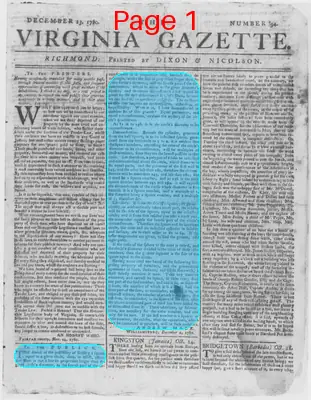
Letter to Editor
December 23, 1780
The Virginia Gazette
Richmond, Williamsburg, Richmond County, Virginia
What is this article about?
Andrew Marr submits a mathematical treatise to the public, claiming to demonstrate the quadrature of the circle using ratios like 81:256 for diameter to circumference, referencing Euclid and geometric properties of cylinders, spheres, and polygons.
Clipping
OCR Quality
95%
Excellent
Full Text
To THE PUBLICK.
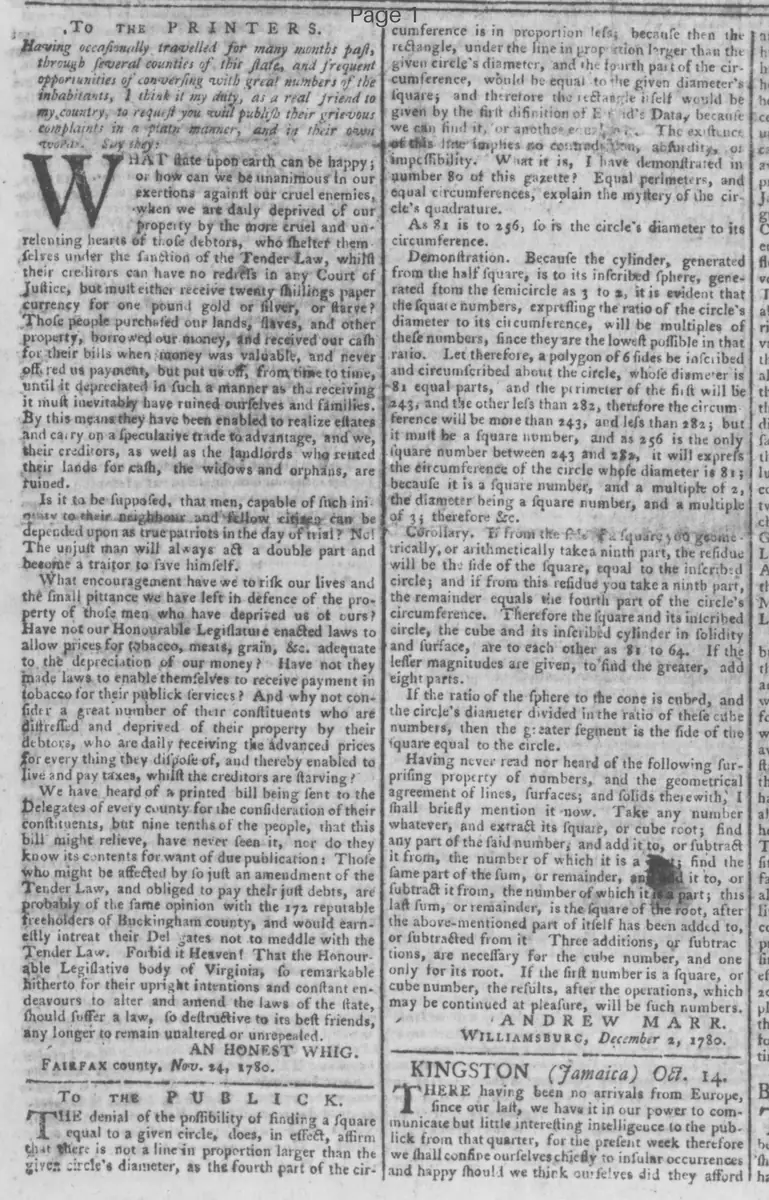
The denial of the possibility of finding a square equal to a given circle, does, in effect, affirm that there is not a line in proportion larger than the given circle's diameter, as the fourth part of the circumference is in proportion less; because then the rectangle, under the line in proportion larger than the given circle's diameter, and the fourth part of the circumference, would be equal to the given diameter's square; and therefore the rectangle itself would be given by the first definition of Euclid's Data, because we can find it, or another equal. The existence of this line implies no contradiction, nor any absurdity, or impossibility. What it is, I have demonstrated in number 80 of this gazette? Equal perimeters, and equal circumferences, explain the mystery of the circle's quadrature.
As 81 is to 256, so is the circle's diameter to its circumference.
Demonstration. Because the cylinder, generated from the half square, is to its inscribed sphere, generated from the semicircle as 3 to 2, it is evident that the square numbers, expressing the ratio of the circle's diameter to its circumference, will be multiples of these numbers, since they are the lowest possible in that ratio. Let therefore, a polygon of 6 sides be inscribed and circumscribed about the circle, whose diameter is 81 equal parts, and the perimeter of the first will be 243, and the other less than 282, therefore the circumference will be more than 243, and less than 282; but it must be a square number, and as 256 is the only square number between 243 and 282, it will express the circumference of the circle whose diameter is 81; because it is a square number, and a multiple of 2, the diameter being a square number, and a multiple of 3; therefore &c.
Corollary. To from the sq. Fa square you geometrically, or arithmetically take a ninth part, the residue will be the side of the square, equal to the inscribed circle; and if from this residue you take a ninth part, the remainder equals the fourth part of the circle's circumference. Therefore the square and its inscribed circle, the cube and its inscribed cylinder in solidity and surface, are to each other as 81 to 64. If the lesser magnitudes are given, to find the greater, add eight parts.
If the ratio of the sphere to the cone is cubed, and the circle's diameter divided in the ratio of these cube numbers, then the greater segment is the side of the square equal to the circle.
Having never read nor heard of the following surprizing property of numbers, and the geometrical agreement of lines, surfaces; and solids therewith, I shall briefly mention it now. Take any number whatever, and extract its square, or cube root; find any part of the said number; and add it to, or subtract it from, the number of which it is a pt; find the same part of the sum, or remainder, and add to, or subtract it from, the number of which it is a part; this last sum, or remainder, is the square of the root, after the above-mentioned part of itself has been added to, or subtracted from it Three additions, or subtractions, are necessary for the cube number, and one only for its root. If the first number is a square, or cube number, the results, after the operations, which may be continued at pleasure, will be such numbers.
ANDREW MARR.
The denial of the possibility of finding a square equal to a given circle, does, in effect, affirm that there is not a line in proportion larger than the given circle's diameter, as the fourth part of the circumference is in proportion less; because then the rectangle, under the line in proportion larger than the given circle's diameter, and the fourth part of the circumference, would be equal to the given diameter's square; and therefore the rectangle itself would be given by the first definition of Euclid's Data, because we can find it, or another equal. The existence of this line implies no contradiction, nor any absurdity, or impossibility. What it is, I have demonstrated in number 80 of this gazette? Equal perimeters, and equal circumferences, explain the mystery of the circle's quadrature.
As 81 is to 256, so is the circle's diameter to its circumference.
Demonstration. Because the cylinder, generated from the half square, is to its inscribed sphere, generated from the semicircle as 3 to 2, it is evident that the square numbers, expressing the ratio of the circle's diameter to its circumference, will be multiples of these numbers, since they are the lowest possible in that ratio. Let therefore, a polygon of 6 sides be inscribed and circumscribed about the circle, whose diameter is 81 equal parts, and the perimeter of the first will be 243, and the other less than 282, therefore the circumference will be more than 243, and less than 282; but it must be a square number, and as 256 is the only square number between 243 and 282, it will express the circumference of the circle whose diameter is 81; because it is a square number, and a multiple of 2, the diameter being a square number, and a multiple of 3; therefore &c.
Corollary. To from the sq. Fa square you geometrically, or arithmetically take a ninth part, the residue will be the side of the square, equal to the inscribed circle; and if from this residue you take a ninth part, the remainder equals the fourth part of the circle's circumference. Therefore the square and its inscribed circle, the cube and its inscribed cylinder in solidity and surface, are to each other as 81 to 64. If the lesser magnitudes are given, to find the greater, add eight parts.
If the ratio of the sphere to the cone is cubed, and the circle's diameter divided in the ratio of these cube numbers, then the greater segment is the side of the square equal to the circle.
Having never read nor heard of the following surprizing property of numbers, and the geometrical agreement of lines, surfaces; and solids therewith, I shall briefly mention it now. Take any number whatever, and extract its square, or cube root; find any part of the said number; and add it to, or subtract it from, the number of which it is a pt; find the same part of the sum, or remainder, and add to, or subtract it from, the number of which it is a part; this last sum, or remainder, is the square of the root, after the above-mentioned part of itself has been added to, or subtracted from it Three additions, or subtractions, are necessary for the cube number, and one only for its root. If the first number is a square, or cube number, the results, after the operations, which may be continued at pleasure, will be such numbers.
ANDREW MARR.
What sub-type of article is it?
Informative
Philosophical
What themes does it cover?
Science Nature
What keywords are associated?
Circle Quadrature
Diameter Circumference Ratio
Euclid Data
Cylinder Sphere Ratio
Numerical Properties
What entities or persons were involved?
Andrew Marr.
The Publick.
Letter to Editor Details
Author
Andrew Marr.
Recipient
The Publick.
Main Argument
the letter argues that the quadrature of the circle is possible, demonstrating that the ratio of diameter to circumference is as 81 to 256, using geometric proofs involving polygons, cylinders, spheres, and numerical properties, refuting denials of its possibility.
Notable Details
References Euclid's Data
Cylinder To Inscribed Sphere As 3 To 2
Hexagon Perimeters Bounding Circumference
Surprising Property Of Numbers For Roots