Thank you for visiting SNEWPapers!
Sign up free
The Milwaukee Leader
Milwaukee, Milwaukee County, Wisconsin
What is this article about?
Article compares distemper in dogs to human measles, describing it as a contagious disease affecting multiple animals, likely caused by a filter-passing virus, with historical research from antiquity to 1875, including Carre's theory.
Clipping
OCR Quality
Full Text
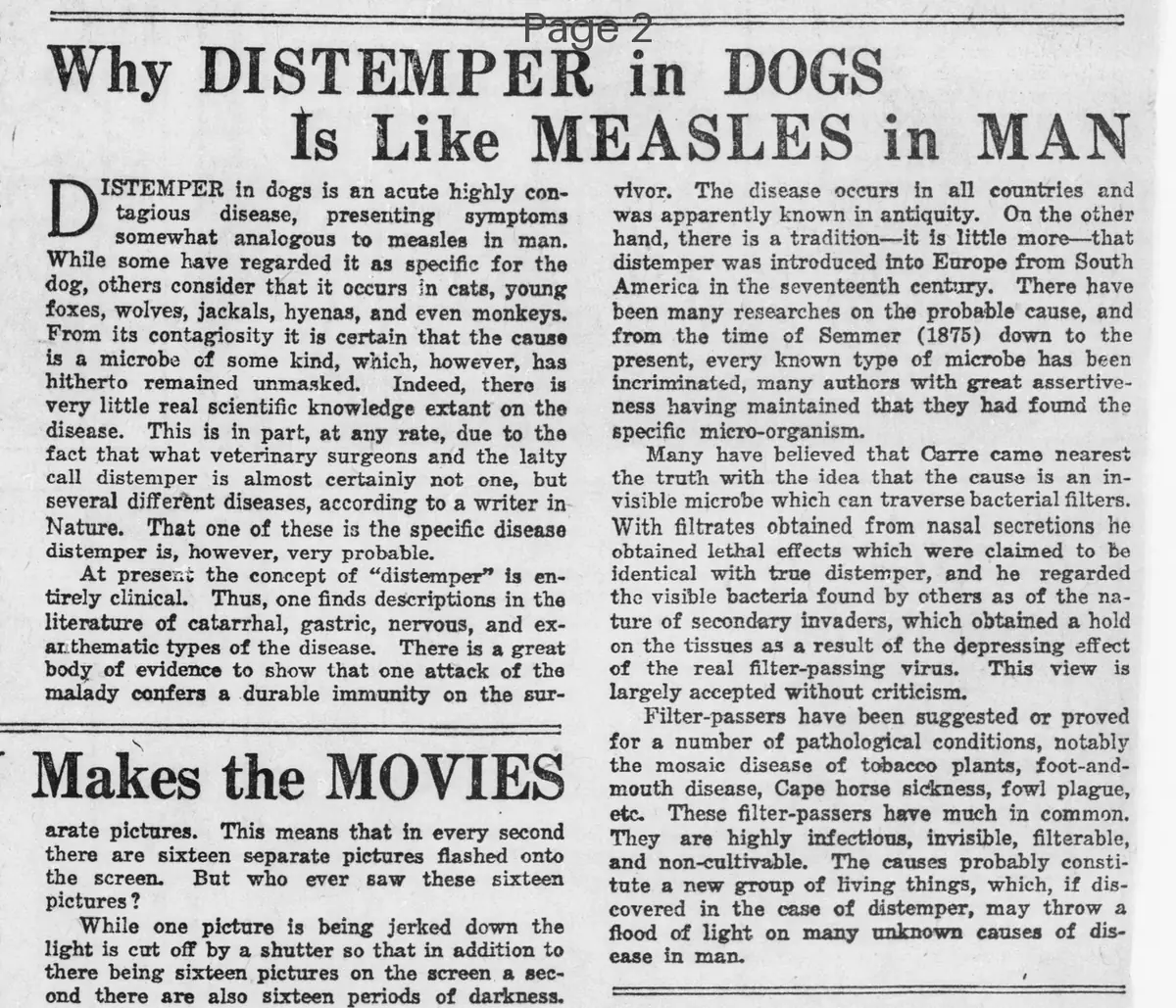
Distemper in dogs is an acute highly contagious disease, presenting symptoms somewhat analogous to measles in man.
While some have regarded it as specific for the dog, others consider that it occurs in cats, young foxes, wolves, jackals, hyenas, and even monkeys. From its contagiosity it is certain that the cause is a microbe of some kind, which, however, has hitherto remained unmasked. Indeed, there is very little real scientific knowledge extant on the disease. This is in part, at any rate, due to the fact that what veterinary surgeons and the laity call distemper is almost certainly not one, but several different diseases, according to a writer in Nature. That one of these is the specific disease distemper is, however, very probable.
At present the concept of "distemper" is entirely clinical. Thus, one finds descriptions in the literature of catarrhal, gastric, nervous, and exanthematic types of the disease. There is a great body of evidence to show that one attack of the malady confers a durable immunity on the survivor. The disease occurs in all countries and was apparently known in antiquity. On the other hand, there is a tradition-it is little more-that distemper was introduced into Europe from South America in the seventeenth century. There have been many researches on the probable cause, and from the time of Semmer (1875) down to the present, every known type of microbe has been incriminated, many authors with great assertiveness having maintained that they had found the specific micro-organism.
Many have believed that Carre came nearest the truth with the idea that the cause is an invisible microbe which can traverse bacterial filters. With filtrates obtained from nasal secretions he obtained lethal effects which were claimed to be identical with true distemper, and he regarded the visible bacteria found by others as of the nature of secondary invaders, which obtained a hold on the tissues as a result of the depressing effect of the real filter-passing virus. This view is largely accepted without criticism.
Filter-passers have been suggested or proved for a number of pathological conditions, notably the mosaic disease of tobacco plants, foot-and-mouth disease, Cape horse sickness, fowl plague, etc. These filter-passers have much in common. They are highly infectious, invisible, filterable, and non-cultivable. The causes probably constitute a new group of living things, which, if discovered in the case of distemper, may throw a flood of light on many unknown causes of disease in man.
What sub-type of article is it?
What themes does it cover?
What keywords are associated?
What entities or persons were involved?
Story Details
Key Persons
Event Date
Seventeenth Century; 1875
Story Details
Distemper in dogs resembles measles in humans, is highly contagious, affects various animals, caused by an unidentified microbe or filter-passing virus, with types including catarrhal, gastric, nervous, and exanthematic; confers immunity; known since antiquity, possibly introduced to Europe from South America; various microbes incriminated since 1875, Carre's filterable virus theory widely accepted.