Thank you for visiting SNEWPapers!
Sign up free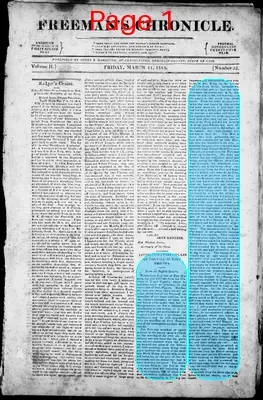
Freeman's Chronicle
Columbus, Franklin County, Ohio
What is this article about?
Eyewitness account by Robert Lee of the British surprise capture of Fort Niagara on December 19, 1813, including the silent entry, American resistance by sick and guards, 80 killed, plunder of property, and harsh confinement and treatment of prisoners before parole or march to Kingston.
Clipping
OCR Quality
Full Text
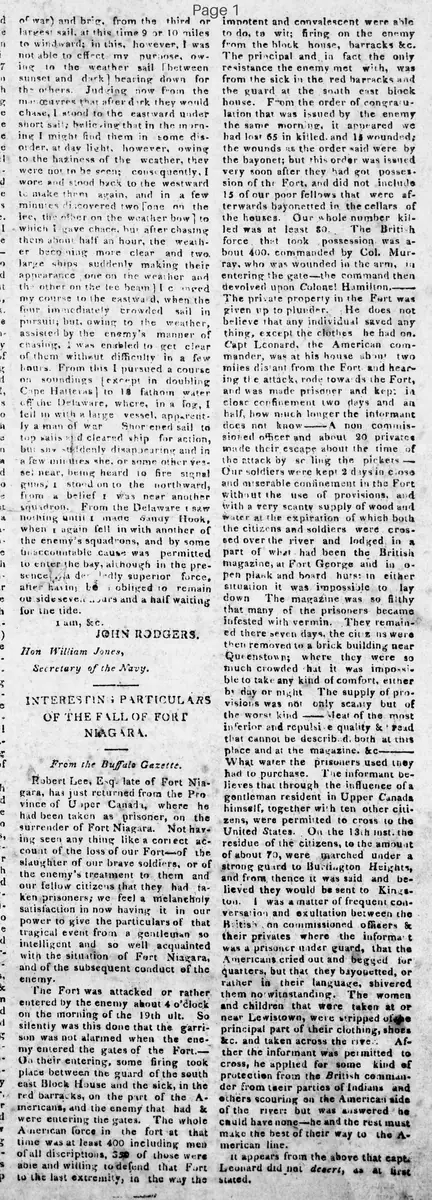
From the Buffalo Gazette.
Robert Lee, Esq. late of Fort Niagara, has just returned from the Province of Upper Canada, where he had been taken as prisoner, on the surrender of Fort Niagara. Not having seen any thing like a correct account of the loss of our Fort nor of the slaughter of our brave soldiers, or of the enemy's treatment to them and our fellow citizens that they had taken prisoners; we feel a melancholy satisfaction in now having it in our power to give the particulars of that tragical event from a gentleman so intelligent and so well acquainted with the situation of Fort Niagara, and of the subsequent conduct of the enemy.
The Fort was attacked or rather entered by the enemy about 4 o'clock on the morning of the 19th ult. So silently was this done that the garrison was not alarmed when the enemy entered the gates of the Fort.—On their entering, some firing took place between the guard of the south east Block House and the sick, in the red barracks, on the part of the Americans, and the enemy that had & were entering the gates. The whole American force in the fort at that time was at least 400 including men of all descriptions, 350 of those were able and willing to defend that Fort to the last extremity, in the way the impotent and convalescent were able to do, to wit; firing on the enemy from the block house, barracks &c. The principal and, in fact the only resistance the enemy met with, was from the sick in the red barracks and the guard at the south east block house. From the order of congratulation that was issued by the enemy the same morning, it appeared we had lost 65 in killed and 13 wounded; the wounds as the order said were by the bayonet; but this order was issued very soon after they had got possession of the Fort, and did not include 15 of our poor fellows that were afterwards bayonetted in the cellars of the houses. Our whole number killed was at least 80. The British force, that took possession was about 400, commanded by Col. Murray, who was wounded in the arm, in entering the gate—the command then devolved upon Colonel Hamilton.—The private property in the Fort was given up to plunder. He does not believe that any individual saved any thing, except the clothes he had on. Capt. Leonard, the American commander, was at his house about two miles distant from the Fort, and hearing the attack, rode towards the Fort, and was made prisoner and kept in close confinement two days and an half, how much longer the informant does not know—A non commissioned officer and about 20 privates made their escape about the time of the attack by scaling the pickets—Our soldiers were kept 2 days in close and miserable confinement in the Fort without the use of provisions, and with a very scanty supply of wood and water at the expiration of which both the citizens and soldiers were crossed over the river and lodged, in a part of what had been the British magazine, at Fort George and in open plank and board huts: in either situation it was impossible to lay down The magazine was so filthy that many of the prisoners became infested with vermin. They remained there seven days. the citizens were then removed to a brick building near Queenstown; where they were so much crowded that it was impossible to take any kind of comfort, either by day or night The supply of provisions was not only scanty but of the worst kind -and meat of the most inferior and repulsive quality & bread that cannot be described, both at this place and at the magazine. &c. What water the prisoners used they had to purchase. The informant believes that through the influence of a gentleman resident in Upper Canada himself, together with ten other citizens, were permitted to cross to the United States. On the 13th inst. the residue of the citizens, to the amount of about 70, were marched under a strong guard to Burlington Heights, and from thence it was said and believed they would be sent to Kingston. It was a matter of frequent conversation and exultation between the British commissioned officers & their privates where the informant was a prisoner under guard, that the Americans cried out and begged for quarters, but that they bayonetted, or rather in their language, shivered them notwithstanding. The women and children that were taken at or near Lewistown, were stripped of the principal part of their clothing, shoes &c. and taken across the river. After the informant was permitted to cross, he applied for some kind of protection from the British commander from their parties of Indians and others scouring on the American side of the river: but was answered he could have none—he and the rest must make the best of their way to the American line.
It appears from the above that capt. Leonard did not desert, as at first stated.
What sub-type of article is it?
What themes does it cover?
What keywords are associated?
What entities or persons were involved?
Where did it happen?
Story Details
Key Persons
Location
Fort Niagara
Event Date
1813 12 19
Story Details
British forces under Col. Murray silently entered Fort Niagara at 4 a.m. on December 19, 1813, surprising the 400 American garrison. Resistance came mainly from sick soldiers and a blockhouse guard, resulting in at least 80 Americans killed by bayonet. Property was plundered, prisoners harshly confined without food, then moved to filthy quarters at Fort George and Queenstown with poor provisions before further marches or parole.