Thank you for visiting SNEWPapers!
Sign up free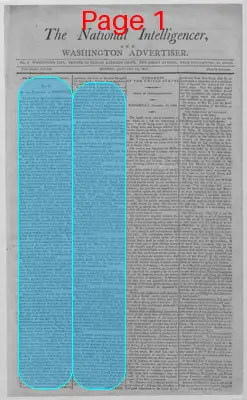
Editorial
January 5, 1801
The National Intelligencer And Washington Advertiser
Washington, District Of Columbia
What is this article about?
This editorial warns against the House of Representatives electing Aaron Burr over Thomas Jefferson in the tied 1800 presidential election, arguing it would undermine public confidence and misrepresent the people's will, given the electoral intent and shifting representation.
Clipping
OCR Quality
95%
Excellent
Full Text
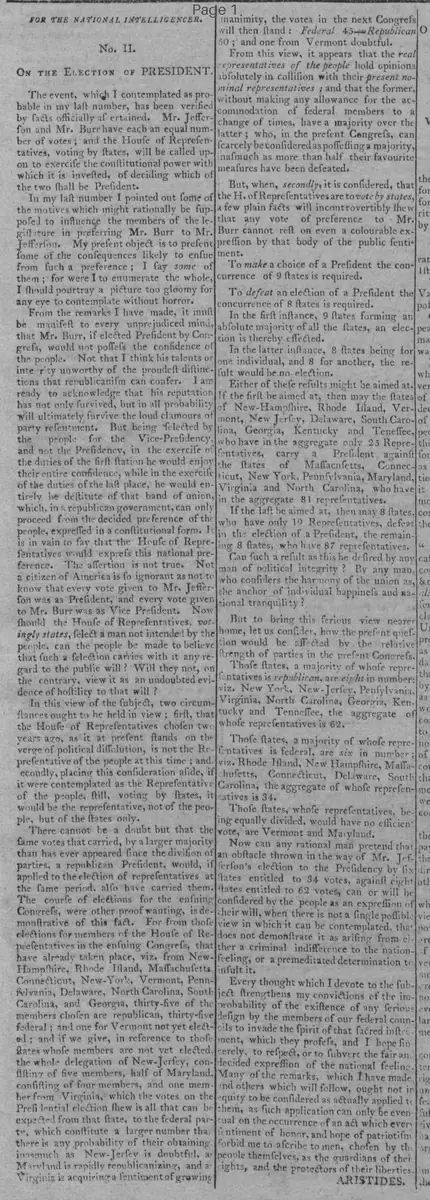
FOR THE NATIONAL INTELLIGENCER,
No. II.
On The ELECTION OF PRESIDENT.
The event, which I contemplated as probable in my last number, has been verified by facts officially ascertained. Mr. Jefferson and Mr. Burr have each an equal number of votes; and the House of Representatives, voting by states, will be called upon to exercise the constitutional power with which it is invested, of deciding which of the two shall be President.
In my last number I pointed out some of the motives which might rationally be supposed to influence the members of the legislature in preferring Mr. Burr to Mr. Jefferson. My present object is to present some of the consequences likely to ensue from such a preference; I say some of them; for were I to enumerate the whole, I should portray a picture too gloomy for any eye to contemplate without horror.
From the remarks I have made, it must be manifest to every unprejudiced mind, that Mr. Burr, if elected President by Congress, would not possess the confidence of the people. Not that I think his talents or integrity unworthy of the proudest distinctions that republicanism can confer. I am ready to acknowledge that his reputation has not only survived, but in all probability will ultimately survive the loud clamors of party resentment. But being elected by the people for the Vice-Presidency, and not the Presidency, in the exercise of the duties of the first station he would enjoy their entire confidence, while in the exercise of the duties of the last place, he would entirely be destitute of that band of union, which, in a republican government, can only proceed from their decided preference of the people, expressed in a constitutional form. It is in vain to assert that the House of Representatives would express this national preference. The assertion is not true. Not a citizen of America is so ignorant as not to know that every vote given to Mr. Jefferson was as President, and every vote given to Mr. Burr was as Vice President. Now should the House of Representatives, voting by states, elect a man not intended by the people, can the people be made to believe that such an election carries with it any regard to the public will? Will they not, on the contrary, view it as an undoubted evidence of hostility to that will?
In this view of the subject, two circumstances ought to be held in view; first, that the House of Representatives chosen two years ago, as it at present stands on the verge of political dissolution, is not the Representative of the people at this time; and, secondly, placing this consideration aside, if it were contemplated as the Representative of the people, still, voting by states, it would be the representative, not of the people, but of the states only.
There cannot be a doubt but that the same votes that carried, by a larger majority than has ever appeared since the division of parties, a republican President, would, if applied to the election of representatives at the same period, also have carried them. The course of elections for the ensuing Congress, were other proof wanting, is demonstrative of this fact. For from those elections for members of the House of Representatives in the ensuing Congress, that have already taken place, viz. from New Hampshire, Rhode Island, Massachusetts, Connecticut, New-York, Vermont, Pennsylvania, Delaware, North Carolina, South Carolina, and Georgia, thirty-five of the members chosen are republican, thirty-five federal; and one for Vermont not yet elected: and if we give, in reference to those states whose members are not yet elected, the whole delegation of New-Jersey, consisting of five members, half of Maryland, consisting of four members, and one member from Virginia, which the votes on the Presidential election show is all that can be expected from that state, to the federal party, which constitute a larger number than there is any probability of their obtaining, inasmuch as New-Jersey is doubtful, a Maryland is rapidly republicanizing, and a Virginia is acquiring a sentiment of growing republicanism, 50; and an entire Vermont doubtful.
From this view, it appears that the representatives of the people hold opinions absolutely in collision with their present nominal representatives; and that the former, without making any allowance for the accommodation of federal members to a change of times, have a majority over the latter; who, in the present Congress, can scarcely be considered as possessing a majority, inasmuch as more than half their favourite measures have been defeated.
But, when, secondly, it is considered, that the H. of Representatives are to vote by states, a few plain facts will incontrovertibly show that any vote of preference to Mr. Burr cannot rest on even a colourable expression by that body of the public sentiment.
To make a choice of a President the concurrence of 9 states is required.
To defeat an election of a President the concurrence of 8 states is required.
In the first instance, 9 states forming an absolute majority of all the states, an election is thereby effected.
In the latter instance, 8 states being for one individual, and 8 for another, the result would be no election.
Either of these results might be aimed at. If the first be aimed at, then may the states of New-Hampshire, Rhode Island, Vermont, New Jersey, Delaware, South Carolina, Georgia, Kentucky and Tennessee, who have in the aggregate only 25 Representatives, carry a President against the states of Massachusetts, Connecticut, New York, Pennsylvania, Maryland, Virginia and North Carolina, who have in the aggregate 81 representatives.
If the last be aimed at, then may 8 states who have only 19 Representatives, defeat in the election of a President, the remaining 8 states, who have 87 representatives.
Can such a result as this be desired by any man of political integrity? By any man who considers the harmony of the union as the anchor of individual happiness and national tranquility?
Before; let us consider, how the present strength of parties in the present Congress. Those states, a majority of whose representatives is republican, are eight in number: viz.: New York, New-Jersey, Pennsylvania, Virginia, North Carolina, Georgia, Kentucky and Tennessee, whose representatives is 62.
Those states, a majority of whose representatives is federal, are six in number: viz. Rhode Island, New Hampshire, Massachusetts, Connecticut, Delaware, South Carolina, the aggregate of whose representatives is 34.
Those states, whose representatives, being equally divided, would have no efficient vote, are Vermont and Maryland.
Now can any rational man pretend that an obstacle thrown in the way of Mr. Jefferson's election to the Presidency by six states entitled to 34 votes, against eight states entitled to 62 votes, can or will be considered by the people as an expression of their will, when there is not a single possible view in which it can be contemplated, that does not demonstrate it as arising from either a criminal indifference to the national feeling, or a premeditated determination to insult it.
Every thought which I devote to the subject strengthens my convictions of the improbability of the existence of any serious design by the members of our federal councils to invade the spirit of that sacred instrument, which they profess, and I hope sincerely, to respect, or to subvert the fair and decided expression of the national feeling.
Many of the remarks, which I have made and others which will follow, ought not in equity to be considered as actually applied to them, as such application can only be even eventual on the occurrence of an act which every sentiment of honor, and hope of patriotism forbid me to ascribe to men, chosen by the people themselves, as the guardians of their rights, and the protectors of their liberties
ARISTIDES.
No. II.
On The ELECTION OF PRESIDENT.
The event, which I contemplated as probable in my last number, has been verified by facts officially ascertained. Mr. Jefferson and Mr. Burr have each an equal number of votes; and the House of Representatives, voting by states, will be called upon to exercise the constitutional power with which it is invested, of deciding which of the two shall be President.
In my last number I pointed out some of the motives which might rationally be supposed to influence the members of the legislature in preferring Mr. Burr to Mr. Jefferson. My present object is to present some of the consequences likely to ensue from such a preference; I say some of them; for were I to enumerate the whole, I should portray a picture too gloomy for any eye to contemplate without horror.
From the remarks I have made, it must be manifest to every unprejudiced mind, that Mr. Burr, if elected President by Congress, would not possess the confidence of the people. Not that I think his talents or integrity unworthy of the proudest distinctions that republicanism can confer. I am ready to acknowledge that his reputation has not only survived, but in all probability will ultimately survive the loud clamors of party resentment. But being elected by the people for the Vice-Presidency, and not the Presidency, in the exercise of the duties of the first station he would enjoy their entire confidence, while in the exercise of the duties of the last place, he would entirely be destitute of that band of union, which, in a republican government, can only proceed from their decided preference of the people, expressed in a constitutional form. It is in vain to assert that the House of Representatives would express this national preference. The assertion is not true. Not a citizen of America is so ignorant as not to know that every vote given to Mr. Jefferson was as President, and every vote given to Mr. Burr was as Vice President. Now should the House of Representatives, voting by states, elect a man not intended by the people, can the people be made to believe that such an election carries with it any regard to the public will? Will they not, on the contrary, view it as an undoubted evidence of hostility to that will?
In this view of the subject, two circumstances ought to be held in view; first, that the House of Representatives chosen two years ago, as it at present stands on the verge of political dissolution, is not the Representative of the people at this time; and, secondly, placing this consideration aside, if it were contemplated as the Representative of the people, still, voting by states, it would be the representative, not of the people, but of the states only.
There cannot be a doubt but that the same votes that carried, by a larger majority than has ever appeared since the division of parties, a republican President, would, if applied to the election of representatives at the same period, also have carried them. The course of elections for the ensuing Congress, were other proof wanting, is demonstrative of this fact. For from those elections for members of the House of Representatives in the ensuing Congress, that have already taken place, viz. from New Hampshire, Rhode Island, Massachusetts, Connecticut, New-York, Vermont, Pennsylvania, Delaware, North Carolina, South Carolina, and Georgia, thirty-five of the members chosen are republican, thirty-five federal; and one for Vermont not yet elected: and if we give, in reference to those states whose members are not yet elected, the whole delegation of New-Jersey, consisting of five members, half of Maryland, consisting of four members, and one member from Virginia, which the votes on the Presidential election show is all that can be expected from that state, to the federal party, which constitute a larger number than there is any probability of their obtaining, inasmuch as New-Jersey is doubtful, a Maryland is rapidly republicanizing, and a Virginia is acquiring a sentiment of growing republicanism, 50; and an entire Vermont doubtful.
From this view, it appears that the representatives of the people hold opinions absolutely in collision with their present nominal representatives; and that the former, without making any allowance for the accommodation of federal members to a change of times, have a majority over the latter; who, in the present Congress, can scarcely be considered as possessing a majority, inasmuch as more than half their favourite measures have been defeated.
But, when, secondly, it is considered, that the H. of Representatives are to vote by states, a few plain facts will incontrovertibly show that any vote of preference to Mr. Burr cannot rest on even a colourable expression by that body of the public sentiment.
To make a choice of a President the concurrence of 9 states is required.
To defeat an election of a President the concurrence of 8 states is required.
In the first instance, 9 states forming an absolute majority of all the states, an election is thereby effected.
In the latter instance, 8 states being for one individual, and 8 for another, the result would be no election.
Either of these results might be aimed at. If the first be aimed at, then may the states of New-Hampshire, Rhode Island, Vermont, New Jersey, Delaware, South Carolina, Georgia, Kentucky and Tennessee, who have in the aggregate only 25 Representatives, carry a President against the states of Massachusetts, Connecticut, New York, Pennsylvania, Maryland, Virginia and North Carolina, who have in the aggregate 81 representatives.
If the last be aimed at, then may 8 states who have only 19 Representatives, defeat in the election of a President, the remaining 8 states, who have 87 representatives.
Can such a result as this be desired by any man of political integrity? By any man who considers the harmony of the union as the anchor of individual happiness and national tranquility?
Before; let us consider, how the present strength of parties in the present Congress. Those states, a majority of whose representatives is republican, are eight in number: viz.: New York, New-Jersey, Pennsylvania, Virginia, North Carolina, Georgia, Kentucky and Tennessee, whose representatives is 62.
Those states, a majority of whose representatives is federal, are six in number: viz. Rhode Island, New Hampshire, Massachusetts, Connecticut, Delaware, South Carolina, the aggregate of whose representatives is 34.
Those states, whose representatives, being equally divided, would have no efficient vote, are Vermont and Maryland.
Now can any rational man pretend that an obstacle thrown in the way of Mr. Jefferson's election to the Presidency by six states entitled to 34 votes, against eight states entitled to 62 votes, can or will be considered by the people as an expression of their will, when there is not a single possible view in which it can be contemplated, that does not demonstrate it as arising from either a criminal indifference to the national feeling, or a premeditated determination to insult it.
Every thought which I devote to the subject strengthens my convictions of the improbability of the existence of any serious design by the members of our federal councils to invade the spirit of that sacred instrument, which they profess, and I hope sincerely, to respect, or to subvert the fair and decided expression of the national feeling.
Many of the remarks, which I have made and others which will follow, ought not in equity to be considered as actually applied to them, as such application can only be even eventual on the occurrence of an act which every sentiment of honor, and hope of patriotism forbid me to ascribe to men, chosen by the people themselves, as the guardians of their rights, and the protectors of their liberties
ARISTIDES.
What sub-type of article is it?
Partisan Politics
Constitutional
What keywords are associated?
Presidential Election
Jefferson Burr
House Vote
Republican Majority
Public Confidence
What entities or persons were involved?
Mr. Jefferson
Mr. Burr
House Of Representatives
Republican Party
Federal Party
Editorial Details
Primary Topic
Election Of President Between Jefferson And Burr
Stance / Tone
Opposition To Electing Burr Over Jefferson
Key Figures
Mr. Jefferson
Mr. Burr
House Of Representatives
Republican Party
Federal Party
Key Arguments
Mr. Burr Elected By Congress Would Lack The Confidence Of The People
Votes For Jefferson Were Intended For President, Burr For Vice President
Current House Not Representative Of Current Public Sentiment
Voting By States Distorts Representation Of Popular Will
Republican Majority In Upcoming Congress Demonstrates Public Preference For Jefferson