Thank you for visiting SNEWPapers!
Sign up free
Story
July 5, 1874
Eureka Daily Sentinel
Eureka, Eureka County, Nevada
What is this article about?
Article from St. Paul Press argues against broad voting rights for untaxed Indians in states like Minnesota, referencing Supreme Court and Constitution; notes exceptions in New Mexico via treaty; discusses Choctaws and Cherokees' local voting and debate over US citizenship, excluding negroes.
Clipping
OCR Quality
70%
Good
Full Text
INDIAN VOTERS.
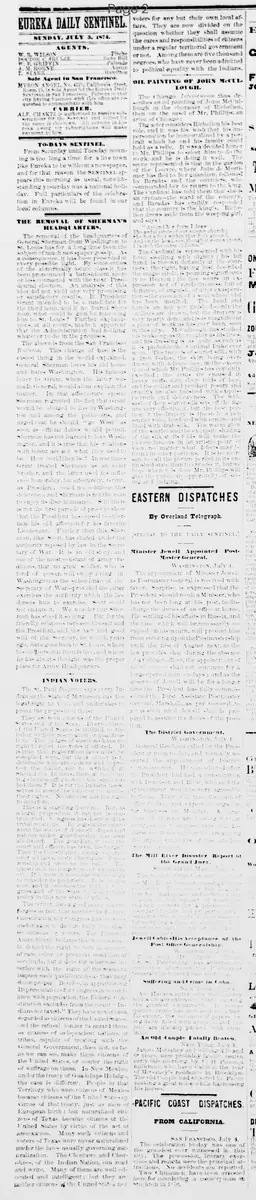
The St. Paul Press thinks the Indian in the States (Minnesota is the head right to vote, it under the highest prove their application this: They have both citizens of the late states and of the States. Every citizen of the United States is entitled to the ballot with relation to his taxation. The decision of the Supreme Court that the Fourteenth Amendment law makes no provision to decree in any way, or to interfere with the right he waives to impose such qualifications as they may deem proper. In apportioning Representatives from Georgia according to population, the Federal Constitution excludes from the count Indians not taxed. They have never been regarded as citizens of the United States, and the refusal longer to regard them as citizens of independent nations, or tribes, capable of treating with the General Government, does not, so far as we can see, make them citizens of the United States, or confer the right of suffrage on them. In New Mexico under the treaty of Guadalupe Hidalgo, the case is different. People in that Territory who were citizens of Mexico became citizens of the United States by virtue of that treaty, just as men of European birth but naturalized citizens of Texas became citizens of the United States by virtue of the act of annexation. Many such citizens and voters of Texas were never naturalized under the laws usually governing naturalization. The Choctaws and Cherokees, of the Indian Nation, can read and write. Many of them are well educated and intelligent; but they are neither citizens of the United States nor voters for any but their own local affairs. They are now divided on the question whether they shall assume the cares and responsibilities of citizens under a regular territorial government or not. Among them are five thousand negroes, who have never been admitted to political equality with the Indians.
The St. Paul Press thinks the Indian in the States (Minnesota is the head right to vote, it under the highest prove their application this: They have both citizens of the late states and of the States. Every citizen of the United States is entitled to the ballot with relation to his taxation. The decision of the Supreme Court that the Fourteenth Amendment law makes no provision to decree in any way, or to interfere with the right he waives to impose such qualifications as they may deem proper. In apportioning Representatives from Georgia according to population, the Federal Constitution excludes from the count Indians not taxed. They have never been regarded as citizens of the United States, and the refusal longer to regard them as citizens of independent nations, or tribes, capable of treating with the General Government, does not, so far as we can see, make them citizens of the United States, or confer the right of suffrage on them. In New Mexico under the treaty of Guadalupe Hidalgo, the case is different. People in that Territory who were citizens of Mexico became citizens of the United States by virtue of that treaty, just as men of European birth but naturalized citizens of Texas became citizens of the United States by virtue of the act of annexation. Many such citizens and voters of Texas were never naturalized under the laws usually governing naturalization. The Choctaws and Cherokees, of the Indian Nation, can read and write. Many of them are well educated and intelligent; but they are neither citizens of the United States nor voters for any but their own local affairs. They are now divided on the question whether they shall assume the cares and responsibilities of citizens under a regular territorial government or not. Among them are five thousand negroes, who have never been admitted to political equality with the Indians.
What sub-type of article is it?
Historical Event
Curiosity
What themes does it cover?
Justice
Social Manners
What keywords are associated?
Indian Voters
Citizenship Rights
Voting Suffrage
Supreme Court Decision
Guadalupe Hidalgo Treaty
Choctaw Cherokee
Territorial Government
What entities or persons were involved?
Choctaws
Cherokees
Where did it happen?
Minnesota, New Mexico, Indian Nation
Story Details
Key Persons
Choctaws
Cherokees
Location
Minnesota, New Mexico, Indian Nation
Story Details
Discussion on whether Indians in the US have voting rights, citing Supreme Court decisions, treaties like Guadalupe Hidalgo, and distinctions between taxed and untaxed Indians; contrasts with Choctaws and Cherokees who vote locally but debate territorial citizenship, excluding 5000 negroes from equality.