Thank you for visiting SNEWPapers!
Sign up free
Editorial
May 30, 1797
Gazette Of The United States, & Philadelphia Daily Advertiser
Philadelphia, Philadelphia County, Pennsylvania
What is this article about?
An editorial by Politicus urges the United States to build naval and military defenses to protect against foreign aggressions during European wars, criticizing 'Patriots or Republicans' for opposing such measures, warning of submission to powers like France or England otherwise.
Clipping
OCR Quality
95%
Excellent
Full Text
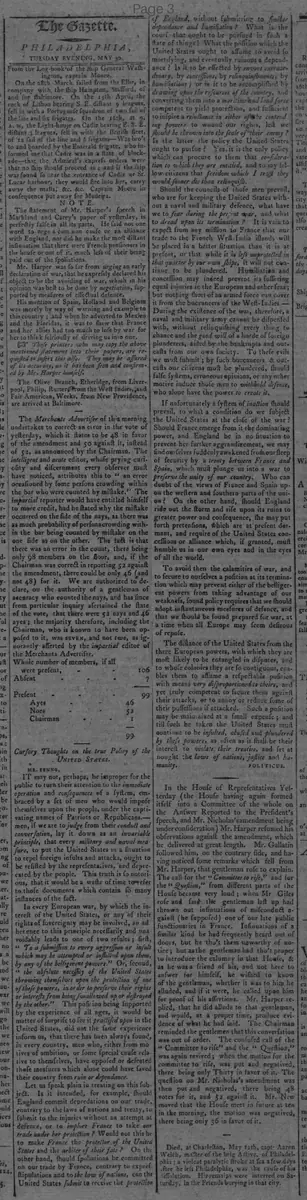
IT may not, perhaps, be improper for the public to turn their attention to the immediate operation and consequences of a system, embraced by a set of men who would impose themselves upon the people, under the captivating names of Patriots or Republicans. men, if we are to judge from their conduct and conversation, lay it down as an invariable principle, that every military and naval measure, to put the United States in a situation to repel foreign insults and attacks, ought to be resisted by the representatives, and deprecated by the people. This truth is so notorious, that it would be a waste of time to refer to those documents which contain so many instances of the fact.
In every European war, by which the interest of the United States, or any of their rights of sovereignty may be involved, an adherence to this principle necessarily and unavoidably leads to one of two results; first, "To a submission to every aggression or insult which may be attempted or inflicted upon them, by any of the belligerent powers." Or, second, "the absolute necessity of the United States throwing themselves upon the protection of one of these powers, in order to preserve their rights or interests from being swallowed up or destroyed by the other." This position being supported by the experience of all ages, it would be matter of surprise to see it practiced upon in the United States, did not the same experience inform us, that there has been always found, in every country, men who, either from motives of ambition, or some special cause relative to themselves, have opposed or defeated those measures which alone could have saved their country from ruin or dependence.
Let us speak plain in treating on this subject. Is it intended, for example, should England commit depredations on our trade, contrary to the laws of nations and treaty, to submit to the injuries without an attempt at defence, or to implore France to take our trade under her protection? Would not this be to make France the protector of the United States and the arbiter of their fate? On the other hand, should spoliations be committed on our trade by France, contrary to express stipulations and to the law of nations, can the United States submit to receive the protection of England, without submitting to similar dependence and humiliation? What is the course that ought to be pursued in such a state of things? What the position which the United States ought to assume to avoid so mortifying, and eventually ruinous a dependence? Is it to be effected by envoys extraordinary, by concessions, by relinquishments, by humiliations; or is it to be accomplished by drawing upon the resources of the country, and converting them into a maritime and land force competent to yield protection, and sufficient to inspire a reluctance in either of the contending powers to wound our rights, lest we should be thrown into the scale of their enemy?
Is the latter the policy the United States ought to pursue? Yes, it is the only policy which can procure to them that consideration to which they are entitled, and to my fellow citizens that freedom which I trust they would sooner die than relinquish.
Should the councils of those men prevail, who are for keeping the United States without a naval and military defence, what have we to fear during the present war, and what to dread upon its termination? It is vain to expect from any mission to France that our trade to the French West-India islands will be placed in a better situation than it is at present, or that while it is left unprotected in that quarter by our own ships, it will not continue to be plundered. Humiliation and concession may indeed prevent its suffering equal injuries in the European and other seas; but nothing short of an armed force can cover it from the buccaneers of the West-Indies.—
During the existence of the war, therefore, a naval and military army cannot be dispensed with, without relinquishing every thing to chance and the good will of a horde of foreign plunderers, aided by the bankrupts and outcasts from our own society. To these evils we must submit; by such buccaneers & outcasts our citizens must be plundered, should false systems, erroneous opinions, or any other motive induce those men to withhold defence, who alone have the power to create it.
If unfortunately a system of inaction should prevail, to what a condition do we subject the United States at the close of the war? Should France emerge from it the dominating power, and England be in no situation to prevent her further aggrandizement, we may find ourselves suddenly awakened from our sleep of security by a treaty between France and Spain, which must plunge us into a war to preserve the unity of our country. Who can doubt of the views of France and Spain upon the western and southern parts of the union? On the other hand, should England ride out the storm and rise upon its ruins to greater power and consequence, she may put forth pretensions, which are at present dormant, and require of the United States concessions or alliance which, if granted, must humble us in our own eyes and in the eyes of all the world.
To avoid then the calamities of war, and to secure to ourselves a position at its termination which may prevent either of the belligerent powers from taking advantage of our weakness, sound policy requires that we should adopt instantaneous measures of defence, and that we should be found prepared for war, at a time when all Europe may seem desirous of repose.
The distance of the United States from the three European powers, with which they are most likely to be entangled in disputes, and to whose colonies they are so contiguous, enables them to assume a respectable position with means very disproportionate to theirs, and yet truly competent to secure them against their attacks, or to annoy or reduce some of their possessions if attacked. Such a position may be maintained at a small expense; and till such be taken the United States must continue to be insulted, abused and plundered by these powers, as often as it shall be their interest to violate their treaties, and set at nought the laws of nations, justice and humanity.
POLITICUS.
In every European war, by which the interest of the United States, or any of their rights of sovereignty may be involved, an adherence to this principle necessarily and unavoidably leads to one of two results; first, "To a submission to every aggression or insult which may be attempted or inflicted upon them, by any of the belligerent powers." Or, second, "the absolute necessity of the United States throwing themselves upon the protection of one of these powers, in order to preserve their rights or interests from being swallowed up or destroyed by the other." This position being supported by the experience of all ages, it would be matter of surprise to see it practiced upon in the United States, did not the same experience inform us, that there has been always found, in every country, men who, either from motives of ambition, or some special cause relative to themselves, have opposed or defeated those measures which alone could have saved their country from ruin or dependence.
Let us speak plain in treating on this subject. Is it intended, for example, should England commit depredations on our trade, contrary to the laws of nations and treaty, to submit to the injuries without an attempt at defence, or to implore France to take our trade under her protection? Would not this be to make France the protector of the United States and the arbiter of their fate? On the other hand, should spoliations be committed on our trade by France, contrary to express stipulations and to the law of nations, can the United States submit to receive the protection of England, without submitting to similar dependence and humiliation? What is the course that ought to be pursued in such a state of things? What the position which the United States ought to assume to avoid so mortifying, and eventually ruinous a dependence? Is it to be effected by envoys extraordinary, by concessions, by relinquishments, by humiliations; or is it to be accomplished by drawing upon the resources of the country, and converting them into a maritime and land force competent to yield protection, and sufficient to inspire a reluctance in either of the contending powers to wound our rights, lest we should be thrown into the scale of their enemy?
Is the latter the policy the United States ought to pursue? Yes, it is the only policy which can procure to them that consideration to which they are entitled, and to my fellow citizens that freedom which I trust they would sooner die than relinquish.
Should the councils of those men prevail, who are for keeping the United States without a naval and military defence, what have we to fear during the present war, and what to dread upon its termination? It is vain to expect from any mission to France that our trade to the French West-India islands will be placed in a better situation than it is at present, or that while it is left unprotected in that quarter by our own ships, it will not continue to be plundered. Humiliation and concession may indeed prevent its suffering equal injuries in the European and other seas; but nothing short of an armed force can cover it from the buccaneers of the West-Indies.—
During the existence of the war, therefore, a naval and military army cannot be dispensed with, without relinquishing every thing to chance and the good will of a horde of foreign plunderers, aided by the bankrupts and outcasts from our own society. To these evils we must submit; by such buccaneers & outcasts our citizens must be plundered, should false systems, erroneous opinions, or any other motive induce those men to withhold defence, who alone have the power to create it.
If unfortunately a system of inaction should prevail, to what a condition do we subject the United States at the close of the war? Should France emerge from it the dominating power, and England be in no situation to prevent her further aggrandizement, we may find ourselves suddenly awakened from our sleep of security by a treaty between France and Spain, which must plunge us into a war to preserve the unity of our country. Who can doubt of the views of France and Spain upon the western and southern parts of the union? On the other hand, should England ride out the storm and rise upon its ruins to greater power and consequence, she may put forth pretensions, which are at present dormant, and require of the United States concessions or alliance which, if granted, must humble us in our own eyes and in the eyes of all the world.
To avoid then the calamities of war, and to secure to ourselves a position at its termination which may prevent either of the belligerent powers from taking advantage of our weakness, sound policy requires that we should adopt instantaneous measures of defence, and that we should be found prepared for war, at a time when all Europe may seem desirous of repose.
The distance of the United States from the three European powers, with which they are most likely to be entangled in disputes, and to whose colonies they are so contiguous, enables them to assume a respectable position with means very disproportionate to theirs, and yet truly competent to secure them against their attacks, or to annoy or reduce some of their possessions if attacked. Such a position may be maintained at a small expense; and till such be taken the United States must continue to be insulted, abused and plundered by these powers, as often as it shall be their interest to violate their treaties, and set at nought the laws of nations, justice and humanity.
POLITICUS.
What sub-type of article is it?
Military Affairs
Foreign Affairs
War Or Peace
What keywords are associated?
Military Defense
Naval Force
Foreign Aggression
European War
Us Sovereignty
Trade Protection
France Spain
England Depredations
What entities or persons were involved?
United States
Patriots Or Republicans
England
France
Spain
Belligerent Powers
Editorial Details
Primary Topic
Advocacy For Us Naval And Military Defense Against European Powers
Stance / Tone
Strongly Pro Military Preparedness And Anti Dependence On Foreign Powers
Key Figures
United States
Patriots Or Republicans
England
France
Spain
Belligerent Powers
Key Arguments
Opposition To Military Measures Leads To Submission Or Dependence On Foreign Powers.
Us Must Build Naval And Land Forces To Protect Trade And Sovereignty.
Inaction Invites Plundering By Buccaneers And Foreign Aggressors.
Preparedness Prevents Humiliation And Secures Independence Post War.
Distance From Europe Allows Effective Defense At Low Cost.