Thank you for visiting SNEWPapers!
Sign up free
Editorial
June 1, 1835
The Daily Cincinnati Republican, And Commercial Register
Cincinnati, Hamilton County, Ohio
What is this article about?
The 1835 editorial from Cincinnati discusses a convention's nomination of Col. R.M. Johnson over initial support for Mr. Rives, despite Virginia's dissent over his U.S. Bank stance. It critiques northern Whigs' push for Daniel Webster against southern backing of Judge White, predicting irreconcilable party divisions rooted in federalist vs. nullifier principles.
Clipping
OCR Quality
95%
Excellent
Full Text
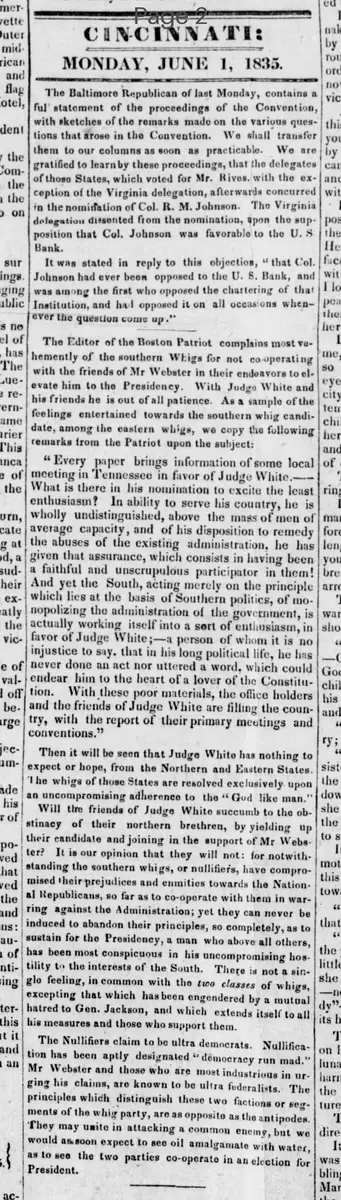
CINCINNATI:
MONDAY, JUNE 1, 1835.
The Baltimore Republican of last Monday, contains a full statement of the proceedings of the Convention, with sketches of the remarks made on the various questions that arose in the Convention. We shall transfer them to our columns as soon as practicable. We are gratified to learn by these proceedings, that the delegates of those States, which voted for Mr. Rives. with the exception of the Virginia delegation, afterwards concurred in the nomination of Col. R. M. Johnson. The Virginia delegation dissented from the nomination, upon the supposition that Col. Johnson was favorable to the U. S Bank.
It was stated in reply to this objection, "that Col Johnson had ever been opposed to the U. S. Bank, and was among the first who opposed the chartering of that Institution, and had opposed it on all occasions whenever the question came up."
The Editor of the Boston Patriot complains most vehemently of the southern Whigs for not co-operating with the friends of Mr Webster in their endeavors to elevate him to the Presidency. With Judge White and his friends he is out of all patience. As a sample of the feelings entertained towards the southern whig candidate, among the eastern whigs, we copy the following remarks from the Patriot upon the subject:
"Every paper brings information of some local meeting in Tennessee in favor of Judge White.—— What is there in his nomination to excite the least enthusiasm? In ability to serve his country, he is wholly undistinguished, above the mass of men of average capacity, and of his disposition to remedy the abuses of the existing administration, he has given that assurance, which consists in having been a faithful and unscrupulous participator in them! And yet the South, acting merely on the principle which lies at the basis of Southern politics, of monopolizing the administration of the government, is actually working itself into a sort of enthusiasm, in favor of Judge White;-a person of whom it is no injustice to say. that in his long political life, he has never done an act nor uttered a word. which could endear him to the heart of a lover of the Constitution. With these poor materials, the office holders and the friends of Judge White are filling the country, with the report of their primary meetings and conventions."
Then it will be seen that Judge White has nothing to expect or hope, from the Northern and Eastern States The whigs of those States are resolved exclusively upon an uncompromising adherence to the " Godlike man.'
Will the friends of Judge White succumb to the obstinacy of their northern brethren, by yielding up their candidate and joining in the support of Mr Webster? It is our opinion that they will not: for notwithstanding the southern whigs, or nullifiers, have compromised their prejudices and enmities towards the National Republicans, so far as to co-operate with them in warring against the Administration; yet they can never be induced to abandon their principles, so completely, as to sustain for the Presidency, a man who above all others, has been most conspicuous in his uncompromising hostility to the interests of the South. There is not a single feeling, in common with the two classes of whigs, excepting that which has been engendered by a mutual hatred to Gen. Jackson, and which extends itself to all his measures and those who support them.
The Nullifiers claim to be ultra democrats. Nullification has been aptly designated "democracy run mad." Mr Webster and those who are most industrious in urging his claims, are known to be ultra federalists. The principles which distinguish these two factions or segments of the whig party, are as opposite as the antipodes. They may unite in attacking a common enemy, but we would as soon expect to see oil amalgamate with water, as to see the two parties co-operate in an election for President.
MONDAY, JUNE 1, 1835.
The Baltimore Republican of last Monday, contains a full statement of the proceedings of the Convention, with sketches of the remarks made on the various questions that arose in the Convention. We shall transfer them to our columns as soon as practicable. We are gratified to learn by these proceedings, that the delegates of those States, which voted for Mr. Rives. with the exception of the Virginia delegation, afterwards concurred in the nomination of Col. R. M. Johnson. The Virginia delegation dissented from the nomination, upon the supposition that Col. Johnson was favorable to the U. S Bank.
It was stated in reply to this objection, "that Col Johnson had ever been opposed to the U. S. Bank, and was among the first who opposed the chartering of that Institution, and had opposed it on all occasions whenever the question came up."
The Editor of the Boston Patriot complains most vehemently of the southern Whigs for not co-operating with the friends of Mr Webster in their endeavors to elevate him to the Presidency. With Judge White and his friends he is out of all patience. As a sample of the feelings entertained towards the southern whig candidate, among the eastern whigs, we copy the following remarks from the Patriot upon the subject:
"Every paper brings information of some local meeting in Tennessee in favor of Judge White.—— What is there in his nomination to excite the least enthusiasm? In ability to serve his country, he is wholly undistinguished, above the mass of men of average capacity, and of his disposition to remedy the abuses of the existing administration, he has given that assurance, which consists in having been a faithful and unscrupulous participator in them! And yet the South, acting merely on the principle which lies at the basis of Southern politics, of monopolizing the administration of the government, is actually working itself into a sort of enthusiasm, in favor of Judge White;-a person of whom it is no injustice to say. that in his long political life, he has never done an act nor uttered a word. which could endear him to the heart of a lover of the Constitution. With these poor materials, the office holders and the friends of Judge White are filling the country, with the report of their primary meetings and conventions."
Then it will be seen that Judge White has nothing to expect or hope, from the Northern and Eastern States The whigs of those States are resolved exclusively upon an uncompromising adherence to the " Godlike man.'
Will the friends of Judge White succumb to the obstinacy of their northern brethren, by yielding up their candidate and joining in the support of Mr Webster? It is our opinion that they will not: for notwithstanding the southern whigs, or nullifiers, have compromised their prejudices and enmities towards the National Republicans, so far as to co-operate with them in warring against the Administration; yet they can never be induced to abandon their principles, so completely, as to sustain for the Presidency, a man who above all others, has been most conspicuous in his uncompromising hostility to the interests of the South. There is not a single feeling, in common with the two classes of whigs, excepting that which has been engendered by a mutual hatred to Gen. Jackson, and which extends itself to all his measures and those who support them.
The Nullifiers claim to be ultra democrats. Nullification has been aptly designated "democracy run mad." Mr Webster and those who are most industrious in urging his claims, are known to be ultra federalists. The principles which distinguish these two factions or segments of the whig party, are as opposite as the antipodes. They may unite in attacking a common enemy, but we would as soon expect to see oil amalgamate with water, as to see the two parties co-operate in an election for President.
What sub-type of article is it?
Partisan Politics
What keywords are associated?
Whig Party
Presidential Nomination
Judge White
Daniel Webster
Col Richard Johnson
Nullifiers
U S Bank
Southern Whigs
What entities or persons were involved?
Col. R. M. Johnson
Mr. Rives
Virginia Delegation
U. S. Bank
Boston Patriot
Mr. Webster
Judge White
Southern Whigs
Nullifiers
Gen. Jackson
Editorial Details
Primary Topic
Whig Party Divisions Over 1836 Presidential Nominations
Stance / Tone
Critical Of Northern Whig Obstinacy And Supportive Of Southern Independence
Key Figures
Col. R. M. Johnson
Mr. Rives
Virginia Delegation
U. S. Bank
Boston Patriot
Mr. Webster
Judge White
Southern Whigs
Nullifiers
Gen. Jackson
Key Arguments
Delegates Shifted Support To Col. Johnson Despite Initial Backing Of Mr. Rives
Virginia Dissented Believing Johnson Favored U.S. Bank, But He Opposed It Consistently
Northern Whigs Criticize Southern Support For Judge White As Lacking Merit
Southern Whigs Unlikely To Abandon White For Webster Due To Ideological Differences
Nullifiers And Federalists Share Only Anti Jackson Sentiment, Not Broader Principles
Party Factions Too Opposed To Cooperate On Presidential Election