Thank you for visiting SNEWPapers!
Sign up free
The Massachusetts Spy
Boston, Suffolk County, Massachusetts
What is this article about?
In 'The Monitor. No. IV.', the author argues that Massachusetts is a distinct sovereign state bound only by its charter to Britain, not subject to Parliament's authority in all cases, as claimed in 6 Geo. III. Citing Blackstone and Coke, it critiques lack of representation and taxation without consent, opposing Governor Hutchinson's stance.
Merged-components note: Merged across pages as this is a clear textual continuation of 'The Monitor. No. IV.' article, with the second part picking up mid-sentence from the first.
Clippings
1 of 2
OCR Quality
Full Text
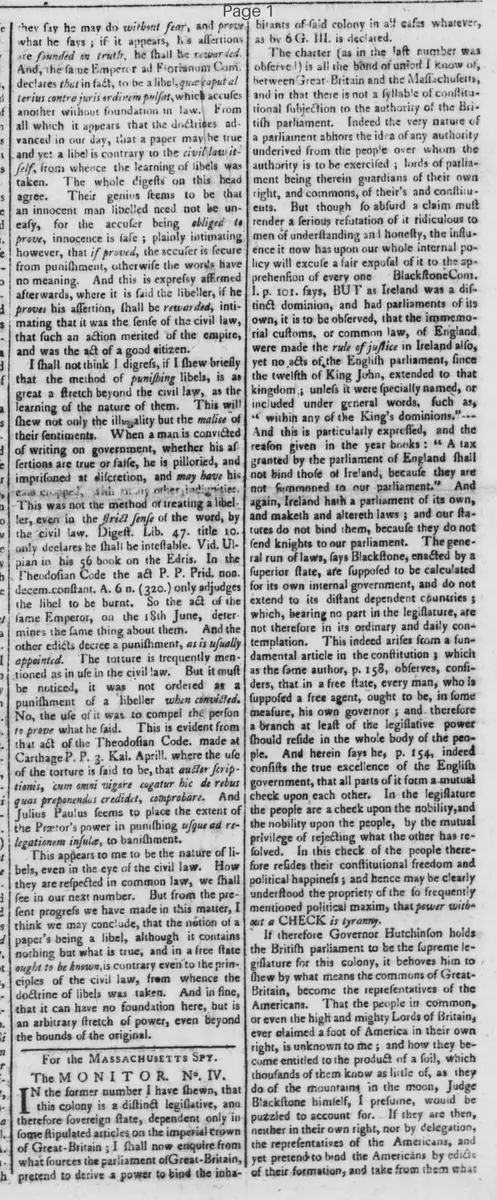
The Monitor. No. IV.
In the former number I have shewn, that
this colony is a distinct legislative, and
therefore sovereign state, dependent only in
some stipulated articles on the imperial crown
of Great-Britain; I shall now enquire from
what sources the parliament of Great-Britain,
pretend to derive a power to bind the inha-
bitants of said colony in all cases whatever,
as by 6 G. III. is declared.
The charter (as in the last number was
observed) is all the bond of union I know of,
between Great-Britain and the Massachusetts,
and in that there is not a syllable of consti-
tutional subjection to the authority of the Bri-
tish parliament. Indeed the very nature of
a parliament abhors the idea of any authority
underived from the people over whom the
authority is to be exercised; lords of parlia-
ment being therein guardians of their own
right, and commons, of theirs and constitu-
ents. But though so absurd a claim must
render a serious refutation of it ridiculous to
men of understanding and honesty, the influ-
ence it now has upon our whole internal po-
licy will excuse a fair exposal of it to the ap-
prehension of every one Blackstone Com.
I. p. 101. says, BUT as Ireland was a dis-
tinct dominion, and had parliaments of its
own, it is to be observed, that the immemo-
rial customs, or common law, of England
were made the rule of justice in Ireland also,
yet no acts of the English parliament, since
the twelfth of King John, extended to that
kingdom; unless it were specially named, or
included under general words, such as,
within any of the King's dominions. And this is particularly expressed, and the
reason given in the year books: "A tax
granted by the parliament of England shall
not bind those of Ireland, because they are
not Summoned to our parliament." And
again, Ireland hath a parliament of its own,
and maketh and altereth laws; and our sta-
tutes do not bind them, because they do not
send knights to our parliament. The gene-
ral run of laws, says Blackstone, enacted by a
superior state, are supposed to be calculated
for its own internal government, and do not
extend to its distant dependent countries;
which, bearing no part in the legislature, are
not therefore in its ordinary and daily con-
templation. This indeed arises from a fun-
damental article in the constitution; which
as the same author, p. 158, observes, con-
siders, that in a free state, every man, who is
supposed a free agent, ought to be, in some
measure, his own governor; and therefore
a branch at least of the legislative power
should reside in the whole body of the peo-
ple. And herein says he, p. 154, indeed
consists the true excellence of the English
government, that all parts of it form a mutual
check upon each other. In the legislature
the people are a check upon the nobility, and
the nobility upon the people, by the mutual
privilege of rejecting what the other has re-
solved. In this check of the people there-
fore resides their constitutional freedom and
political happiness; and hence may be clearly
understood the propriety of the so frequently
mentioned political maxim, that power with-
out a CHECK is tyranny.
If therefore Governor Hutchinson holds
the British parliament to be the supreme le-
gislature for this colony, it behoves him to
show by what means the commons of Great-
Britain, become the representatives of the
Americans. That the people in common,
or even the high and mighty Lords of Britain,
ever claimed a foot of America in their own
right, is unknown to me; and how they be-
come entitled to the product of a soil, which
thousands of them know as little of, as they
do of the mountains in the moon, Judge
Blackstone himself, I presume, would be
puzzled to account for. If they are then,
neither in their own right, nor by delegation,
the representatives of the Americans, and
yet pretend to bind the Americans by edicts
of their formation, and take from them what
There of their property they please without their consent, and yet consent on all hands acknowledged to be the very soul of constitutional legislation, and soul and body together of taxation, we need a new set of law books to support Mr. Hutchinson's idea of the supreme legislature of this province.
Laws considered as rules of human conduct in general, may very unexceptionably extend over the whole empire, and doubtless the tacit consent of both Irishmen and Americans will give sufficient sanction to these; but acts of the British parliament plainly tending to deprive Ireland or America of some natural advantage, and monopolize particular articles of manufacture and commerce to themselves, must inevitably draw into question the right of such unequal exertions of power, by no means derived from the people. If the disposal of the property of a freeman by his own consent, or that of his representative, by him freely and fairly chosen for that end, be his natural, constitutional and unalienable RIGHT, he will think himself wronged when this disposal is wrested from him by any other. And as this cannot be done but by an ACT contrary to the great charter of English liberties, to which he is equally entitled with any subject in Britain, it must be done against law; for all the books tell him that any act made against Magna Charta shall be holden for none.
It is now pretty universally known that laws by which freemen should be governed, should be laws originating with themselves; subject, no doubt, to the rejection of the other branches: But to be controlled by the edicts of any power on earth, without a right of rejection, or any advisement in the case, is as utterly incompatible with the right, privilege and immunity of an Englishman, as close imprisonment in a dungeon is with perfect liberty.
Two questions arise on this head, viz. Will the Americans long suffer such a cruel, injurious and dangerous treatment? or, if not, how will they attempt a relief from so intolerable a grievance? The answer to the last is, by the laws of the land.
If a jury of Suffolk can so easily be taught to distinguish between justifiable and excusable homicide, manslaughter, and murder; a man must be timorous indeed who dare not trust them with the issue of a few pounds, ravished by colour of one of those unconstitutional edicts, which every cobbler knows wants what even Blackstone himself declares indispensable to the constitution of a law, the consent of the commons whose actions it is to control.
Well did the sage Lord Coke observe, that the law was every man's safe castle; and a very recent history informs us how industrious a late infamous murderous plunderer was to prevent the victims of his rapacity and cruelty, to gain any acquaintance with the laws of their country. But thanks to the God who rules in the armies of heaven, and looks down with indignation on such rebels to his government. No Fanning, Tryon, Hutchinson, nor Hillsborough, were they disposed, could hide the laws from the happy inhabitants of this favored province.
...The noble ambition of saving a devoted empire, has taken such thorough possession of so many bosoms that earth nor hell can quench the spark, which every breath of opposition serves but to inflame.--- The ruling passion and reigning taste is easily perceived by the encouragement given to Painters on one or other side the important question of, whether freemen shall retain the disposal of their property in their own hands, or accept the favour of Charles Paxton, Esq; Benjamin Hallowell, &c. to manage it at their discretion, in providing for such gentry as Fellows, Richardson and Wilmot.
Many very feelingly realize 'that the constitution and its laws are the basis of public tranquillity, - the firmest support of the public authority and pledge of the liberty of the citizens.' And they as fully believe, that 'to attack the constitution of the state, and to violate its laws, is a capital crime against society, and if those guilty of it are invested with authority, they add to this crime a perfidious abuse of the power, with which they are intrusted.' The adequate punishment of such traitors may not always be in the power of the wise and worthy citizens; but every woman and child may manifest their abhorrence and contempt of them; and never was heart so case hardened as to be wholly insensible to the just reproach of all men.
What sub-type of article is it?
What keywords are associated?
What entities or persons were involved?
Editorial Details
Primary Topic
Opposition To British Parliament's Authority Over Massachusetts Colony
Stance / Tone
Strongly Anti Parliamentary Supremacy, Pro Colonial Sovereignty
Key Figures
Key Arguments