Thank you for visiting SNEWPapers!
Sign up free
Literary
June 15, 1832
Morning Star
Limerick, York County, Maine
What is this article about?
Descriptive essay on the wild ass, emphasizing its wild nature, swiftness, and love of liberty, illustrated through biblical references from Job, Psalms, and Jeremiah. Includes moral reflections comparing the animal to human disobedience and untamed dispositions, ending with a short verse.
Clipping
OCR Quality
98%
Excellent
Full Text
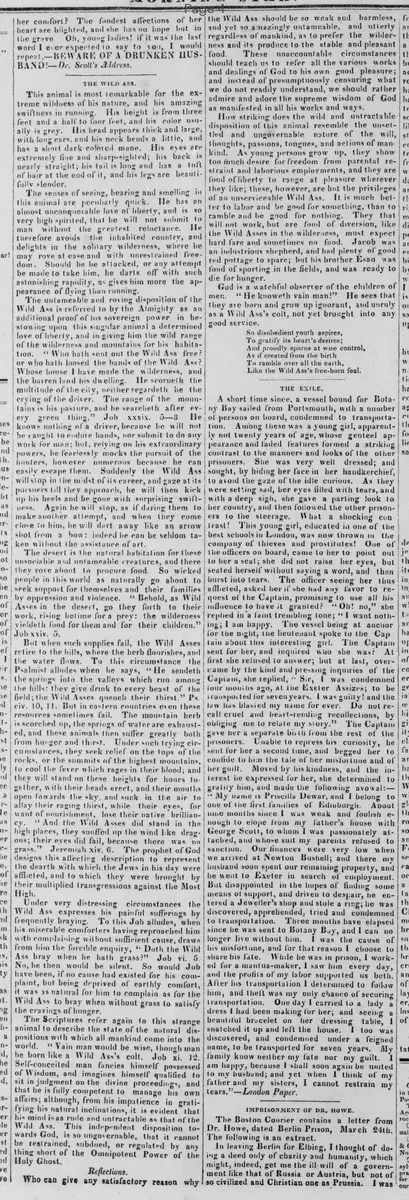
THE WILD ASS.
This animal is most remarkable for the extreme wildness of his nature, and his amazing swiftness in running. His height is from three feet and a half to four feet, and his color usually is grey. His head appears thick and large, with long ears, and his neck bends a little, and has a short dark-colored mane. His eyes are extremely fine and sharp-sighted; his back is nearly straight; his tail is long and has a tuft of hair at the end of it, and his legs are beautifully slender.
The senses of seeing, hearing and smelling in this animal are peculiarly quick. He has an almost unconquerable love of liberty, and is so very high spirited, that he will not submit to man without the greatest reluctance. He therefore avoids the inhabited country, and delights in the solitary wilderness, where he may rove at ease and with unrestrained freedom. Should he be attacked, or any attempt be made to take him, he darts off with such astonishing rapidity, as gives him more the appearance of flying than running.
The untameable and roving disposition of the Wild Ass is referred to by the Almighty as an additional proof of his sovereign power in bestowing upon this singular animal a determined love of liberty, and in giving him the wild range of the wilderness and mountains for his habitation. "Who hath sent out the Wild Ass free? or who hath loosed the bands of the Wild Ass? Whose house I have made the wilderness, and the barren land his dwelling. He scorneth the multitude of the city, neither regardeth he the crying of the driver. The range of the mountains is his pasture, and he searcheth after every green thing." Job xxxix. 5-8. He knows nothing of a driver, because he will not be caught to endure bands, nor submit to do any work for man; but, relying on his extraordinary powers, he fearlessly mocks the pursuit of the hunters, however numerous because he can easily escape them. Suddenly the Wild Ass will stop in the midst of his career, and gaze at his pursuers till they approach, he will then kick up his heels and be gone with surprising swiftness. Again he will stop, as if daring them to make another attempt, and when they come close to him, he will dart away like an arrow shot from a bow: indeed he can be seldom taken without the assistance of art.
The desert is the natural habitation for these unsociable and untameable creatures, and there they rove about to procure food. So wicked people in this world as naturally go about to seek support for themselves and their families by oppression and violence. "Behold, as Wild Asses in the desert, go they forth to their work, rising betimes for a prey: the wilderness yieldeth food for them and for their children." Job xxiv. 5. But when such supplies fail, the Wild Asses retire to the hills, where the herb flourishes, and the water flows. To this circumstance the Psalmist alludes when he says, "He sendeth the springs into the valleys which run among the hills: they give drink to every beast of the field; the Wild Asses quench their thirst." Ps. civ. 10, 11. But in eastern countries even these resources sometimes fail. The mountain herb is scorched up, the springs of water are exhausted, and these animals then suffer greatly both from hunger and thirst. Under such trying circumstances, they seek relief on the tops of the rocks, or the summits of the highest mountains, to cool the fever which rages in their blood; and they will stand on these heights for hours together, with their heads erect, and their mouths open towards the sky, and suck in the air to allay their raging thirst, while their eyes, for want of nourishment, lose their native brilliancy.
"And the Wild Asses did stand in the high places, they snuffed up the wind like dragons; their eyes did fail, because there was no grass." Jeremiah xiv. 6. The prophet of God designs this affecting description to represent the dearth with which the Jews in his day were afflicted, and to which they were brought by their multiplied transgressions against the Most High.
Under very distressing circumstances the Wild Ass expresses his painful sufferings by frequently braying. To this Job alludes, when his miserable comforters having reproached him with complaining without sufficient cause, draws from him the forcible enquiry, "Doth the Wild Ass bray when he hath grass?" Job vi. 5. No, he then would be silent. So would Job have been, if no cause had existed for his complaint, but being deprived of earthly comfort, it was as natural for him to complain as for the Wild Ass to bray when without grass to satisfy the cravings of hunger.
The Scriptures refer again to this strange animal to describe the state of the natural dispositions with which all mankind come into the world. "Vain man would be wise, though man be born like a Wild Ass's colt." Job xi. 12. Self-conceited man fancies himself possessed of wisdom, and imagines himself qualified to sit in judgment on the divine proceedings, and that he is fully competent to manage his own affairs; although, from his impatience in gratifying his natural inclinations, it is evident "that his mind is as rude and untractable as that of the Wild Ass. This independent disposition towards God, is so ungovernable, that it cannot be restrained, subdued, or regulated by any thing short of the Omnipotent Power of the Holy Ghost.
Reflections.
Who can give any satisfactory reason why the Wild Ass should be so weak and harmless, and yet so amazingly untameable, and utterly regardless of mankind, as to prefer the wilderness and its produce to the stable and pleasant food. These unaccountable circumstances should teach us to refer all the various works and dealings of God to his own good pleasure; and instead of presumptuously censuring what we do not readily understand, we should rather admire and adore the supreme wisdom of God as manifested in all his works and ways.
How striking does the wild and untractable disposition of this animal resemble the unsettled and ungovernable nature of the will, thoughts, passions, tongues, and actions of mankind. As young persons grow up, they show too much desire for freedom from parental restraint and laborious employments, and they are fond of liberty to range at pleasure wherever they like; these, however, are but the privileges of an unserviceable Wild Ass. It is much better to labor and be good for something, than to ramble and be good for nothing. They that will not work, but are fond of diversion, like the Wild Asses in the wilderness, must expect hard fare and sometimes no food. Jacob was an industrious shepherd, and had plenty of good red pottage to spare; but his brother Esau was fond of sporting in the fields, and was ready to die for hunger.
God is a watchful observer of the children of men. "He knoweth vain man!" He sees that they are born and grow up ignorant, and unruly as a Wild Ass's colt, not yet brought into any good service.
So disobedient youth aspires,
To gratify its heart's desires;
And proudly spurns at wise control,
As if created from the birth
To ramble over all the earth,
Like the Wild Ass's free-born foal.
This animal is most remarkable for the extreme wildness of his nature, and his amazing swiftness in running. His height is from three feet and a half to four feet, and his color usually is grey. His head appears thick and large, with long ears, and his neck bends a little, and has a short dark-colored mane. His eyes are extremely fine and sharp-sighted; his back is nearly straight; his tail is long and has a tuft of hair at the end of it, and his legs are beautifully slender.
The senses of seeing, hearing and smelling in this animal are peculiarly quick. He has an almost unconquerable love of liberty, and is so very high spirited, that he will not submit to man without the greatest reluctance. He therefore avoids the inhabited country, and delights in the solitary wilderness, where he may rove at ease and with unrestrained freedom. Should he be attacked, or any attempt be made to take him, he darts off with such astonishing rapidity, as gives him more the appearance of flying than running.
The untameable and roving disposition of the Wild Ass is referred to by the Almighty as an additional proof of his sovereign power in bestowing upon this singular animal a determined love of liberty, and in giving him the wild range of the wilderness and mountains for his habitation. "Who hath sent out the Wild Ass free? or who hath loosed the bands of the Wild Ass? Whose house I have made the wilderness, and the barren land his dwelling. He scorneth the multitude of the city, neither regardeth he the crying of the driver. The range of the mountains is his pasture, and he searcheth after every green thing." Job xxxix. 5-8. He knows nothing of a driver, because he will not be caught to endure bands, nor submit to do any work for man; but, relying on his extraordinary powers, he fearlessly mocks the pursuit of the hunters, however numerous because he can easily escape them. Suddenly the Wild Ass will stop in the midst of his career, and gaze at his pursuers till they approach, he will then kick up his heels and be gone with surprising swiftness. Again he will stop, as if daring them to make another attempt, and when they come close to him, he will dart away like an arrow shot from a bow: indeed he can be seldom taken without the assistance of art.
The desert is the natural habitation for these unsociable and untameable creatures, and there they rove about to procure food. So wicked people in this world as naturally go about to seek support for themselves and their families by oppression and violence. "Behold, as Wild Asses in the desert, go they forth to their work, rising betimes for a prey: the wilderness yieldeth food for them and for their children." Job xxiv. 5. But when such supplies fail, the Wild Asses retire to the hills, where the herb flourishes, and the water flows. To this circumstance the Psalmist alludes when he says, "He sendeth the springs into the valleys which run among the hills: they give drink to every beast of the field; the Wild Asses quench their thirst." Ps. civ. 10, 11. But in eastern countries even these resources sometimes fail. The mountain herb is scorched up, the springs of water are exhausted, and these animals then suffer greatly both from hunger and thirst. Under such trying circumstances, they seek relief on the tops of the rocks, or the summits of the highest mountains, to cool the fever which rages in their blood; and they will stand on these heights for hours together, with their heads erect, and their mouths open towards the sky, and suck in the air to allay their raging thirst, while their eyes, for want of nourishment, lose their native brilliancy.
"And the Wild Asses did stand in the high places, they snuffed up the wind like dragons; their eyes did fail, because there was no grass." Jeremiah xiv. 6. The prophet of God designs this affecting description to represent the dearth with which the Jews in his day were afflicted, and to which they were brought by their multiplied transgressions against the Most High.
Under very distressing circumstances the Wild Ass expresses his painful sufferings by frequently braying. To this Job alludes, when his miserable comforters having reproached him with complaining without sufficient cause, draws from him the forcible enquiry, "Doth the Wild Ass bray when he hath grass?" Job vi. 5. No, he then would be silent. So would Job have been, if no cause had existed for his complaint, but being deprived of earthly comfort, it was as natural for him to complain as for the Wild Ass to bray when without grass to satisfy the cravings of hunger.
The Scriptures refer again to this strange animal to describe the state of the natural dispositions with which all mankind come into the world. "Vain man would be wise, though man be born like a Wild Ass's colt." Job xi. 12. Self-conceited man fancies himself possessed of wisdom, and imagines himself qualified to sit in judgment on the divine proceedings, and that he is fully competent to manage his own affairs; although, from his impatience in gratifying his natural inclinations, it is evident "that his mind is as rude and untractable as that of the Wild Ass. This independent disposition towards God, is so ungovernable, that it cannot be restrained, subdued, or regulated by any thing short of the Omnipotent Power of the Holy Ghost.
Reflections.
Who can give any satisfactory reason why the Wild Ass should be so weak and harmless, and yet so amazingly untameable, and utterly regardless of mankind, as to prefer the wilderness and its produce to the stable and pleasant food. These unaccountable circumstances should teach us to refer all the various works and dealings of God to his own good pleasure; and instead of presumptuously censuring what we do not readily understand, we should rather admire and adore the supreme wisdom of God as manifested in all his works and ways.
How striking does the wild and untractable disposition of this animal resemble the unsettled and ungovernable nature of the will, thoughts, passions, tongues, and actions of mankind. As young persons grow up, they show too much desire for freedom from parental restraint and laborious employments, and they are fond of liberty to range at pleasure wherever they like; these, however, are but the privileges of an unserviceable Wild Ass. It is much better to labor and be good for something, than to ramble and be good for nothing. They that will not work, but are fond of diversion, like the Wild Asses in the wilderness, must expect hard fare and sometimes no food. Jacob was an industrious shepherd, and had plenty of good red pottage to spare; but his brother Esau was fond of sporting in the fields, and was ready to die for hunger.
God is a watchful observer of the children of men. "He knoweth vain man!" He sees that they are born and grow up ignorant, and unruly as a Wild Ass's colt, not yet brought into any good service.
So disobedient youth aspires,
To gratify its heart's desires;
And proudly spurns at wise control,
As if created from the birth
To ramble over all the earth,
Like the Wild Ass's free-born foal.
What sub-type of article is it?
Essay
What themes does it cover?
Religious
Moral Virtue
Liberty Freedom
What keywords are associated?
Wild Ass
Biblical References
Love Of Liberty
Moral Reflections
Human Nature
Job Scripture
Divine Providence
Literary Details
Title
The Wild Ass.
Key Lines
Who Hath Sent Out The Wild Ass Free? Or Who Hath Loosed The Bands Of The Wild Ass? Whose House I Have Made The Wilderness, And The Barren Land His Dwelling. He Scorneth The Multitude Of The City, Neither Regardeth He The Crying Of The Driver. The Range Of The Mountains Is His Pasture, And He Searcheth After Every Green Thing." Job Xxxix. 5 8.
"And The Wild Asses Did Stand In The High Places, They Snuffed Up The Wind Like Dragons; Their Eyes Did Fail, Because There Was No Grass." Jeremiah Xiv. 6.
So Disobedient Youth Aspires,
To Gratify Its Heart's Desires;
And Proudly Spurns At Wise Control,
As If Created From The Birth
To Ramble Over All The Earth,
Like The Wild Ass's Free Born Foal.