Thank you for visiting SNEWPapers!
Sign up free
Story
December 25, 1925
The Winslow Mail
Winslow, Navajo County, Arizona
What is this article about?
Article details trick photography and engineering illusions in early Hollywood films, including glass ceilings, miniature shipwrecks, prehistoric models, composite shots, fog machines, and safe explosions to depict impossible scenes economically.
Clipping
OCR Quality
98%
Excellent
Full Text
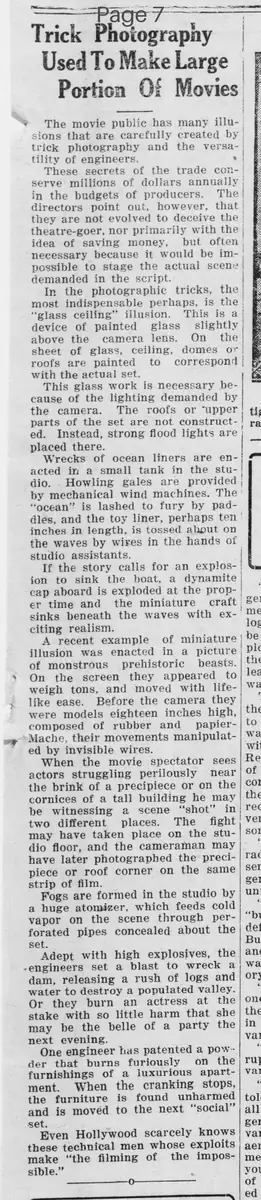
Trick Photography
Used To Make Large
Portion Of Movies
The movie public has many illusions that are carefully created by trick photography and the versatility of engineers.
These secrets of the trade conserve millions of dollars annually in the budgets of producers. The directors point out, however, that they are not evolved to deceive the theatre-goer, nor primarily with the idea of saving money, but often necessary because it would be impossible to stage the actual scene demanded in the script.
In the photographic tricks, the most indispensable perhaps, is the "glass ceiling" illusion. This is a device of painted glass slightly above the camera lens. On the sheet of glass, ceiling, domes or roofs are painted to correspond with the actual set.
This glass work is necessary because of the lighting demanded by the camera. The roofs or upper parts of the set are not constructed. Instead, strong flood lights are placed there.
Wrecks of ocean liners are enacted in a small tank in the studio. Howling gales are provided by mechanical wind machines. The "ocean" is lashed to fury by paddles. and the toy liner. perhaps ten inches in length, is tossed about on the waves by wires in the hands of studio assistants.
If the story calls for an explosion to sink the boat, a dynamite cap aboard is exploded at the proper time and the miniature craft sinks beneath the waves with exciting realism.
A recent example of miniature illusion was enacted in a picture of monstrous prehistoric beasts. On the screen they appeared to weigh tons, and moved with life-like ease. Before the camera they were models eighteen inches high composed of rubber and papier-mache. their movements manipulated by invisible wires.
When the movie spectator sees actors struggling perilously near the brink of a precipice or on the cornices of a tall building he may be witnessing a scene "shot" in two different places. The fight may have taken place on the studio floor. and the cameraman may have later photographed the precipice or roof corner on the same strip of film.
Fogs are formed in the studio by a huge atomizer. which feeds cold vapor on the scene through perforated pipes concealed about the set.
Adept with high explosives. the engineers set a blast to wreck a dam, releasing a rush of logs and water to destroy a populated valley.
Or they burn an actress at the stake with so little harm that she may be the belle of a party the next evening.
One engineer has patented a powder that burns furiously on the furnishings of a luxurious apartment. When the cranking stops the furniture is found unharmed and is moved to the next "social" set.
Even Hollywood scarcely knows these technical men whose exploits make "the filming of the impossible."
Used To Make Large
Portion Of Movies
The movie public has many illusions that are carefully created by trick photography and the versatility of engineers.
These secrets of the trade conserve millions of dollars annually in the budgets of producers. The directors point out, however, that they are not evolved to deceive the theatre-goer, nor primarily with the idea of saving money, but often necessary because it would be impossible to stage the actual scene demanded in the script.
In the photographic tricks, the most indispensable perhaps, is the "glass ceiling" illusion. This is a device of painted glass slightly above the camera lens. On the sheet of glass, ceiling, domes or roofs are painted to correspond with the actual set.
This glass work is necessary because of the lighting demanded by the camera. The roofs or upper parts of the set are not constructed. Instead, strong flood lights are placed there.
Wrecks of ocean liners are enacted in a small tank in the studio. Howling gales are provided by mechanical wind machines. The "ocean" is lashed to fury by paddles. and the toy liner. perhaps ten inches in length, is tossed about on the waves by wires in the hands of studio assistants.
If the story calls for an explosion to sink the boat, a dynamite cap aboard is exploded at the proper time and the miniature craft sinks beneath the waves with exciting realism.
A recent example of miniature illusion was enacted in a picture of monstrous prehistoric beasts. On the screen they appeared to weigh tons, and moved with life-like ease. Before the camera they were models eighteen inches high composed of rubber and papier-mache. their movements manipulated by invisible wires.
When the movie spectator sees actors struggling perilously near the brink of a precipice or on the cornices of a tall building he may be witnessing a scene "shot" in two different places. The fight may have taken place on the studio floor. and the cameraman may have later photographed the precipice or roof corner on the same strip of film.
Fogs are formed in the studio by a huge atomizer. which feeds cold vapor on the scene through perforated pipes concealed about the set.
Adept with high explosives. the engineers set a blast to wreck a dam, releasing a rush of logs and water to destroy a populated valley.
Or they burn an actress at the stake with so little harm that she may be the belle of a party the next evening.
One engineer has patented a powder that burns furiously on the furnishings of a luxurious apartment. When the cranking stops the furniture is found unharmed and is moved to the next "social" set.
Even Hollywood scarcely knows these technical men whose exploits make "the filming of the impossible."
What sub-type of article is it?
Curiosity
Extraordinary Event
What themes does it cover?
Deception
What keywords are associated?
Trick Photography
Movie Illusions
Miniature Models
Studio Effects
Glass Ceiling
Safe Explosions
Where did it happen?
Hollywood Studio
Story Details
Location
Hollywood Studio
Story Details
Explanation of film production techniques using trick photography and engineering to create realistic illusions for scenes like shipwrecks, prehistoric beasts, precipice struggles, fogs, dam wrecks, and burnings without actual danger or full sets.