Thank you for visiting SNEWPapers!
Sign up free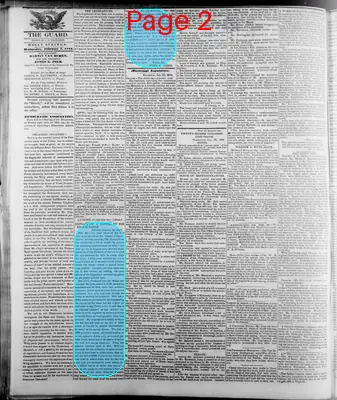
Letter to Editor
February 7, 1844
The Guard
Holly Springs, Marshall County, Mississippi
What is this article about?
In a letter from Jackson dated January 25, 1844, Robert S. Greer defends his bill to repeal the 1840 law abolishing imprisonment for debt, arguing it enables fraudulent escape; he advocates reverting to the 1839 law allowing imprisonment only for proven fraud to safeguard creditors.
Clipping
OCR Quality
98%
Excellent
Full Text
EXTRACT OF A LETTER TO THE EDITOR, DATED
Jackson, January 25, 1844.
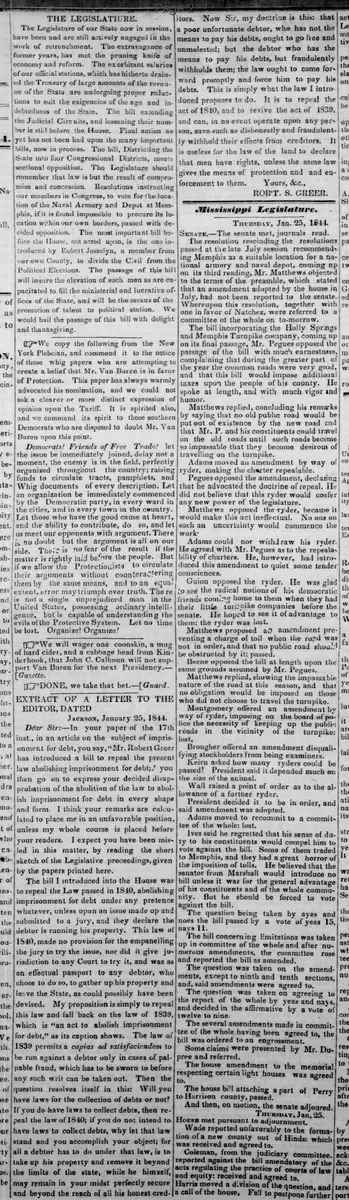
Dear Sir:--In your paper of the 17th inst., in an article on the subject of imprisonment for debt, you say, "Mr. Robert Greer has introduced a bill to repeal the present law abolishing imprisonment for debt;" you then go on to express your decided disapprobation of the abolition of the law to abolish imprisonment for debt in every shape and form. I think your remarks are calculated to place me in an unfavorable position, unless my whole course is placed before your readers. I expect you have been misled in this matter, by reading the short sketch of the Legislative proceedings, given by the papers printed here.
The bill I introduced into the House was to repeal the Law passed in 1840, abolishing imprisonment for debt under any pretence whatever, unless upon an issue made up and submitted to a jury, and they declare the debtor is running his property. This law of 1840, made no provision for the empanelling the jury to try the issue, nor did it give jurisdiction to any Court to try it, and was as effectual passport to any debtor, who chose to do so, to gather up his property and leave the State, as could possibly have been devised. My proposition is simply to repeal this law and fall back on the law of 1839, which is "an act to abolish imprisonment for debt," as its caption shows. The law of 1839 permits a capias ad satisfaciendum to be run against a debtor only in cases of palpable fraud, which has to be sworn to before any such writ can be taken out. Then the question resolves itself in this: Will you have laws for the collection of debts or not? If you do have laws to collect debts, then repeal the law of 1840; if you do not intend to have laws to collect debts, why let that law stand and you accomplish your object; for all a debtor has to do under that law, is to take up his property and remove it beyond the limits of the state, while he himself, may remain in your midst perfectly secure from his cred
itors. Now Sir, my doctrine is this: that a poor unfortunate debtor, who has not the means to pay his debts, ought to go free and unmolested; but the debtor who has the means to pay his debts, but fraudulently withholds them; the law ought to come forward promptly and force him to pay his debts. This is simply what the law I introduced proposes to do. It is to repeal the act of 1840, and to revive the act of 1839, and can in no event operate upon any person, save such as dishonestly and fraudulently withhold their effects from creditors. It is useless for the law of the land to declare that men have rights, unless the same law gives the means of protection and enforcement to them.
Yours, &c.,
ROB'T. S. GREER.
Jackson, January 25, 1844.
Dear Sir:--In your paper of the 17th inst., in an article on the subject of imprisonment for debt, you say, "Mr. Robert Greer has introduced a bill to repeal the present law abolishing imprisonment for debt;" you then go on to express your decided disapprobation of the abolition of the law to abolish imprisonment for debt in every shape and form. I think your remarks are calculated to place me in an unfavorable position, unless my whole course is placed before your readers. I expect you have been misled in this matter, by reading the short sketch of the Legislative proceedings, given by the papers printed here.
The bill I introduced into the House was to repeal the Law passed in 1840, abolishing imprisonment for debt under any pretence whatever, unless upon an issue made up and submitted to a jury, and they declare the debtor is running his property. This law of 1840, made no provision for the empanelling the jury to try the issue, nor did it give jurisdiction to any Court to try it, and was as effectual passport to any debtor, who chose to do so, to gather up his property and leave the State, as could possibly have been devised. My proposition is simply to repeal this law and fall back on the law of 1839, which is "an act to abolish imprisonment for debt," as its caption shows. The law of 1839 permits a capias ad satisfaciendum to be run against a debtor only in cases of palpable fraud, which has to be sworn to before any such writ can be taken out. Then the question resolves itself in this: Will you have laws for the collection of debts or not? If you do have laws to collect debts, then repeal the law of 1840; if you do not intend to have laws to collect debts, why let that law stand and you accomplish your object; for all a debtor has to do under that law, is to take up his property and remove it beyond the limits of the state, while he himself, may remain in your midst perfectly secure from his cred
itors. Now Sir, my doctrine is this: that a poor unfortunate debtor, who has not the means to pay his debts, ought to go free and unmolested; but the debtor who has the means to pay his debts, but fraudulently withholds them; the law ought to come forward promptly and force him to pay his debts. This is simply what the law I introduced proposes to do. It is to repeal the act of 1840, and to revive the act of 1839, and can in no event operate upon any person, save such as dishonestly and fraudulently withhold their effects from creditors. It is useless for the law of the land to declare that men have rights, unless the same law gives the means of protection and enforcement to them.
Yours, &c.,
ROB'T. S. GREER.
What sub-type of article is it?
Persuasive
Informative
Political
What themes does it cover?
Economic Policy
Crime Punishment
Politics
What keywords are associated?
Imprisonment For Debt
Debt Collection Laws
Fraudulent Debtors
1840 Law Repeal
1839 Act Revival
Legislative Proceedings
Creditor Protection
What entities or persons were involved?
Rob't. S. Greer
Dear Sir
Letter to Editor Details
Author
Rob't. S. Greer
Recipient
Dear Sir
Main Argument
the bill repeals the 1840 law abolishing imprisonment for debt, which allowed fraudulent debtors to escape, and reverts to the 1839 law permitting imprisonment only in cases of palpable fraud to protect creditors while exempting honest poor debtors.
Notable Details
References 1840 Law Lacking Jury Provisions
1840 Law Enables Debtors To Remove Property And Leave State
1839 Law Requires Sworn Fraud For Capias Ad Satisfaciendum
Emphasizes Need For Laws To Enforce Debt Collection Rights