Thank you for visiting SNEWPapers!
Sign up free
Story
October 20, 1842
Watchman Of The South
Richmond, Virginia
What is this article about?
In colonial India, a British narrator witnesses a native snake charmer use shrill pipe music to fascinate and capture cobras in Colonel E—'s garden, observing the snakes dance before being trapped, with one escape attributed to the evil eye.
Clipping
OCR Quality
95%
Excellent
Full Text
THE SNAKE-CHARMER
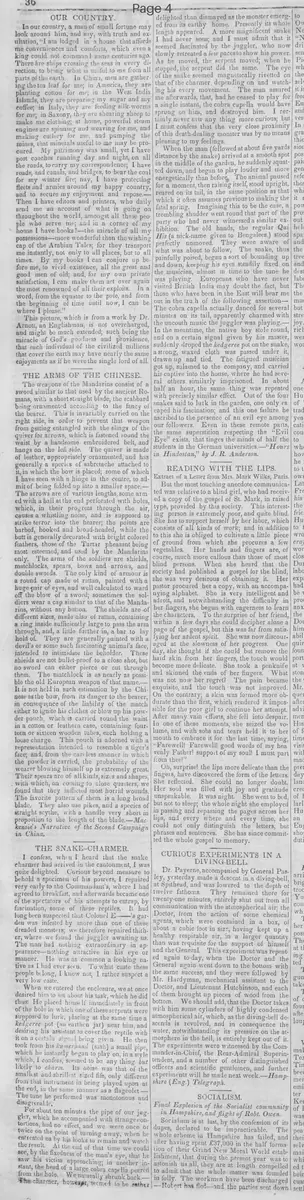
I confess, when I heard that the snake charmer had arrived in the cantonment, I was quite delighted. Curious beyond measure to behold a specimen of his powers, I repaired very early to the Commandant's, where I had agreed to breakfast, and afterwards became one of the spectators of his attempts to entrap, by fascination, some of these reptiles. It had long been suspected that Colonel E—'s garden was infested by more than one of these dreaded monsters; we therefore repaired thither, where we found the juggler awaiting us. The man had nothing extraordinary in appearance—nothing attractive in his eye or manner. He was as common a looking native as I had ever seen. To what caste these people belong, I know not; I rather suspect a very low caste.
When we entered the enclosure, we at once desired him to set about his task, which he did thus: He placed himself immediately in front of the hole in which one of these serpents were supposed to lurk, placing at the same time a kedgeree pot (an earthen jar) near him, and desiring his assistant to cover the reptile with it on a certain signal being given. He then took from his kummerbund (sash) a small pipe, which he instantly began to play on, in a style which, I confess, seemed to be any thing but likely to charm. Its noise was that of the smallest and shrillest sized fife, only different from that instrument in being played upon at the end, in the same manner as a flageolet—The tune he performed was monotonous and disagreeable.
For about ten minutes the pipe of our juggler, which he accompanied with strange contortions, had no effect, and we were once or twice on the point of turning away, when he entreated us by his looks to remain and watch the result. At the end of that time we could see, by the fixedness of the man's eye, that he saw his victim approaching; in another instant, the head of a large cobra capella peered from the hole. We naturally shrunk back.—The charmer, however, seemed to be rather delighted than dismayed as the monster emerged from its earthy home. Presently its whole length appeared. A more magnificent snake I had never seen; and I must admit that it seemed fascinated by the juggler, who now slowly retreated a few paces to show his power. As he moved, the serpent moved; when he stopped, the serpent did the same. The eye of the snake seemed magnetically rivetted on that of the charmer depending on and watching his every movement. The man assured me afterwards, that, had he ceased to play for a single instant, the cobra capella would have sprung on him, and destroyed him. I certainly never saw any thing more curious; but I must confess that the very close proximity of this death-dealing monster was by no means pleasing to my feelings.
When the man (followed at about five yards distance by the snake) arrived at a smooth spot in the middle of the garden, he suddenly squatted down, and began to play louder and more energetically than before. The animal paused for a moment, then raising itself, stood upright, reared on its tail, in the same position as that which it often assumes previous to making the fatal spring. Imagining this to be the case, a trembling shudder went round that part of the party who had never witnessed a similar exhibition. The old hands, the regular Qui His (a nick-name given to Bengalees) stood perfectly unmoved. They were aware of what was about to follow. The snake, thus painfully poised, began a sort of bounding up and down, keeping his eyes steadily fixed on the musician, almost in time to the tune he was playing. Europeans who have never visited British India may doubt the fact, but those who have been in the East will bear me out in the truth of the following assertion—The cobra capella actually danced for several minutes on its tail, apparently charmed with the uncouth music the juggler was playing.—In the meantime, the native boy stole round and on a certain signal given by his master, suddenly dropped the kedgeree pot on the snake. A strong, waxed cloth was passed under it, drawn up and tied. The fatigued musician got up, salamed to the company, and carried his captive into the house, where he had several others similarly imprisoned. In about half an hour, the same thing was repeated with precisely similar effect. Out of the four snakes said to lurk in the garden, one only escaped his fascination; and this one failure he ascribed to the presence of an evil eye among our followers. Even in these remote parts, the same superstition respecting the "Evil Eye" exists, that tinges the minds of half the students in the German universities.—"Hours in Hindostan," by J. R. Anderson.
I confess, when I heard that the snake charmer had arrived in the cantonment, I was quite delighted. Curious beyond measure to behold a specimen of his powers, I repaired very early to the Commandant's, where I had agreed to breakfast, and afterwards became one of the spectators of his attempts to entrap, by fascination, some of these reptiles. It had long been suspected that Colonel E—'s garden was infested by more than one of these dreaded monsters; we therefore repaired thither, where we found the juggler awaiting us. The man had nothing extraordinary in appearance—nothing attractive in his eye or manner. He was as common a looking native as I had ever seen. To what caste these people belong, I know not; I rather suspect a very low caste.
When we entered the enclosure, we at once desired him to set about his task, which he did thus: He placed himself immediately in front of the hole in which one of these serpents were supposed to lurk, placing at the same time a kedgeree pot (an earthen jar) near him, and desiring his assistant to cover the reptile with it on a certain signal being given. He then took from his kummerbund (sash) a small pipe, which he instantly began to play on, in a style which, I confess, seemed to be any thing but likely to charm. Its noise was that of the smallest and shrillest sized fife, only different from that instrument in being played upon at the end, in the same manner as a flageolet—The tune he performed was monotonous and disagreeable.
For about ten minutes the pipe of our juggler, which he accompanied with strange contortions, had no effect, and we were once or twice on the point of turning away, when he entreated us by his looks to remain and watch the result. At the end of that time we could see, by the fixedness of the man's eye, that he saw his victim approaching; in another instant, the head of a large cobra capella peered from the hole. We naturally shrunk back.—The charmer, however, seemed to be rather delighted than dismayed as the monster emerged from its earthy home. Presently its whole length appeared. A more magnificent snake I had never seen; and I must admit that it seemed fascinated by the juggler, who now slowly retreated a few paces to show his power. As he moved, the serpent moved; when he stopped, the serpent did the same. The eye of the snake seemed magnetically rivetted on that of the charmer depending on and watching his every movement. The man assured me afterwards, that, had he ceased to play for a single instant, the cobra capella would have sprung on him, and destroyed him. I certainly never saw any thing more curious; but I must confess that the very close proximity of this death-dealing monster was by no means pleasing to my feelings.
When the man (followed at about five yards distance by the snake) arrived at a smooth spot in the middle of the garden, he suddenly squatted down, and began to play louder and more energetically than before. The animal paused for a moment, then raising itself, stood upright, reared on its tail, in the same position as that which it often assumes previous to making the fatal spring. Imagining this to be the case, a trembling shudder went round that part of the party who had never witnessed a similar exhibition. The old hands, the regular Qui His (a nick-name given to Bengalees) stood perfectly unmoved. They were aware of what was about to follow. The snake, thus painfully poised, began a sort of bounding up and down, keeping his eyes steadily fixed on the musician, almost in time to the tune he was playing. Europeans who have never visited British India may doubt the fact, but those who have been in the East will bear me out in the truth of the following assertion—The cobra capella actually danced for several minutes on its tail, apparently charmed with the uncouth music the juggler was playing.—In the meantime, the native boy stole round and on a certain signal given by his master, suddenly dropped the kedgeree pot on the snake. A strong, waxed cloth was passed under it, drawn up and tied. The fatigued musician got up, salamed to the company, and carried his captive into the house, where he had several others similarly imprisoned. In about half an hour, the same thing was repeated with precisely similar effect. Out of the four snakes said to lurk in the garden, one only escaped his fascination; and this one failure he ascribed to the presence of an evil eye among our followers. Even in these remote parts, the same superstition respecting the "Evil Eye" exists, that tinges the minds of half the students in the German universities.—"Hours in Hindostan," by J. R. Anderson.
What sub-type of article is it?
Curiosity
Extraordinary Event
What themes does it cover?
Bravery Heroism
Nature
Fate Providence
What keywords are associated?
Snake Charming
Cobra Capella
Fascination
Juggler
Evil Eye
India
What entities or persons were involved?
Snake Charmer
Colonel E—
J. R. Anderson
Where did it happen?
Colonel E—'S Garden In The Cantonment, British India
Story Details
Key Persons
Snake Charmer
Colonel E—
J. R. Anderson
Location
Colonel E—'S Garden In The Cantonment, British India
Story Details
A snake charmer uses pipe music to fascinate cobras from their holes, making them follow and dance before capturing them with a pot; one escapes due to the evil eye.