Thank you for visiting SNEWPapers!
Sign up free
Daily National Intelligencer
Washington, District Of Columbia
What is this article about?
A critical letter denouncing a Boston religious festival organized by English partisans, led by Mr. Gore, for hypocritically promoting monarchical and aristocratic sentiments through resolutions praising the Bourbon restoration and Lord Wellington, while masking federalist bias against republican principles. It warns Americans against trusting such leaders and critiques publications spreading similar royalist views, like Chateaubriand's tirade.
Merged-components note: These two components are contiguous parts of the same continuous letter to the editor criticizing federalist activities.
Clipping
OCR Quality
Full Text
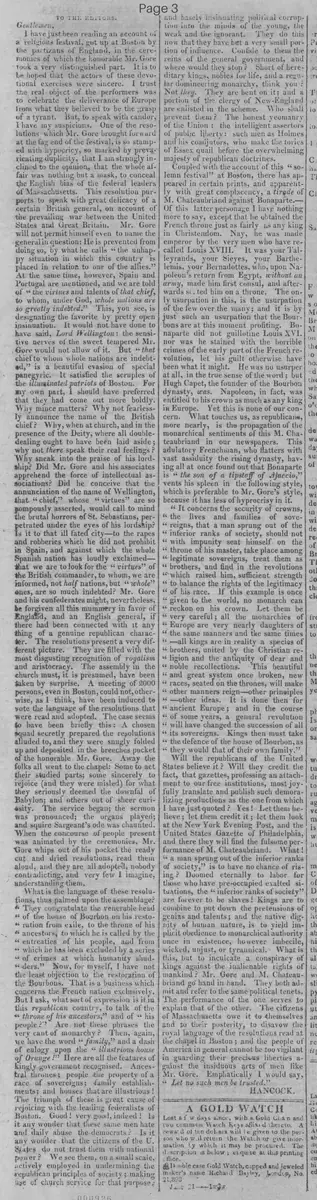
I have just been reading an account by a religious festival, got up at Boston by the partizans of England, in the ceremonies of which the honorable Mr. Gore took a very distinguished part. It is to be hoped that the actors of these devotional exercises were sincere. I trust the real object of the performers was to celebrate the deliverance of Europe from what they believed to be the grasp of a tyrant. But, to speak with candor, I have my suspicions. One of the resolutions which Mr. Gore brought forward at the fag end of the festival, is so stamped with hypocrisy, so marked by prevaricating duplicity, that I am strongly inclined to the opinion, that the whole affair was nothing but a mask, to conceal the English bias of the federal leaders of Massachusetts. This resolution purports to speak with great delicacy of a certain British general, on account of the prevailing war between the United States and Great Britain. Mr. Gore will not permit himself even to name the general in question: He is prevented from doing so, by what he calls "the unhappy situation in which this country is placed in relation to one of the allies." At the same time, however, Spain and Portugal are mentioned, and we are told of "the virtues and talents of that chief to whom, under God, whole nations are so greatly indebted." This, you see, is designating the favorite by pretty open insinuation. It would not have done to have said, Lord Wellington: the sensitive nerves of the sweet tempered Mr. Gore would not allow of it. But "that chief" to whom whole nations are indebted, is a beautiful evasion of special panegyric. It satisfied the scruples of the illuminated patriots of Boston. For my own part, I should have preferred that they had come out more boldly. Why mince matters? Why not fearlessly announce the name of the British chief? Why, when at church, and in the presence of the Deity, where all double-dealing ought to have been laid aside; why not there speak their real feelings? Why sneak into the praise of his lordship? Did Mr. Gore and his associates apprehend the force of intellectual associations? Did he conceive that the annunciation of the name of Wellington, that "chief," whose "virtues" are so pompously asserted, would call to mind the brutal horrors of St. Sebastians, perpetrated under the eyes of his lordship? Is it to that ill fated city—to the rapes and robberies which he did not prohibit in Spain, and against which the whole Spanish nation has loudly exclaimed—that we are to look for the "virtues" of the British commander, to whom, we are informed, not half nations, but "whole" ones, are so much indebted? Mr. Gore and his confederates might, nevertheless, be forgiven all this mummery in favor of England, and an English general, if there had been connected with it anything of a genuine republican character. The resolutions present a very different picture. They are filled with the most disgusting recognition of royalism and aristocracy. The assembly in the church must, it is presumed, have been taken by surprise. A meeting of 2000 persons, even in Boston, could not, otherwise, as I think, have been induced to vote the language of the resolutions that were read and adopted. The case seems to have been briefly this: A chosen squad secretly prepared the resolutions alluded to, and they were snugly folded up and deposited in the breeches pocket of the honorable Mr. Gore. Away the folks all went to the chapel: Some to act their studied parts; some sincerely to rejoice (and they were misled) for what they seriously deemed the downfall of Babylon; and others out of sheer curiosity. The service began; the sermon was pronounced; the organs played; and squire Sargeant's ode was chaunted. When the concourse of people present was animated by the ceremonies. Mr. Gore whips out of his pocket the ready cut and dried resolutions, read them aloud, and they are all adopted, nobody contradicting, and very few I imagine, understanding them.
What is the language of these resolutions, thus palmed upon the assemblage? They congratulate the venerable head "of the house of Bourbon on his restoration from exile, to the throne of his ancestors, to which he is called by the entreaties of his people, and from which he has been excluded by a series of crimes at which humanity shudders." Now, for myself, I have not the least objection to the restoration of the Bourbons. That is a business which concerns the French nation exclusively. But I ask, what sort of expression is it in this republican country, to talk of the throne of his ancestors," and of "his people?" Are not these phrases the very cant of monarchy? Then, again, we have the word "family," and a dash of eulogy upon the "illustrious house of Orange!" Here are all the features of kingly government recognised. Ancestral thrones; people the property of a race of sovereigns; family establishments; and houses that are illustrious! The triumph of these is great cause of rejoicing with the leading federalists of Boston. Good! very good, indeed! Is it any wonder that these same men hate and daily abuse the democrats? Is it any wonder that the citizens of the U. States do not trust them with national power? We see them, on a small scale, actively employed in undermining the republican principles of society; making use of church service for that purpose
and basely insinuating political corruption into the minds of the young, the weak and the ignorant. They do this now that they have but a very small portion of influence. Confide to them the reins of the general government, and where would they stop? Short of hereditary kings, nobles for life, and a regular domineering monarchy, think you? Not they. They are bent on it; and a portion of the clergy of New-England are enlisted in the scheme. Who shall prevent them? The honest yeomanry of the Union: the intelligent assertors of public liberty: such men as Holmes and his coadjutors, who make the tories of Essex quail before the overwhelming majesty of republican doctrines.
Coupled with the account of this "solemn festival" at Boston, there has appeared in certain prints, and apparently with great complacency, a tirade of M. Chateaubriand against Bonaparte.—Of this latter personage I have nothing more to say, except that he obtained the French throne just as fairly as any king in Christendom. Nay, he was made emperor by the very men who have recalled Louis XVIII. It was your Talleyrands, your Sieyes, your Barthelemi's, your Bernadottes, who, upon Napoleon's return from Egypt, without an army, made him first consul, and afterwards seated him on a throne. The only usurpation in this, is the usurpation of the few over the many; and it is by just such an usurpation that the Bourbons are at this moment profiting. Bonaparte did not guillotine Louis XVI. nor was he stained with the horrible crimes of the early part of the French revolution, let his guilt otherwise have been what it might. He was no usurper at all, in the true sense of the word; but Hugh Capet, the founder of the Bourbon dynasty, was. Napoleon, in fact, was entitled to his crown as much as any king in Europe. Yet this is none of our concern. What touches us, as republicans, more nearly, is the propagation of the monarchical sentiments of this M. Chateaubriand in our newspapers. This adulatory Frenchman, who flatters with vast assiduity the rising dynasty, having all at once found out that Bonaparte is "the son of a tipstaff of Ajaccio," vents his spleen in the following style, which is preferable to Mr. Gore's style, because it has less of hypocrisy in it.
"It concerns the security of crowns, the lives and families of sovereigns, that a man sprung out of the inferior ranks of society, should not with impunity seat himself, on the throne of his master, take place among legitimate sovereigns, treat them as brothers, and find in the revolutions which raised him, sufficient strength to balance the rights of the legitimacy of his race. If this example is once given to the world, no monarch can reckon on his crown. Let them be very careful; all the monarchies of Europe are very nearly daughters of the same manners and the same times—all kings are in reality a species of brothers, united by the Christian religion and the antiquity of dear and noble recollections. This beautiful and great system once broken, new races, seated on the thrones, will make other manners reign—other principles—other ideas. It is done then for ancient Europe; and in the course of some years, a general revolution will have changed the succession of all its sovereigns. Kings then must take the defence of the house of Bourbon, as they would that of their own family."
Will the republicans of the United States believe it? Will they credit the fact, that gazettes, professing an attachment to our free institutions, most joyfully translate and publish such demoralizing productions as the one from which I have just quoted? Yes! Let then believe: let them credit it: let them look at the New York Evening Post, and the United States Gazette of Philadelphia, and there they will find the fulsome performance of M. Chateaubriand. What! "a man sprung out of the inferior ranks of society," is to have no chance of rising? Doomed eternally to labor for those who have pre-occupied exalted situations, the "inferior ranks of society" are forever to be slaves! Kings are to combine to put down the pretensions of genius and talents; and the native dignity of human nature, is to yield implicit obedience to monarchical authority once in existence, however imbecile, wicked, unjust, or tyrannical. What is this, but to inculcate a conspiracy of kings against the inalienable rights of mankind? Mr. Gore and M. Chateaubriand go hand in hand. They both admit and refer to the same political tenets. The performance of the one serves to explain that of the other. The citizens of Massachusetts owe it to themselves and to their posterity, to disavow the royal language of the resolutions read at the chapel in Boston; and the people of America in general cannot be too vigilant in guarding their precious liberties against the insiduous arts of men like Mr. Gore. Emphatically I would say, "Let no such men be trusted"
HANCOCK.
What sub-type of article is it?
What themes does it cover?
What keywords are associated?
What entities or persons were involved?
Letter to Editor Details
Author
Hancock
Recipient
Gentlemen
Main Argument
the boston festival led by federalists like mr. gore hypocritically masks pro-english and monarchical biases under the pretense of celebrating tyranny's defeat, promoting royalism through resolutions and aligning with publications like chateaubriand's that defend monarchy against republican ideals; americans must distrust and guard against such leaders to protect republican liberties.
Notable Details